



























Subaru Telescope Uncovers A Hidden Pattern In Jupiter Trojan Asteroids

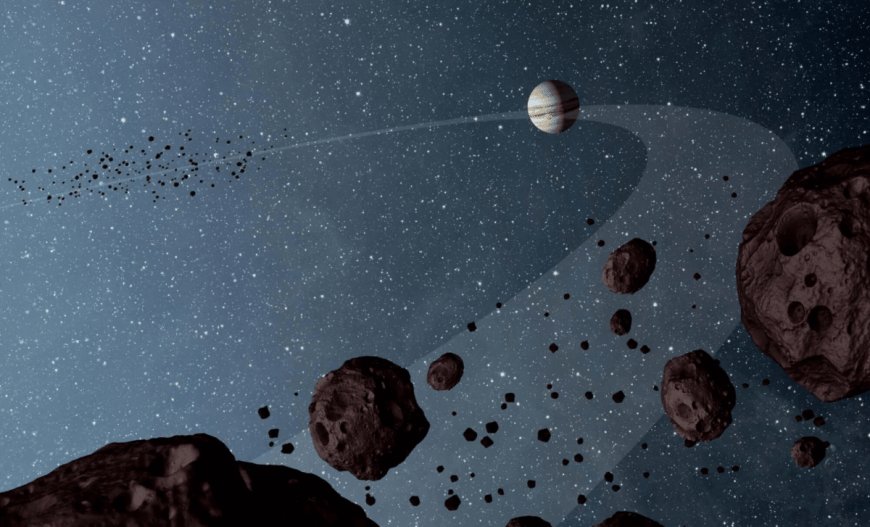
A new study based on observations from the Subaru Telescope reveals that smaller Jupiter Trojan asteroids behave very differently from their larger counterparts, challenging long-standing assumptions about their origin and evolution. Published in The Astronomical Journal under the title “Color And Size Distributions Of Small Jupiter Trojans,” the research offers a rare glimpse into the early solar system by decoding subtle color variations among these distant objects.
A Fossil Population That Refuses To Behave
The vast swarms of Jupiter Trojans, asteroids trapped in stable regions ahead of and behind Jupiter, have long been considered relics of planetary formation. These objects are thought to preserve chemical fingerprints from billions of years ago, making them critical to reconstructing the solar system’s early dynamics. For decades, astronomers observed a clear divide among larger Trojans: two distinct color groups known as D-type (redder) and P-type/C-type (less red). This bimodal distribution suggested different origins, possibly tied to formation distances from the Sun and later migration during the chaotic reshuffling of giant planets.
The new findings disrupt that tidy picture. By focusing on smaller, kilometer-scale asteroids, researchers discovered that this clean division breaks down. Instead of falling into two categories, these smaller bodies display a continuous range of colors, with no sharp boundary separating groups. This subtle shift may seem technical, yet it carries major implications. It suggests that the processes shaping these asteroids, collisions, fragmentation, and surface evolution, may blur or even erase original compositional differences over time. In other words, the smallest Trojans may hold a more complex and less “organized” record of solar system history than previously believed.

Credit: The Astronomical Journal
Small Asteroids Reveal A Different Story
To probe this mystery, the research team targeted faint, hard-to-detect objects roughly 3 to 16 kilometers in diameter. These smaller asteroids are widely believed to be fragments from past collisions, meaning they could expose the internal composition of larger parent bodies. Unlike larger asteroids whose surfaces have been altered by prolonged exposure to radiation and micrometeorite impacts, these fragments may preserve more pristine material.
The analysis revealed two striking results. First, the absence of clear color bimodality among small Trojans suggests that the traditional classification system does not apply at smaller scales. Second, the size distribution appears identical across color groups, contradicting earlier theories that redder asteroids fragment differently than less-red ones. This challenges the idea that one population evolves into the other through collisions. Instead, both groups may share similar physical histories, undergoing comparable fragmentation processes regardless of their original composition.
These insights reshape how scientists interpret Trojan asteroids as a population. Rather than representing two neatly separated families, they may form a continuum shaped by both primordial conditions and billions of years of collisions. The result is a far more dynamic and interconnected system than previously assumed.
A Final Night That Made The Discovery Possible
Capturing these faint signals required a unique observational approach. The team relied on Suprime-Cam, a first-generation wide-field camera mounted on the Subaru Telescope. Unlike its successor, Hyper Suprime-Cam, which offers a much larger field of view, Suprime-Cam allowed rapid switching between filters—an essential feature for measuring asteroid colors before their rotation alters brightness readings.
“Suprime-Cam was indispensable for this study, which required rapid multicolor observations over a wide area of the sky,” says Fumi Yoshida (University of Occupational and Environmental Health/Chiba Institute of Technology), who led the research. The observations took place in May 2017, during the instrument’s final night of operation, a symbolic and scientifically productive farewell.
“I am deeply grateful that our research was carried out during such a special occasion. My work on small bodies in the solar system began in 2000 with test observations from Suprime-Cam. Over the following 17 years, I continued using this instrument to study the size and spatial distributions of small solar system bodies,” Yoshida reflects.
This long-term connection underscores how instrumental continuity can enable breakthroughs, especially when studying faint and transient targets like asteroid populations.
Why This Changes Our View Of Planetary Evolution
The study, published in The Astronomical Journal as “Color And Size Distributions Of Small Jupiter Trojans,” adds an important constraint to models of solar system formation. If small Trojans lack the distinct color split seen in larger bodies, then current theories about their origin, especially those involving planetary migration, may need refinement. It raises the possibility that mixing processes were more efficient than expected, or that surface evolution plays a stronger role in shaping observed colors.
Future missions are expected to build on these findings. NASA’s Lucy mission, which is set to fly by multiple Jupiter Trojans, will provide direct observations of their surface composition and structure. Meanwhile, the ESA JUICE mission continues to explore the Jovian system, offering broader context for understanding these asteroid populations. By combining spacecraft data with ground-based surveys and theoretical modeling, scientists are moving closer to reconstructing the complex timeline of planetary formation.
What emerges is a picture that is less binary and more nuanced. The Trojans are not just passive remnants; they are evolving records shaped by collisions, migration, and time itself. Each small asteroid adds a piece to a puzzle that is far from complete—but now, finally, a little clearer.
Enjoyed this article? Subscribe to our free newsletter for engaging stories, exclusive content, and the latest news.
What's Your Reaction?
 Like
0
Like
0
 Dislike
0
Dislike
0
 Love
0
Love
0
 Funny
0
Funny
0
 Angry
0
Angry
0
 Sad
0
Sad
0
 Wow
0
Wow
0