


























Hiroshima’s oyster farmers are pulling up their rafts to find 90% of their harvest dead — and the cause lies just beneath the surface

At the Kure oyster festival, the longest lines stretch in front of the shellfish stalls, where chefs shuffle mottled bivalves across hot griddles. The atmosphere is festive — beer, grilled skewers, families gathered around steaming buckets. But Nobuyuki Miyaoka, watching chefs work the grill with his grandchildren nearby, notices something off. “The local oysters were fine until this year,” he says. “They used to be a lot bigger.”
He’s not alone in that unease. The shellfish are noticeably scarcer this season — and for the region that produces nearly two-thirds of Japan’s oyster supply, that scarcity points to something far more serious than a slow harvest year.
A harvest turned disaster
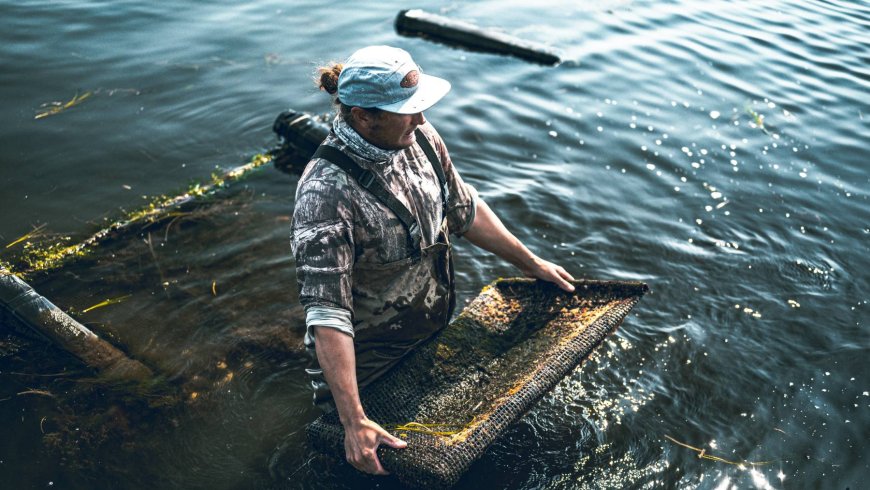
Taketoshi Niina doesn’t need data to know something is wrong. When he pulls his oyster rafts to the surface near his fishery in Kure, roughly 80% of what he finds is dead. “This is something out of the ordinary,” he says. “And a lot of those that do survive are in poor condition — they are not of a high enough quality to sell to shops and restaurants.”
In a normal season, mortality rates run between 30% and 50%. This year, according to Japan’s fisheries ministry, death rates in parts of Hiroshima have reached 90%.
The crisis stretches along the Seto Inland Sea, from Hiroshima in the west to Hyogo in the east. Hiroshima — which produced 89,000 tons of farmed oysters in 2023 and accounts for nearly two-thirds of Japan’s supply — has been hit hardest of all. Tatsuya Morio, who has farmed oysters in the prefecture for more than 20 years, puts it plainly: “I’ve never experienced this in my whole career.”
Record heat and a suffocating sea
The immediate culprit is heat. Japan’s 2025 summer was the hottest since records began in 1898, with average temperatures running 2.36°C above normal. Along Hiroshima’s coast, water temperatures from July through October were between 1.5°C and 1.9°C above the 1991–2020 average — a stretch of months critical to oyster cultivation.
Kazuhiko Koike, a professor at Hiroshima University’s graduate school of integrated sciences for life, explains what happens next. When shallow coastal water becomes abnormally warm, it stops mixing with colder, deeper layers. That stratification cuts off oxygen to the seabed and starves oysters of the nutrients they need.
Prolonged heat also weakens the oysters themselves. “If higher temperatures remain for a few weeks, that weakens oysters and makes them more susceptible to viruses and bacteria,” says Shoichi Yokouchi, head of the marine products division at the Hiroshima prefectural government. Oxygen depletion, food shortages, biological vulnerability — the combination proved devastating.
Economic ripples beyond the fisheries
The damage doesn’t stop at the water’s edge. Kure’s oyster industry anchors a broad local economy, touching fisheries, distribution networks, food tourism, and seasonal employment across the region. “It supports a wide range of sectors,” says Tomonori Uemoto, director of the fisheries promotion office at the Kure municipal government. “So the oyster deaths are likely to have a significant impact.”
The signs are already visible. Kure Oyster Land, a popular pop-up restaurant where diners steam buckets of shellfish at their tables, is closing earlier than usual this season due to shortages. The city’s hometown tax program — through which residents direct a portion of their income tax to a local municipality in exchange for regional gifts — can no longer offer raw oysters as a return.
In December, Japan’s fisheries agency announced emergency measures: five-year government loans at near-zero interest and expanded access to mutual aid programs for aquaculture businesses. Officials have been careful not to downplay how uncertain the recovery timeline remains.
Adapting to a warming ocean
Koike sees limited but real options for farmers willing to adapt. Moving oyster rafts to cooler waters, or suspending oysters at greater depths to escape surface heat, could offer some protection. He’s candid about the constraints, though. If early rainy seasons and prolonged heat become the norm, oxygen depletion and food shortages will likely recur regardless of what individual farmers do.
For Niina, the uncertainty is personal. He left a corporate career a decade ago to continue his father’s half-century legacy in oyster farming, and a few years back his son committed to taking over the business. “But this year,” Niina says, “I’ve begun to really worry whether there is a future for him.”
His concern reaches beyond his own family. Hiroshima’s oyster crisis offers a close-up view of what climate-driven disruption looks like when it arrives not as an abstraction but as a season’s ruined harvest — and a son’s uncertain future. Coastal food producers around the world are facing versions of the same question: how much adaptation is possible, and at what point does a way of life simply become unviable?
What's Your Reaction?
 Like
0
Like
0
 Dislike
0
Dislike
0
 Love
0
Love
0
 Funny
0
Funny
0
 Angry
0
Angry
0
 Sad
0
Sad
0
 Wow
0
Wow
0