





























Alien Signals Could Have Already Reached Us: Why Haven’t We Detected Them?

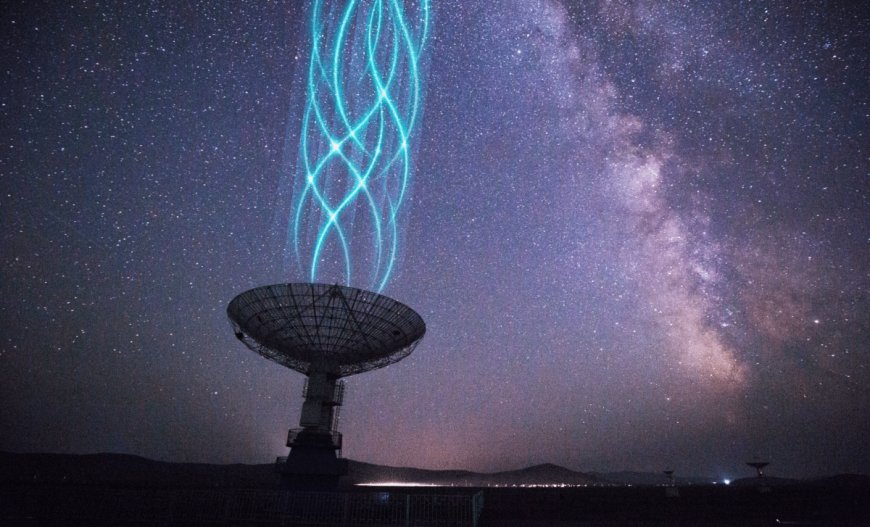
For decades, scientists have been actively searching for signs of extraterrestrial life. From radio waves to laser flashes and infrared heat signatures, the hunt for alien technosignatures has captivated both researchers and the public. However, despite the extensive efforts, no confirmed signals have been found. A recent study, published in The Astronomical Journal, asks a critical question: if alien signals have already reached Earth, why haven’t we detected them? Claudio Grimaldi, a theoretical physicist from the École Polytechnique Fédérale de Lausanne (EPFL), argues that the likelihood of us missing these signals is higher than previously thought.
The Challenge of Detecting Alien Technosignatures
A technosignature is any measurable sign of extraterrestrial technology, whether it be artificial radio transmissions, laser pulses, or excess heat from large engineering projects. For any technosignature to be detected, two things must happen. The signal must physically reach Earth, and our instruments must be sensitive enough to pick it up. While the first condition seems straightforward, the second is much more complex. Even if alien signals have already passed through our solar system, they may have been too weak, too brief, or simply lost in the background noise of our space observations. In fact, the likelihood of detecting a signal is directly tied to how well our instruments are tuned to pick up different wavelengths, as well as the strength and duration of the signal itself.
The possibility that alien signals have been missed because of these technical limitations is a point of debate within the scientific community. Many researchers speculate that while signals may have been detected by past searches, the chances of them slipping past unnoticed due to these factors are high. But Grimaldi’s study offers a new perspective: the actual number of alien signals passing through Earth may not be as large as we think.
The New Study from EPFL: A Statistical Approach to Alien Signals
Grimaldi’s study, published in The Astronomical Journal, uses a statistical framework to reframe the search for technosignatures. By modeling the chances of detecting signals from distant technological civilizations, he evaluates factors such as the lifetime of technosignatures and the distances they could realistically come from. The study suggests that for us to have a high probability of detecting these signals today, a large number of technosignals must have already passed Earth unnoticed in the past. Grimaldi’s analysis shows that this scenario becomes increasingly unlikely, especially when considering that the number of potential sources may exceed the number of habitable planets in a given region of the galaxy.
The study further considers two types of signals: omnidirectional emissions, such as waste heat from large-scale engineering projects, and more focused signals like beacons or laser flashes. While the former can be more diffuse and spread over larger distances, the latter is more targeted, but both would require instruments with extraordinary sensitivity to detect them effectively. Grimaldi’s approach to this problem offers new insights into why previous attempts may have failed to uncover any concrete evidence of extraterrestrial life.

Why Have Alien Signals Gone Undetected for So Long?
If alien signals have indeed passed Earth undetected, why haven’t we found them despite decades of searching? The short answer, according to Grimaldi’s study, is that the universe is vast, and our search efforts have been limited. The Milky Way alone is 100,000 light-years in diameter, and even with the most advanced telescopes, we are only able to survey a tiny fraction of the sky. The signals we’re hoping to detect are likely to be rare, and given the vast distances involved, only a few detectable signals would be expected at any given time. Therefore, detecting them requires not only the right technology but also the right focus.
Furthermore, the very nature of the signals may make them difficult to identify. A focused laser pulse, for example, could be extremely weak by the time it reaches Earth, and its narrow beam could miss our detectors entirely. Conversely, an omnidirectional emission might be stronger but could still be lost in the noise of natural cosmic signals. This complexity means that even if signals are out there, the odds of detecting them at the right moment are incredibly low.
Enjoyed this article? Subscribe to our free newsletter for engaging stories, exclusive content, and the latest news.
What's Your Reaction?
 Like
0
Like
0
 Dislike
0
Dislike
0
 Love
0
Love
0
 Funny
0
Funny
0
 Angry
0
Angry
0
 Sad
0
Sad
0
 Wow
0
Wow
0