




























The Sun Has Cracked Open Across 400,000 Miles, Triggering Six Major Flares in Under 96 Hours

The sunspot region designated AR 14098 rotated over the Sun’s eastern limb in late January carrying magnetic complexity forecasters had not seen since the final months of 2025. Within 96 hours of becoming fully visible from Earth, it produced six eruptions powerful enough to saturate X ray sensors on spacecraft.
The first and strongest came at 23:59 UTC on February 1, registering X8.1 on the GOES scale. Three more followed on February 2, one on February 3, and another on February 4. Together they represent the most concentrated sequence of major flares since Solar Cycle 25 reached its official maximum more than a year ago. Imagery from the Solar Dynamics Observatory shows each event in multiple extreme ultraviolet wavelengths.

The February sequence indicates the Sun remains highly active. The solar maximum declared in 2024 was never expected to mark an abrupt endpoint. Based on historical records, periods of peak activity typically extend two to three years beyond the formal maximum date.
A Region That Would Not Quiet
The NASA Scientific Visualization Studio published a composite image on February 5 that layers all six flares onto the Sun at once. The X8.1 event on February 1 originated from the same region that produced an X1.0 flare approximately 11 hours earlier and an X2.8 flare shortly after midnight on February 2. An X1.6 followed at 08:15 UTC that same day.

An X1.5 eruption occurred at 14:15 UTC on February 3, and an X4.2 followed at 12:16 UTC on February 4. Different SDO filters emphasize different flare characteristics. The 131 Angstrom wavelength highlights extremely hot material. The 171 Angstrom wavelength shows features in the Sun’s corona at lower temperatures.
Where the Wind Gets Its Speed
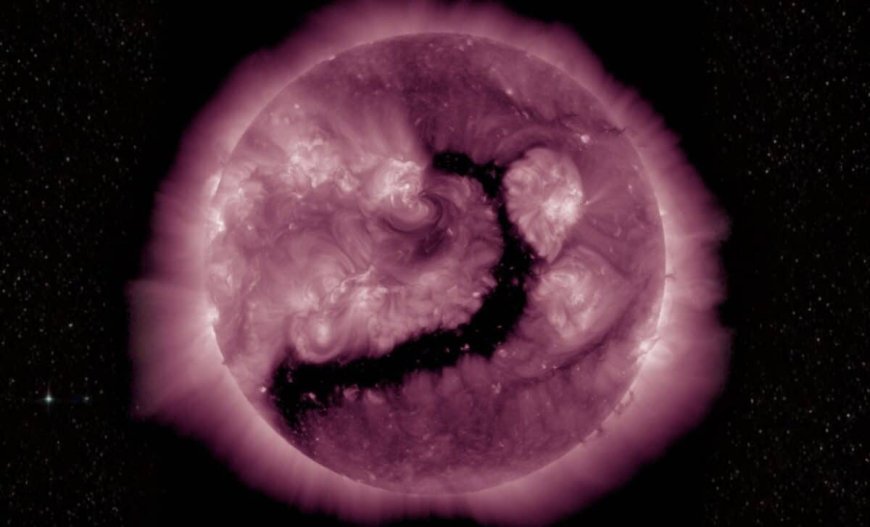
While flares originate from magnetically complex active regions, a separate class of solar feature influences space weather through different mechanisms. Coronal holes appear as dark areas in extreme ultraviolet solar images. They appear dark because they are cooler, less dense regions than the surrounding plasma and are regions of open, unipolar magnetic fields.
This open field structure allows the solar wind to escape more readily into space, producing streams of fast solar wind. Coronal holes can develop at any time but are more common during years around solar minimum. Persistent holes can last through several 27 day solar rotations.

When a high speed stream interacts with slower ambient solar wind, a compression region forms called a co rotating interaction region. This region leads the coronal hole high speed stream and can cause particle density enhancement and magnetic field strength increases before the stream arrives.
The Challenge of Seeing Dark
Coronal holes near the solar equator are most likely to result in higher solar wind speeds at Earth. Strong interaction regions and fast streams can impact Earth’s magnetosphere enough to cause geomagnetic storming at G1 to G2 levels. Larger coronal holes can be sources for high solar wind speeds that buffet Earth for many days.
Automated identification of coronal holes presents technical challenges. Research published through ScienceDirect describes the modified SPoCA CH module developed to improve detection quality. Visual inspection from June 2010 through December 2016 identified artifacts as the main issue. These artifacts are patches of the quiet Sun with lower intensity than average quiet Sun but higher mean intensity than coronal holes.

The artifacts appear especially when no coronal hole is on the solar disk or when large active regions are present. The modified module addresses this by taking a more conservative approach when classifying pixels as belonging to the low intensity class.
What Forecasters Watch
The Solar Ultraviolet Imager on GOES R series satellites produces bright region, flare location, and coronal hole reports. These distill thematic maps into reports tracking features with important space weather impacts. The bright region report characterizes location and radiance of bright regions. Locations matter because these regions are often sources of powerful solar eruptions.
The coronal hole location product provides boundaries of coronal holes detected in SUVI thematic maps. Knowledge of coronal hole boundaries is particularly important because location correlates closely with high speed solar wind streams that induce space weather effects at Earth.
The Ulysses mission data established that solar wind has two typical regimes. Above helmet streamers where magnetic field lines are closed, the solar wind is slow. Above coronal holes where the magnetic field is open, the solar wind is fast. The two types are relatively orderly during solar minimum but at solar maximum the conditions are chaotic.
The fast solar wind originates from coronal holes and ranges between 450 and 800 kilometers per second. The slow solar wind originates above helmet streamers and ranges below 450 kilometers per second. The X8.1 event on February 1 demonstrated the region’s capacity for major eruptions, but the magnetic orientation of any associated coronal mass ejections cannot be determined from extreme ultraviolet imagery alone.
Enjoyed this article? Subscribe to our free newsletter for engaging stories, exclusive content, and the latest news.
What's Your Reaction?
 Like
0
Like
0
 Dislike
0
Dislike
0
 Love
0
Love
0
 Funny
0
Funny
0
 Angry
0
Angry
0
 Sad
0
Sad
0
 Wow
0
Wow
0