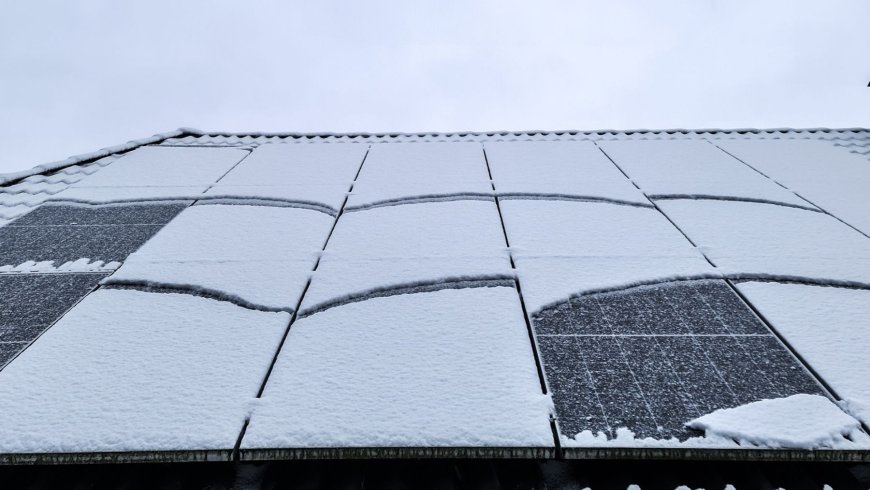
Every winter, the same story repeats itself. Photos of snow-covered solar panels appear online, followed by comments like “so much for clean energy” or “this is why solar doesn’t work.” It feels convincing. White panels, grey skies, freezing temperatures.
At first glance, it really looks like solar power has taken a long winter break. But that picture leaves out something important — and slightly embarrassing.
Why snow on solar panels looks worse than it is
Snow triggers doubt almost instantly. The moment people see panels covered in white, the conclusion is already made: no sun, no electricity. Simple as that.
But solar panels are not designed like flat tables. They are dark, smooth, and tilted on purpose. That design isn’t about looks — it’s about physics and weather. Even in winter, sunlight still reaches the panels, and even weak sunlight can slightly warm their surface.
Because of that, snow rarely stays where it lands. It loosens from the bottom, cracks, and slowly slides away. What looks like a frozen failure is often just a short pause that fixes itself.
What homeowners in cold states already know
People who actually live with solar panels in cold climates see a very different reality. From Minnesota to Vermont, many homeowners have learned that winter doesn’t kill solar power — it just changes how it behaves.
Most systems are back to producing electricity within a day or two after snowfall. Sometimes the snow falls off even faster, especially on sunny winter days. Heavy snow might reduce output briefly, but it rarely lasts long enough to matter over the year.
That’s why solar keeps growing in some of the coldest parts of the U.S., even when online comments say it shouldn’t.
The viral moment that surprised everyone
This quiet reality suddenly became very visible thanks to a short viral video. Not from a scientist. Not from a company. Just from a guy with a phone.
The video was posted by @martin_extraordinaire, a U.S. Marine Corps veteran who shares simple, practical solutions online. He calls himself “Mr. I Woulda Never THUNK of that.”
In the clip, he gently taps the frame of a snow-covered solar panel. One small tap. Five seconds. The entire sheet of snow slides off in one clean piece. No shovels. No heaters. No effort.
The reason it shocked people is simple: it looked too easy.
Why this small detail changes the whole debate
Snow sticks to solar panels as one bonded layer. When that bond is broken — even slightly — gravity does the rest. That’s basic physics, not a trick.
What many people also don’t realize is that solar panels often perform better in cold temperatures. Lower heat reduces electrical resistance inside the cells, allowing them to convert sunlight more efficiently. The real problem isn’t cold — it’s long-term coverage, which well-designed systems rarely suffer from.
That’s why yearly energy losses from snow are usually small, often just a few percentage points. Those losses are easily balanced out during brighter seasons.
In the end, snow on solar panels isn’t a crisis. It’s not a failure. It’s a brief interruption. And sometimes, all it takes to fix it is five seconds and a gentle tap.































 Like
0
Like
0
 Dislike
0
Dislike
0
 Love
0
Love
0
 Funny
0
Funny
0
 Angry
0
Angry
0
 Sad
0
Sad
0
 Wow
0
Wow
0