



























Semi-Autonomous Legged Robots Could Unlock Faster, More Efficient Discoveries on Mars and the Moon

Exploration beyond Earth has always been a slow, methodical process, with rovers carefully navigating harsh, uncharted terrains on Mars and the Moon. These missions, guided by scientists on Earth, are constrained by communication delays and the need for meticulous planning. But what if we could break free from these limitations? A new study published in Frontiers in Space Technologies reveals that legged robots equipped with compact instruments could dramatically accelerate space exploration. These semi-autonomous machines are capable of independently surveying large areas, gathering crucial data in less time, and paving the way for faster discoveries about the resources and potential life on other planets.
A New Era of Space Exploration
Planetary exploration has traditionally been slow and cautious, with rovers moving carefully across surfaces, taking several days or even weeks to cover relatively small areas. With communication delays between Earth and distant missions, typically ranging from four to 22 minutes, each move made by these rovers is carefully planned and meticulously executed. As a result, scientists have been limited to exploring only small portions of a landing site. The new study, published in Frontiers in Space Technologies however, challenges this status quo and opens the door for semi-autonomous robots to explore vast areas far more rapidly.
The study, conducted by a team led by Dr. Gabriela Ligeza from the University of Basel and the European Space Agency, introduces a promising alternative: legged robots capable of autonomously navigating multiple locations on planetary surfaces, collecting data without constant human supervision. These robots could be equipped with simple, yet powerful scientific instruments that would allow them to perform quick, meaningful analyses of various targets.

Semi-Autonomous Robots: Faster, Smarter, More Efficient
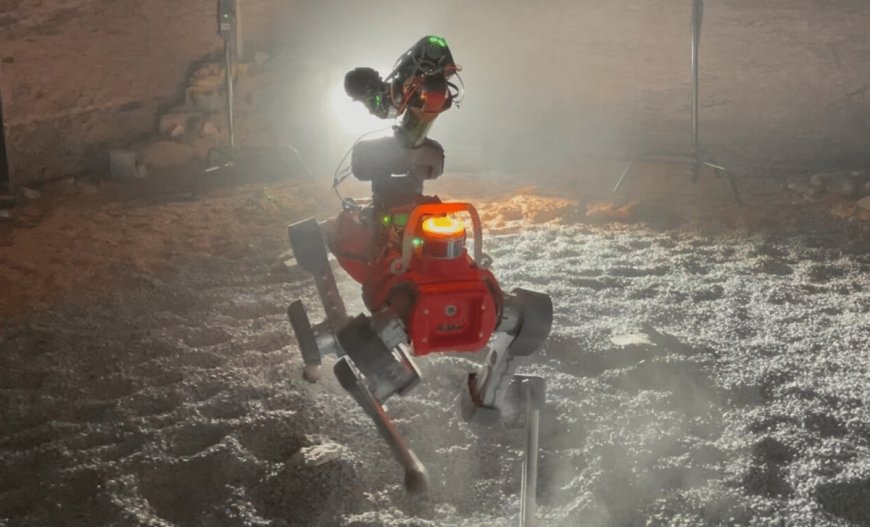
The research team tested this new concept using the quadrupedal robot “ANYmal,” which was equipped with a robotic arm carrying two cutting-edge instruments: the microscopic imager (MICRO) and a portable Raman spectrometer. These tools allowed the robot to take detailed measurements and gather scientific data from different types of rocks, simulating the search for astrobiological and resource-bearing targets.
The tests, which took place in the “Marslabor” facility at the University of Basel, showcased the robot’s ability to autonomously approach and investigate various targets. In the experiments, the robot was able to identify important planetary rocks, such as gypsum, carbonates, and basalts. These materials are not only geologically significant but could also indicate the presence of valuable resources needed for future space missions.
The most impressive result from the tests was the speed at which these semi-autonomous robots could work. While human-guided missions took 41 minutes to complete similar analyses, the robot was able to conduct its multi-target exploration in just 12 to 23 minutes. This efficiency means future missions could survey larger areas in less time, potentially uncovering more valuable data in a fraction of the time it would traditionally take.

Credit: Dr. Gabriela Ligeza
The Future of Space Missions: Swift, Autonomous Exploration
What makes this study so revolutionary is its ability to merge autonomy with scientific exploration. Space agencies have long relied on rovers to complete slow and deliberate tasks under the careful supervision of scientists back on Earth. However, these methods limit the amount of terrain that can be covered and the speed at which valuable data can be collected. Semi-autonomous robots, as shown in this study, could move freely across planetary surfaces, gather data, and return results to Earth much faster.
This shift toward autonomous robots is particularly important for the ongoing search for signs of life on Mars. Rather than waiting for a human operator to direct every step, these robots can move from one rock to another, autonomously gathering data that could reveal traces of ancient microbial life. The ability to analyze large areas swiftly and identify the most promising locations for further study could drastically increase the chances of finding evidence of past life on Mars.
Potential for Resource Prospecting on the Moon
In addition to searching for signs of life, the robotic approach could revolutionize resource prospecting, particularly on the Moon. For example, rocks like anorthosite, which were found in the tests, may contain valuable elements needed for future lunar missions. Currently, prospecting for such resources on the Moon is a time-intensive process. However, autonomous robots could rapidly assess and pinpoint the locations of valuable materials, allowing space agencies to plan for long-term human presence on the Moon and, eventually, Mars.
With missions to the Moon and Mars on the horizon, this technology could become essential for space exploration. Instead of relying solely on large and complex instrument suites, future missions could deploy smaller, more agile robots that can cover greater distances, autonomously flag promising sites, and return key data back to Earth with remarkable speed.
Enjoyed this article? Subscribe to our free newsletter for engaging stories, exclusive content, and the latest news.
What's Your Reaction?
 Like
0
Like
0
 Dislike
0
Dislike
0
 Love
0
Love
0
 Funny
0
Funny
0
 Angry
0
Angry
0
 Sad
0
Sad
0
 Wow
0
Wow
0