
























Scientists Say This Single Captured Moon May Have Tilted an Entire Planet

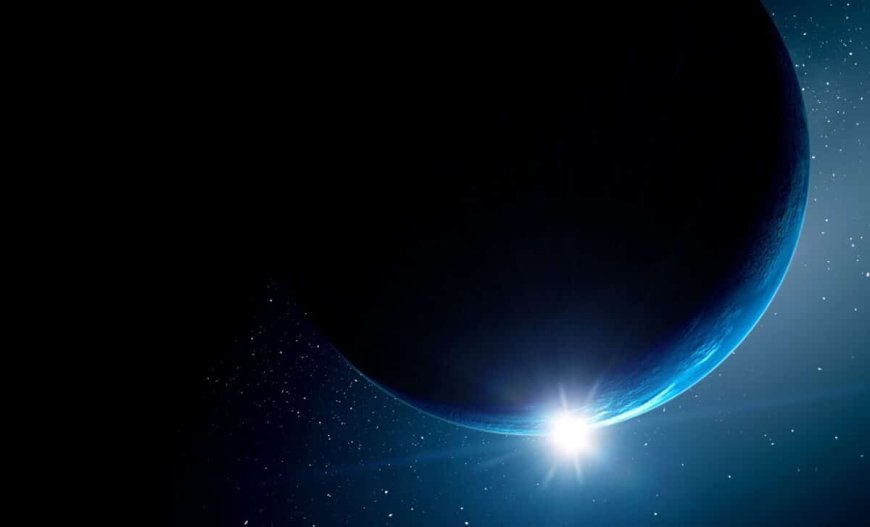
New findings indicate that Neptune’s unusual tilt could stem from a prolonged gravitational interaction with its largest moon, Triton. This gradual process may have altered the planet’s orientation over millions of years.
Far from the Sun, Neptune stands as one of the solar system’s most extreme worlds. Orbiting at nearly 30 times Earth’s distance, it endures temperatures close to -200 degrees Celsius and completes a single orbit every 165 Earth years. Despite that isolation, the planet hosts violent atmospheric dynamics and a surprisingly intricate internal history.
One of its enduring mysteries has been its 28-degree axial tilt. Planetary tilts are not unusual, yet Neptune’s specific angle has resisted clear explanation for decades. Scientists have long suspected that an external force, particularly a moon, rather than simple formation processes, played a role in shaping its current orientation.
Triton’s Unusual Orbit Reveals a Chaotic Past
The focus of the new study is Triton, Neptune’s largest moon and one of the most peculiar satellites in the solar system. It orbits in a retrograde direction, meaning it moves opposite to Neptune’s rotation.
“Triton has always been one of the most exciting and intriguing bodies in the solar system,” Louise Prockter, who leads the Trident proposal team at the Lunar and Planetary Institute in Houston. “I’ve always loved the Voyager 2 images and their tantalizing glimpses of this bizarre, crazy moon that no one understands.”
As explained by the research published on the arXiv preprint server, this backward motion strongly indicates that this moon did not form around Neptune. Instead, it likely originated as a dwarf planet in the Kuiper Belt before being captured by the eighth planet’s gravity.

That capture event would have been highly disruptive. Rather than settling smoothly into orbit, Triton likely began its life around Neptune on an inclined and highly eccentric path. Over time, tidal interactions gradually reshaped that orbit into the more stable configuration observed today.
A Slow Gravitational Dance That Tipped A Planet
The study, led by Rodney Gomes of São Paulo State University, proposes that Triton’s evolving orbit did more than stabilize. It altered Neptune itself.
As he explained, as Neptune’s Moon spiraled inward over millions of years, its gravitational influence interacted with the planet’s spin axis through a mechanism linked to a resonance known as s8. This resonance represents a specific frequency within the solar system that can amplify orbital and rotational effects.
The ringed ice giant Neptune and its moon Triton by James Webb telescope pic.twitter.com/owbziIG1vM— Curiosity (@CuriosityonX) October 7, 2025
The phenomenon can be likened to repeatedly nudging a spinning object. Each interaction may seem minor, yet over vast timescales, the cumulative effect becomes significant. In simulations presented in the study, Neptune’s tilt could increase dramatically under these conditions.
The results show that obliquities exceeding 50 degrees are possible in some scenarios, while nearly one in four simulations produced tilts greater than 20 degrees. These figures align closely with Neptune’s observed tilt.
Collision or Ring Formation?
Triton’s influence is not limited to the past. Its orbit continues to evolve today, driven by ongoing tidal interactions with the ice giant. Base on the same research, Triton is gradually moving closer to the planet and is expected to cross Neptune’s Roche limit in about 3.6 billion years. This boundary marks the distance at which tidal forces can tear a celestial body apart.
What happens next remains stark. Triton could either break apart into a ring system or collide directly with Neptune. In either case, the event would dramatically reshape the planet’s appearance and environment.
Enjoyed this article? Subscribe to our free newsletter for engaging stories, exclusive content, and the latest news.
What's Your Reaction?
 Like
0
Like
0
 Dislike
0
Dislike
0
 Love
0
Love
0
 Funny
0
Funny
0
 Angry
0
Angry
0
 Sad
0
Sad
0
 Wow
0
Wow
0