




























Scientists filmed a sperm whale giving birth and discovered that unrelated females rushed in to help

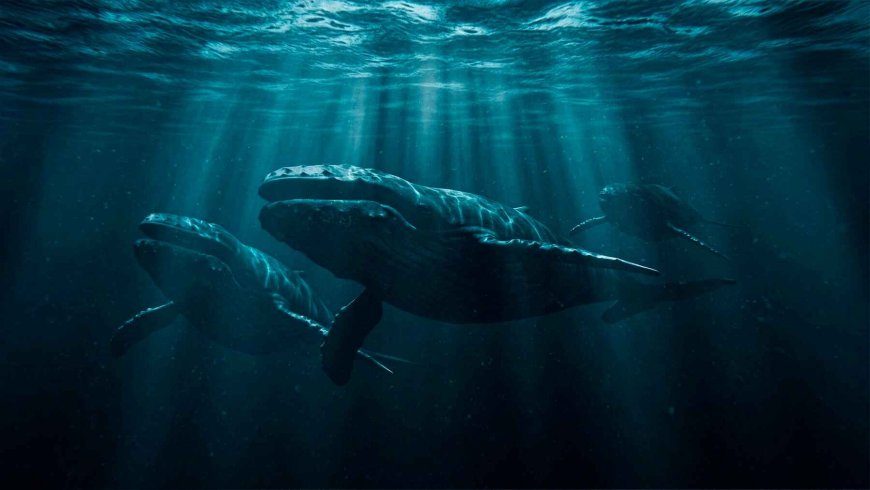
Animal life mimics our own in a variety of ways.
We have spent the best part of the last century studying animal life on our planet. And through this extensive study, we have recently found that sperm whales exhibit remarkably similar behavior to us, especially during the miracle of birth.
Why do other unrelated females rush in to help sperm whales during birth?
How studying animal life has evolved over the last century
Charles Darwin started the world on the path to studying the physical anatomy of animal life on our planet.
However, in recent decades, we have shifted more towards studying the behavior of animals as opposed to their biological makeup. And over the last half-century, we have increased the time spent studying the world of animals around us.
Researchers now follow certain animal species throughout their entire lifespan.
This can reveal many unknown behaviors and proclivities that animals have over a far longer timeframe. Sperm whales are remarkable animals and have mostly remained hidden from the world of science for decades.
The Earth is a complex mystery that needs extensive study to understand
Our planet is a unique mixture of life that requires decades of study to fully understand.
In recent years, we have seen remarkable discoveries about the Earth being revealed. Such as a living fossil that vanished without a trace before scientists rediscovered it after a decade.
As we know, humanity has spent more time studying space than our own oceans.
The sea holds an alien world of life that needs not only our attention to better understand it, but more importantly, our collective conservation efforts to ensure that the ocean remains filled with life.
And we have been learning at a rapid pace that animal life mimics the behavior of humans in many ways.
Grandmother elephants have been found to place themselves in danger to protect their young, mimicking the paternal and maternal instincts that we thought only existed in humans.
Sperm whales are remarkable creatures, and due to the depths that they spend most of their lives in, we know very little about them.
A recent study led by the Harvard School of Engineering and Applied Sciences has found an oddly familiar behavior in sperm whales. The question becomes, why do they exhibit these eerily similar traits to humans?
Sperm whale midwifery is a real thing that we know almost nothing about
The team from the Harvard School of Engineering and Applied Sciences has found that sperm whales have been acting very much the same to us in one specific regard. By studying animal life, we can reveal a few secrets about ourselves.
The miracle of birth is an astonishing development for life, regardless of species or location.
Researchers from Project CETI and Harvard SEAS recently documented a rare sperm whale birth by utilizing drone footage and AI. And what they found paints a picture of a whale society that experiences many of the same feelings that we do.

The overwhelming instinct to protect a mother during childbirth is a deep-rooted part of being a human.
But the researchers have found that this trait also applies to sperm whales. They found that during the birthing process, other unrelated female sperm whales form a raft to lift the negatively buoyant calf in case it can not sustain its own buoyancy.
This proves that these protective instincts are, in fact, an ancient, complex social trait that has been part of sperm whale behavior for as long as we know.
By conducting these types of studies, we can better understand how animal life affects the world around us. From how bees affect global crop production to how sperm whales come together to protect birthing mothers, life is beginning to explain itself.
What's Your Reaction?
 Like
0
Like
0
 Dislike
0
Dislike
0
 Love
0
Love
0
 Funny
0
Funny
0
 Angry
0
Angry
0
 Sad
0
Sad
0
 Wow
0
Wow
0