

























New AI Tool Can Predict Solar Storms Weeks Before They Strike, Safeguarding Earth’s Critical Systems

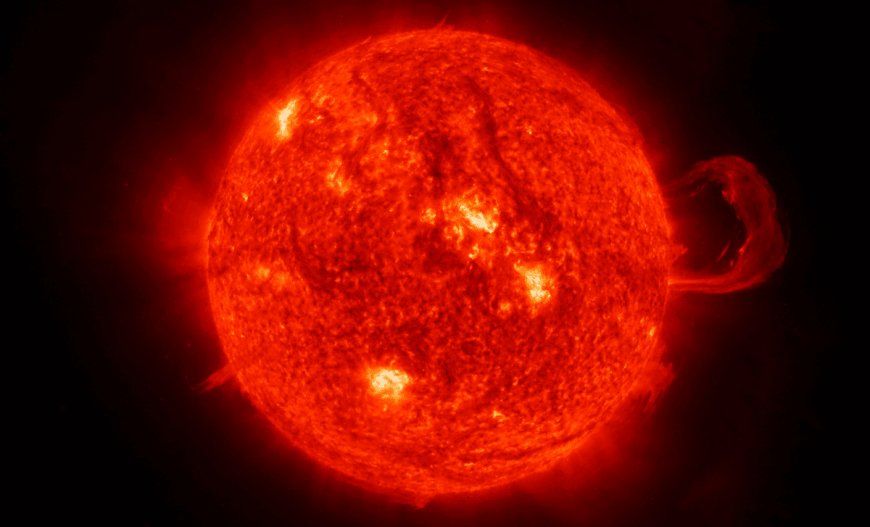
Solar storms and coronal mass ejections (CMEs) can disrupt everything from satellites to power grids. A new AI tool, PINNBARDS, developed by Southwest Research Institute (SwRI) and NSF-NCAR, can now predict these events weeks in advance by linking surface solar observations to the Sun’s deeper magnetic dynamics. This breakthrough could provide crucial protection for Earth’s infrastructure and astronauts in space.
The Challenge of Solar Active Regions
The Sun’s magnetic fields are complex and often unpredictable, making it a longstanding challenge to forecast when and where large, flare-producing active regions (ARs) will emerge. These regions, formed by tangled magnetic fields beneath the Sun’s surface, can become unstable, leading to explosive solar events such as solar flares and coronal mass ejections (CMEs). These powerful events can send harmful radiation and energetic particles toward Earth, disrupting critical technologies like communication systems and power grids.
As Dr. Subhamoy Chatterjee, an early-career scientist from Southwest Research Institute (SwRI) and co-author of the research, explained, “Understanding where and when large, flare-producing active regions (ARs) on the sun would emerge is a long-standing problem in heliophysics.” For decades, scientists have faced significant challenges in predicting the formation of these active regions and the subsequent solar events. Traditional forecasting tools have been limited to short-term predictions, often providing only hours of lead time before an event occurs. This short window makes it difficult to effectively mitigate the risks posed by solar activity. The dynamic and turbulent nature of the Sun’s magnetic fields adds to the complexity, making it hard to predict these events far enough in advance to take preventive measures.

Credit: NASA/SDO HMI/SwRI/NCAR
The Breakthrough: PINNBARDS and AI-Driven Forecasting
The research team developed PINNBARDS, a Physics-Informed Neural Network-Based AR Distribution Simulator, which takes a bold new approach to solar forecasting. Unlike traditional methods that focus on small-scale magnetic signatures, PINNBARDS connects surface observations of solar active regions to the deep magnetic dynamics of the Sun. This revolutionary tool uses data from the Solar Dynamics Observatory and the Helioseismic and Magnetic Imager (HMI) to observe the Sun’s surface and infer the state of the magnetic fields deep beneath the Sun’s surface. This innovative approach allows scientists to predict solar events much earlier than before, giving agencies and industries more time to protect critical infrastructure.
“The reconstructed subsurface states from PINNBARDS provide initial conditions for forward simulations of solar magnetic evolution, opening the door to predicting where and when large, flare-producing active regions are likely to emerge weeks in advance,” explained Dr. Mausumi Dikpati, a senior scientist from NSF-NCAR who led the team.
The key difference with PINNBARDS is its ability to extend the prediction window from hours to weeks, giving decision-makers much more time to prepare for potential solar disruptions.
Implications for Space Weather Forecasting
The ability to predict solar flares and CMEs weeks in advance has vast implications for protecting satellites, power grids, and even astronauts in space. Space weather, which includes phenomena like solar flares, solar energetic particles, and CMEs, can have devastating impacts on our technology. A powerful CME, for example, can knock out communication satellites, disrupt GPS systems, and even damage power grids. With this new tool, the researchers aim to give the global community the time needed to mitigate these risks.
The technology is also crucial for future human space exploration. As humanity sets its sights on missions to Mars and beyond, astronaut safety becomes a top priority. Long-duration space missions are especially vulnerable to space weather, with solar radiation potentially posing severe risks to astronauts. By forecasting solar events well in advance, space agencies can take precautions, such as adjusting the trajectory of spacecraft or implementing shielding for astronauts, to avoid exposure to harmful solar radiation.
A New Era for Solar Research and Forecasting
The work published in the Astrophysical Journal represents a significant leap forward in solar physics. The research combines cutting-edge AI with traditional solar observational techniques to provide an integrated solution for long-term space weather forecasting. By reconstructing the subsurface states of the Sun, the team has created a new pathway for simulating the evolution of solar magnetic fields, allowing for more accurate predictions of where solar active regions will emerge.
This breakthrough could change the way we understand and prepare for space weather. As the technology advances, it could lead to even longer prediction windows and more refined models that can help predict specific solar events with greater accuracy. The researchers are hopeful that, in the near future, this tool could be integrated into operational forecasting systems, enhancing our ability to protect critical infrastructure and ensure the safety of those working in space.
Enjoyed this article? Subscribe to our free newsletter for engaging stories, exclusive content, and the latest news.
What's Your Reaction?
 Like
0
Like
0
 Dislike
0
Dislike
0
 Love
0
Love
0
 Funny
0
Funny
0
 Angry
0
Angry
0
 Sad
0
Sad
0
 Wow
0
Wow
0