




























James Webb Uncovers A Strange Galaxy That Could Finally Explain Cosmic “Little Red Dots”

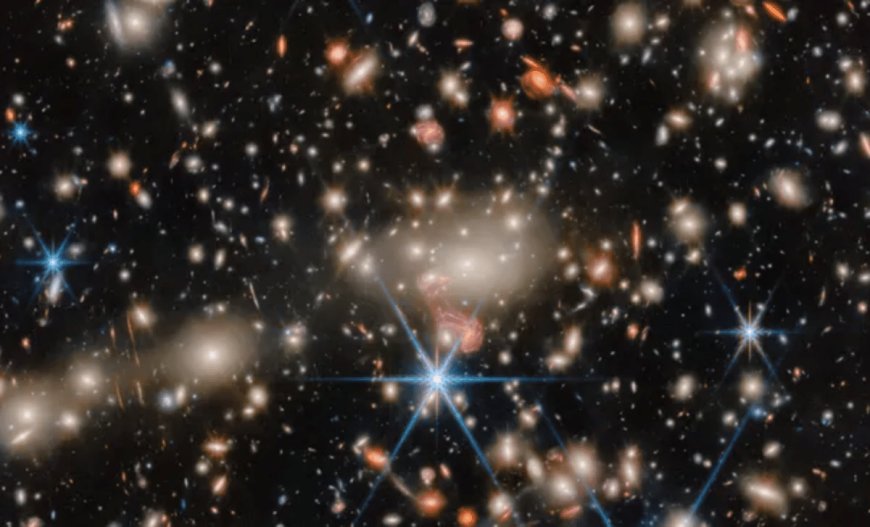
A newly identified galaxy observed by NASA’s James Webb Space Telescope could mark a turning point in understanding one of the most puzzling discoveries in modern astronomy: the so-called little red dots. Detailed in a study published in Astronomy and Astrophysics, this unusual system, nicknamed a “stingray” galaxy due to its shape, appears to sit at a critical evolutionary crossroads, offering the strongest evidence yet that these enigmatic objects may not be a separate class of galaxies, but rather a fleeting phase in cosmic evolution.
A Cosmic Hybrid Caught In Transition
The newly observed system stands out because it does not fit neatly into existing categories. Instead, it appears to blend properties of compact active galactic nuclei (AGN) and little red dots (LRDs), two populations that have puzzled astronomers since Webb first revealed them in deep-field surveys. The galaxy’s compact structure, combined with its spectral signatures, suggests an object undergoing rapid and unusual changes driven by both internal processes and external interactions.
“This galaxy is strategically in between the little red dot population and compact Type I AGN,” Mérida said. “Therefore, tLRD is part AGN and part LRD, but it’s unclear whether it is entering or exiting the LRD phase.”
This ambiguity is exactly what makes the discovery so compelling: it offers a rare glimpse into a transitional state that had previously only been theorized. Observations indicate that the galaxy is interacting with a nearby companion, a process known to trigger bursts of star formation and potentially fuel the growth of central black holes. The system’s morphology, distorted and elongated, supports the idea that gravitational interactions are actively reshaping it in real time.

Credit: Image: NASA, ESA, CSA, STScI, Dale Kocevski (Colby College)
Evidence Points To An Evolutionary Phase
, The findings, published in Astronomy and Astrophysics, add weight to a growing hypothesis that little red dots are not permanent structures but short-lived phases in galaxy evolution. These objects, first identified in Webb data, are small, red, and unusually bright for their size, often linked to rapidly growing black holes in the early universe. Their origin has remained unclear, with competing theories suggesting everything from obscured quasars to entirely new types of galaxies.
“The paper supports the idea that at least some little red dots are evolutionary phases rather than a wholly distinct class,” Devesh Nandal, a postdoctoral researcher at the Harvard and Smithsonian Center for Astrophysics who was not involved in the study, told Live Science in an email.
“The system is physically compact, spectroscopically confirmed, and the authors infer enhanced recent growth in the tLRD and [satellite galaxy],” compared what would be expected from their normal, internal processes, making their interaction-driven interpretation credible. His assessment highlights a key point: the observed growth rates exceed what isolated galaxies typically exhibit, suggesting that interactions are accelerating their evolution in measurable ways.

Credit: Astronomy and Astrophysics
A Black Hole Puzzle Still Unresolved
Despite the breakthrough, major questions remain unanswered, especially concerning the mass of the central black hole and the broader implications for galaxy formation models. While interactions between galaxies can trigger both star formation and black hole feeding, they do not fully account for the extreme properties observed in little red dots. The newly discovered system shows signs of enhanced activity, yet its characteristics still challenge existing theoretical frameworks.
Nandal noted that while galaxy interactions may initiate or terminate the LRD phase, they cannot entirely explain the scale of black hole growth implied by the observations. This suggests that additional mechanisms, possibly linked to early-universe conditions or unknown feedback processes, are at play. The discovery therefore acts less like a final answer and more like a crucial missing piece, narrowing the range of viable explanations while opening new avenues of investigation.
A Glimpse Into The Early Universe’s Hidden Dynamics
What makes this discovery particularly significant is its timing. The James Webb Space Telescope is uniquely capable of probing the early universe with unprecedented clarity, revealing populations of galaxies that were previously invisible. The identification of a transitional object like this “stingray” system provides direct observational evidence of processes that were once purely theoretical.
As more such systems are identified, astronomers expect to build a clearer picture of how galaxies evolve, interact, and grow their central black holes. The emerging view suggests a dynamic and chaotic early universe, where collisions and rapid transformations were common. This single object, sitting between two known populations, may represent a snapshot of a much broader cosmic narrative, one in which the mysterious little red dots are not anomalies, but milestones in the life cycle of galaxies.
Enjoyed this article? Subscribe to our free newsletter for engaging stories, exclusive content, and the latest news.
What's Your Reaction?
 Like
0
Like
0
 Dislike
0
Dislike
0
 Love
0
Love
0
 Funny
0
Funny
0
 Angry
0
Angry
0
 Sad
0
Sad
0
 Wow
0
Wow
0