



























Fossils Found at 8,000 Meters on Everest Reveal an Ancient Ocean Beneath the Himalayas

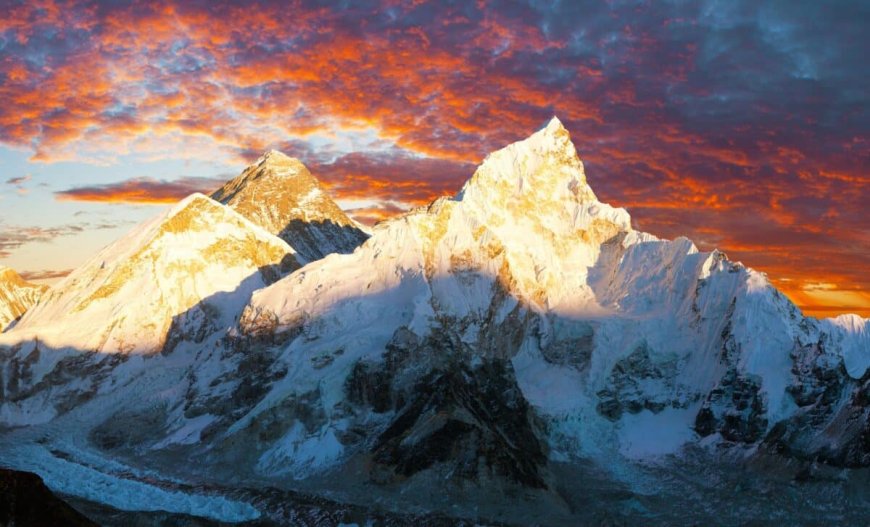
An astonishing discovery has been made atop the world’s highest peak. Fossils of marine life have been uncovered at over 8,000 meters above sea level on Mount Everest. These ancient remnants date back approximately 500 million years, offering a new perspective on Earth’s geological history and revealing dramatic transformations over millions of years.
At first glance, finding marine fossils at such an extreme altitude seems paradoxical. Today, the Himalayas are a high-altitude, ice-covered landscape, but these fossils provide clear evidence of the Earth’s transformative past. They serve as a striking reminder of how the Earth’s surface has been reshaped by natural forces over eons.
A Shallow Ocean That Once Covered the Himalayas
The fossils found on Everest were once part of a shallow sea that covered the region long before it became the towering mountain range it is today. These marine organisms lived in seas that were far from the harsh, high-altitude environment now defining the Himalayas. As reported by BBC Science Focus, the fossils are embedded in limestone, a sedimentary rock formed from marine shells and organic materials. This limestone, which dates back about 500 million years
The existence of these marine fossils, such as trilobites, crinoids, and brachiopods, high on Everest tells the story of a remarkable shift in the Earth’s surface. What were once ocean floors, covered in layers of marine sediment, were gradually pushed upward over millions of years due to the movement of tectonic plates.
Did you know there are seashells ON TOP of Mount Everest!? How!?#science #geology #paleontology #fossil #fossils #biology #museum #Houston pic.twitter.com/XWnkOYbkH2— The Houston Museum of Natural Science 


 (@hmns) August 11, 2025
The Tectonic Forces Behind the Himalayan Formation
The fossils found on Mount Everest also provide powerful evidence for the theory of plate tectonics, which explains how the Earth’s surface is divided into massive plates that interact with each other. Around 200 million years ago, the supercontinent Pangaea began to break apart, began to break apart, and the Indian plate started its journey northward toward the Eurasian plate, carrying remnants of ancient seas and marine life.
Between 40 and 55 million years ago, the Indian plate collided with the Eurasian plate. Unlike typical subduction zones, where one plate dives beneath the other, the two plates resisted subduction because they were both light. As explained by Geological Society:
“At this time Tethys Ocean floor would have been subducting northwards beneath Asia and the plate margin would have been a Convergent oceanic-continental one just like the Andes today.”
This collision caused the Earth’s crust to fold, pushing ocean sediments that had once been part of an ancient sea to the surface, eventually forming the towering Himalayas.
The Ever-Changing Landscape of Everest
The formation of Mount Everest is still an ongoing process. The Indian plate continues to move northward at a rate of a few centimeters per year, maintaining pressure that keeps the Himalayas rising. This constant tectonic activity leads to frequent seismic events, which serve as a reminder of the continuing transformations taking place beneath the Earth’s surface.
At the same time, wind, ice, and glaciers work to erode the peaks, creating a delicate balance between the forces of uplift and erosion. This dynamic process results in an ever-changing landscape, with new geological layers being added and eroded over time.
Enjoyed this article? Subscribe to our free newsletter for engaging stories, exclusive content, and the latest news.
What's Your Reaction?
 Like
0
Like
0
 Dislike
0
Dislike
0
 Love
0
Love
0
 Funny
0
Funny
0
 Angry
0
Angry
0
 Sad
0
Sad
0
 Wow
0
Wow
0