


























Easter Island’s Collapse: It Wasn’t the People, It Was Something Much Bigger!

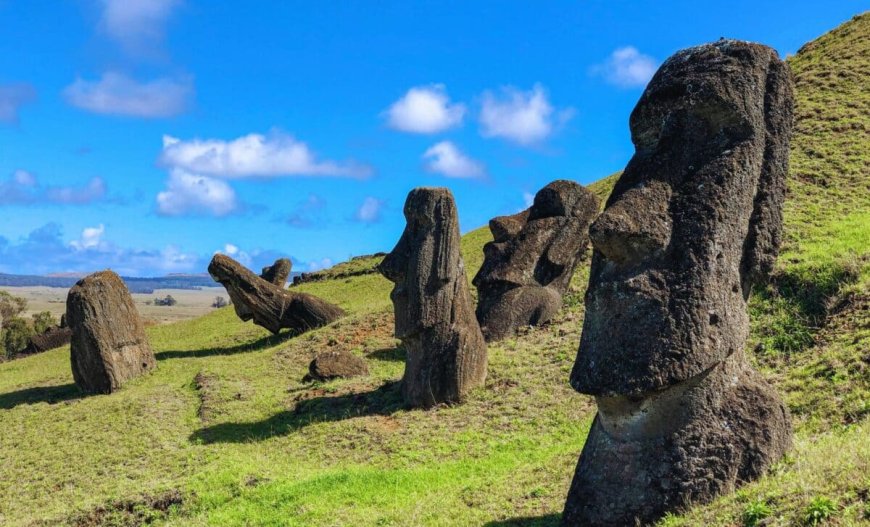
For centuries, Easter Island‘s story hhas been framed as a tragic tale of environmental collapse. The islanders were often blamed for destroying their own land, leading to societal breakdown. But a new study, published in Communications Earth & Environment, is turning that narrative on its head.
According to the popular “ecocide” theory, the island’s inhabitants cut down trees and overexploited resources, leading to famine, war, and eventual collapse. But this new research suggests that climate change, not human mismanagement, was likely the main force behind the island’s transformation.
A Drought That Lasted Centuries
The new study, led by Redmond Stein and his team at Lamont-Doherty Earth Observatory, sheds light on a much deeper, more complex history of Easter Island. Using sediment cores from two freshwater sites on the island, the researchers were able to reconstruct an 800-year rainfall record. Their findings show that starting in the mid-1500s, rainfall sharply decreased, with a reduction of 600 to 800 millimeters annually, “which is of a greater magnitude than the drying observed in recent decades,” as stated in the study.

Instead of triggering a sudden collapse, the prolonged drought appears to have pushed the islanders to adapt. The researchers say that the people of Rapa Nui didn’t just sit back and watch their society crumble, they adjusted over time. Far from a quick breakdown, the drought set off slow, ongoing changes in the island’s culture and social structure.
Drought, Not Ecocide, Shaped Easter Island
For a long time, the collapse of Easter Island was blamed on “ecocide,” the idea that the islanders destroyed their environment through deforestation and overuse of resources. This theory suggested that the people’s own actions led to famine, conflict, and eventual societal collapse. But the latest research challenges this view. According to Stein and his team, while deforestation did occur, the real issue was the extreme climate shift.
“We present evidence for a transition to persistent drought conditions on Rapa Nui beginning in the mid 16th century, based on two independent reconstructions of hydrogen isotopes in rainfall inferred from hydrogen isotopes of leaf waxes preserved in wetland sediments,” said the authors.

Adapting to a Changing Environment
The study points out that as the drought continued, the islanders made some major cultural and social adjustments. For example, the building of the famous ahu ceremonial platforms dropped off, and a new leadership system called Tangata Manu emerged. Leaders were now chosen through athletic contests instead of being passed down through ancestry tied to the moai statues.
The researchers argue that these changes were a direct response to the climate challenges the islanders were facing. With limited resources and water, the community likely had to reorganize to survive in the tough conditions.
Enjoyed this article? Subscribe to our free newsletter for engaging stories, exclusive content, and the latest news.
What's Your Reaction?
 Like
0
Like
0
 Dislike
0
Dislike
0
 Love
0
Love
0
 Funny
0
Funny
0
 Angry
0
Angry
0
 Sad
0
Sad
0
 Wow
0
Wow
0