



























Did Life From Mars Arrive on Earth Through an Asteroid? New Evidence Surfaces

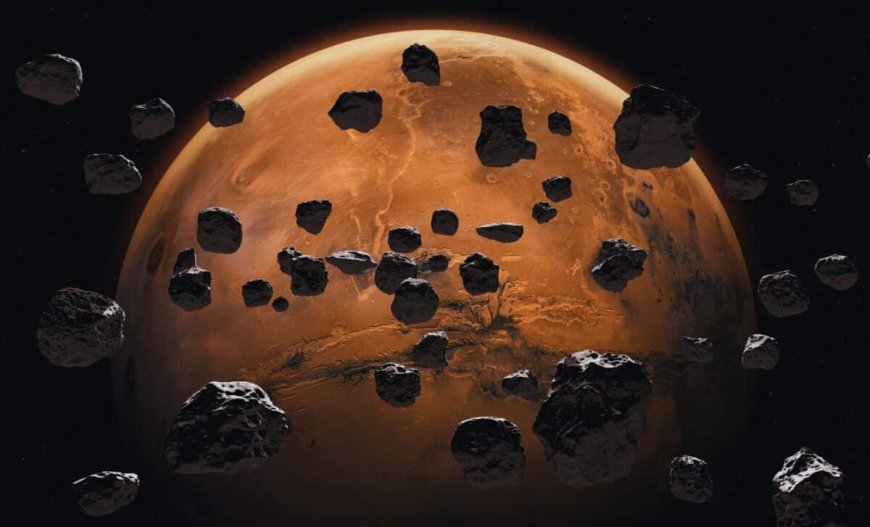
A new study has provided compelling evidence that life from Mars could have arrived on Earth by hitching a ride on debris ejected during asteroid impacts. The research, led by scientists at Johns Hopkins University, demonstrated that Deinococcus radiodurans, a resilient microbe known for its ability to survive extreme conditions, can withstand the immense pressures caused by asteroid impacts.
Published in PNAS NEXUS, the study’s results suggest that the idea of life spreading across the solar system by traveling on space debris is more plausible than previously thought. If D. radiodurans can survive the harsh conditions of an asteroid impact, it raises the possibility that microbes from Mars, or even Earth could have been transported between planets.
A Bacterium Built to Endure
Deinococcus radiodurans has earned the nickname “Conan the Bacterium” due to its incredible resilience to radiation, dehydration, and extreme temperatures. This microbe is often used as a model organism in studies examining life’s survival in extreme environments. However, this new study takes things a step further, testing the bacterium’s ability to survive the shock pressures generated by asteroid impacts.
Researchers at Johns Hopkins University subjected D. radiodurans to high-speed impacts simulating asteroid collisions. According to Lily Zhao, the lead author of the study, nearly all of the bacteria survived pressures up to 1 gigapascal (GPa), 30 times greater than the deepest ocean pressures. Even at 3 GPa, more than half survived, demonstrating their ability to endure impacts, repair DNA, and reproduce afterward.
These findings suggest that microorganisms with similar hardiness could survive the stresses of asteroid impacts and potentially survive the journey through space, traveling between planets via meteorite debris.

Lithopanspermia: An Increasingly Likely Theory
The concept of lithopanspermia, life spreading across the solar system through space debris, has intrigued scientists for more than a century.
Initially considered speculative, the idea gained traction as researchers discovered the resilience of extremophiles like D. radiodurans and began to consider the possibility that life might travel between planets through asteroid or meteorite collisions. According to K.T. Ramesh, an impact expert at Johns Hopkins University:
“If you can get one life-form, an extremophile, to survive these kinds of conditions, that shows there’s a ‘seed’ for biology to build on,” he said. “You’ve got the DNA; you’ve got the cellular structures. And from there, biology can move—it doesn’t start in one place and just stay there.”
If life once existed on Mars, these impacts could have propelled Martian microbes to Earth, where they might have survived and potentially led to the origin of life.

The Space Mission We Didn’t See Coming!
The discovery that microbes like D. radiodurans can survive extreme impact pressures has significant implications for planetary protection, an area of concern for space agencies like NASA. Planetary protection protocols are designed to prevent contamination of other planets with Earth’s microorganisms and to protect Earth from potential extraterrestrial life.
As Moogega Cooper, a planetary protection engineer at NASA’s Jet Propulsion Laboratory, noted, the survival of extremophiles in asteroid impacts suggests that planetary protection measures may need to be updated, particularly for missions aiming to return Martian samples to Earth. Japan’s Martian Moons Exploration (MMX) mission, which plans to bring back samples from Mars’s moon Phobos, could potentially return material containing Martian microbes or their remnants.
“Indeed, the remarkable ability [of D. radiodurans] to potentially survive both the immense pressures of meteorite impact and eons of deep-space radiation suggests that the MMX Phobos moon samples returned to Earth may require a higher level of planetary protection,” explained Michael Daly, particularly known for his research on the resilience of microorganisms in extreme conditions.
If these microbes are able to survive impact and space travel, the samples could pose new risks to both Earth and extraterrestrial ecosystems.
Enjoyed this article? Subscribe to our free newsletter for engaging stories, exclusive content, and the latest news.
What's Your Reaction?
 Like
0
Like
0
 Dislike
0
Dislike
0
 Love
0
Love
0
 Funny
0
Funny
0
 Angry
0
Angry
0
 Sad
0
Sad
0
 Wow
0
Wow
0