
























At Nearly 66 Pounds and 20 Inches Long, This Coconut Is the World’s Largest Seed. How It Gets So Big Stayed a Mystery

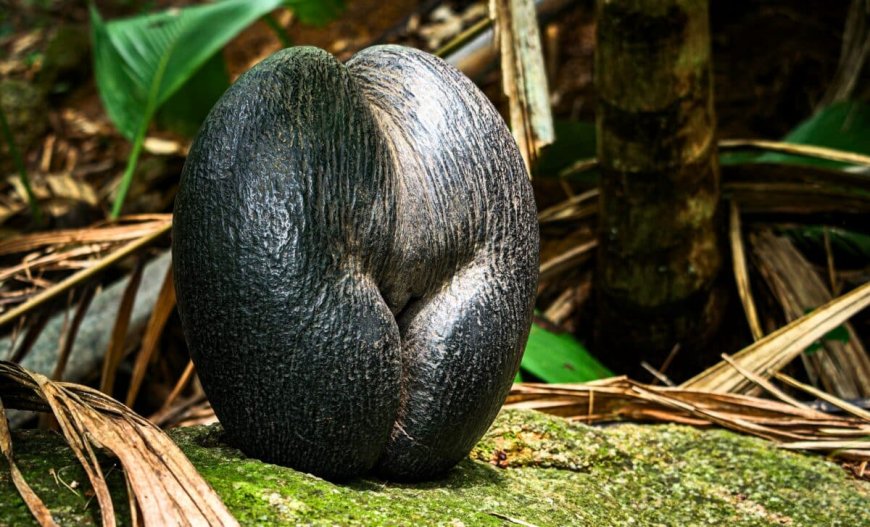
Researchers studying the coco de mer palm say they have solved one of botany’s strangest puzzles: how a tree rooted in extremely poor island soil can produce the largest and heaviest seed known in the plant world. The answer is a built-in rainwater harvesting system that turns the palm’s giant leaves into funnels, sending water and nutrients straight to the base of the tree where its seedlings grow.
That strategy helps explain how the Seychelles palm, Lodoicea maldivica, can support fruits that take up to seven years to mature and seeds that weigh as much as 18 kilograms, or about 40 pounds, while reaching roughly half a meter in diameter. In findings published in New Phytologist, researchers found that the tree does not simply survive in nutrient-poor soil. It actively concentrates scarce resources exactly where its giant seeds fall and germinate.
The result is more than a record-breaking plant. The coco de mer reshapes its own habitat, enriches the soil around its trunk and gives its offspring a better chance of survival in one of the harshest environments where a palm can grow. The species grows naturally only on the islands of Praslin and Curieuse, where it once formed extensive palm forests.
Giant Leaves That Work like Gutters
The coco de mer’s leaves can reach about 10 square meters, and their shape is central to the tree’s survival. The stiff, fan-shaped leaves form a funnel that channels rainwater down the trunk instead of letting it spread across the forest floor.
As the water moves, it collects dead leaves, organic debris, animal waste and unused pollen. Christopher Kaiser-Bunbury said, “The palm captures water as well as animal and plant organic waste and debris. Even its own pollen is recycled if it is not eaten by geckos.”

That recycling system helps explain why the palm can sustain such an enormous reproductive investment. Kaiser-Bunbury also described the original mystery behind the tree’s giant seed, saying, “This is an enormous commitment of energy in very nutrient-poor soil – it does not really make sense.” Most trees produce no more than ten coconuts at a time, which makes each fruit a major investment.
Nutrients End up Exactly Where Seedlings Need Them
Soil tests showed the system is highly effective. Phosphorus and nitrogen levels measured 20 centimeters from the trunk were about 50 percent higher than levels measured two meters away, creating a concentrated patch of fertility around the base of the palm.
That is exactly where the giant seeds fall. Instead of dispersing nutrients broadly, the tree sends them to a narrow zone where germination happens, effectively feeding the next generation. The researchers found that the palm’s nutrient-funneling system is so precise that it places the richest soil in the very spot where seedlings are most likely to emerge.

The effect is visible across the forest floor. Kaiser-Bunbury said, “Even in a torrential rain, you can walk through the palm forest almost without getting wet.” The reason is that so much rainwater is redirected down the trunks rather than falling evenly across the ground. Areas farther from the trunk remain drier than expected, which appears to make it harder for other plants to establish.
Why Giant Seeds Made Sense on Islands
The coco de mer’s huge seed long seemed biologically inefficient. Most plants benefit from moving seeds away from the parent tree, reducing competition for light, water and nutrients. The coco de mer cannot do that because its seeds are too heavy to travel far.
Researchers argue that island evolution changed the rules. After the Seychelles became isolated from India about 65 million years ago, the palm’s ancestors lost the large animals that may once have dispersed their seeds. Seeds that stayed close to the parent tree were the ones that survived.
That created intense competition among seedlings growing under the same canopy. In those conditions, a larger seed offered a major advantage because it contained more stored energy, helping seedlings grow taller and faster than smaller rivals in the same shaded patch.

Peter Edwards described that process as an internal evolutionary contest, saying, “The competition for the transfer of their own genes within the species fuelled the race for even bigger seeds.” In other words, the tree’s giant seed may have been favored not despite competition near the parent, but because of it.
A Broader Pattern in Island Plants
The coco de mer may be extreme, but it is not entirely unique. A 2014 study in Proceedings of the Royal Society B examined island and mainland plant pairings from island groups near New Zealand and found island species consistently evolved larger seeds than their mainland relatives.
The pattern appeared across different kinds of plants and different methods of dispersal. Wind-dispersed plants also tended to evolve larger seeds that do not travel as far, and fleshy-fruited species showed the same trend. The explanation was similar: long-distance dispersal on remote islands often ends badly, including what researchers described as “propagule mortality at sea.”
That makes staying close to home a safer strategy. Once seedlings are growing near relatives, larger seeds can provide the extra reserves needed to establish more successfully and outcompete neighboring plants. The coco de mer is the most dramatic example of that broader seed dispersal pattern.
A Palm That Engineers Its Own Environment
The coco de mer is not just producing giant seeds. It is altering the surrounding environment in ways that favor its own survival. The concentrated water flow keeps the ground near the trunk wetter and richer, while nearby areas remain drier and less welcoming for competing plants.
The palm is also dioecious, meaning male and female flowers grow on separate trees. Researchers are still not certain how pollination works, though geckos that feed mainly on pollen may help. The tree grows slowly and does not begin flowering until its trunk reaches about six to eight meters, high enough for its leaves to access the canopy. Most existing trees are old males.
That helps explain how the species once formed monodominant forest on Praslin and Curieuse before human harvesting and deforestation reduced its numbers. The tree’s structure does not just support reproduction. It changes the habitat itself. Today the species is still at risk, and trade in the giant nuts remains regulated.
Kaiser-Bunbury said many plants collect water, but researchers do not know another species that has “perfected it to such a degree.” That may be the clearest explanation for why the coco de mer palm, a rare endemic species and producer of the world’s largest seed, has survived in such poor Seychelles soil for so long.
Enjoyed this article? Subscribe to our free newsletter for engaging stories, exclusive content, and the latest news.
What's Your Reaction?
 Like
0
Like
0
 Dislike
0
Dislike
0
 Love
0
Love
0
 Funny
0
Funny
0
 Angry
0
Angry
0
 Sad
0
Sad
0
 Wow
0
Wow
0