




























Astronomers tried to reconstruct a galaxy from 12 billion years ago until they realized it had grown by slowly devouring smaller galaxies

How the universe expands is becoming easier to understand.
Recent findings made by the Hubble and James Webb Telescopes have left millions in awe. However, astronomers have reconstructed an ancient galaxy and found out how it got bigger over time. Science has developed several new discoveries that paint the early days of the universe in a new light.
How has this 12-billion-year-old galaxy gotten so large?
How reconstructing galaxies has changed our understanding of the early universe
Astronomers and space scientists have made remarkable discoveries by reconstructing galaxies that existed a long time ago, in a part of space far, far from us.
The Lambda-CDM model predicted that galaxies in the early days of the universe should grow at a slow and steady pace, but recent observations of galaxies that existed roughly between 300–700 million years after the Big Bang have found that they were actually as large as the Milky Way, even at such a “young “age.
By reconstructing galaxies in a simulated environment, science has made several astonishing findings.
Such as the “red monsters” that formed stars almost twice as efficiently as galaxies in the later universe. This proves that the universe was far busier in the early days after the Big Bang than we initially thought.
Necessity breeds innovation, and we need to study space further
Most of our technological and scientific progress has come from needs identified in modern-day life.
The life-changing development of the James Webb Space Telescope has opened the door to a new era of scientific study that will reshape our collective understanding of the universe we live in, albeit briefly on the cosmic scale.
And we are only now beginning to develop our knowledge set about the cosmos. We have recently explained odd cosmic scars in some regions of space.
Using the Webb telescope, researchers have found a strange planet in deep space that baffles the mind. The never-ending day that the planet experiences has led to the planet being dubbed a “space hot pocket” that never cools down.
Reconstructing galaxies has resulted in some stating that the “cosmic dawn” may have occurred much earlier than we first thought.
Some astronomers and astrophysicists have noted that evidence has suggested that a few stars in these ancient galaxies may have formed as early as 180–200 million years after the Big Bang, bringing light to the universe long before we initially thought.
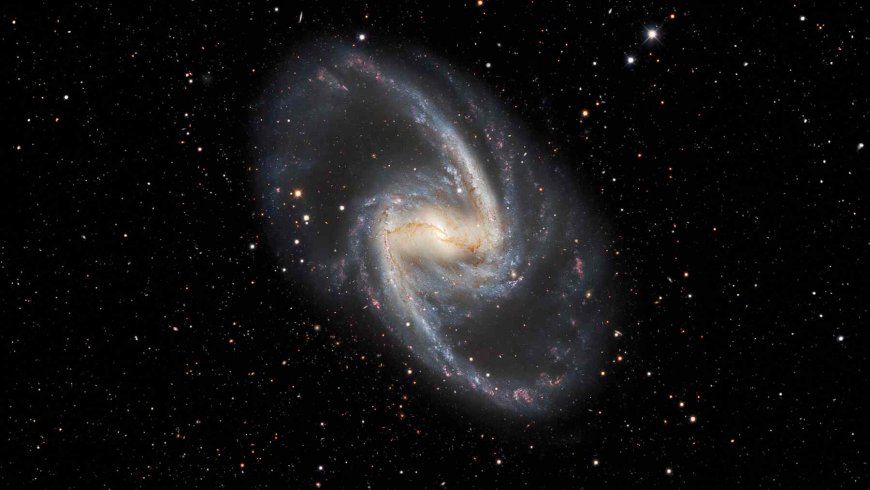
A study, “The assembly history of NGC 1365 through chemical archaeology,” published in Nature, has found how galaxies actually consume each other.
Some galaxies have an insatiable appetite for others, study finds
The aforementioned study attempted to reconstruct the 12-billion-year growth history of NGC 1365.
The team used the Illustris simulation suite to digitally reconstruct the 12 billion-year-old galaxy, and they found that it had an insatiable appetite. Studying space and all that’s out there has recently gained notable public attention, as one home in Texas saw a celestial object crashing through its roof.
For the best part of the last 50 years, science believed that galaxies grew through a hierarchical process.
Meaning that they grew by forming small clusters of dark matter first, which then collided to enable the galaxy to grow in a steady and slow process. This reconstruction takes things in a far different direction.
The team found evidence that these ancient galaxies actually consumed much smaller ones, like something out of a cartoon or sci-fi movie.
They used “galactic archaeology” to make the findings, which note that mapping oxygen levels as a chemical fingerprint proves that these galaxies ate up smaller ones around them to get as large as they are now.
So while the astrophysicists of the world attempt to study black holes, this is the first time a successful reconstruction of a galaxy other than the Milky Way has been made, proving how the universe grows.
What's Your Reaction?
 Like
0
Like
0
 Dislike
0
Dislike
0
 Love
0
Love
0
 Funny
0
Funny
0
 Angry
0
Angry
0
 Sad
0
Sad
0
 Wow
0
Wow
0