




























Astronomers to Achieve Unprecedented Clarity in Space Observations With Quantum Technology

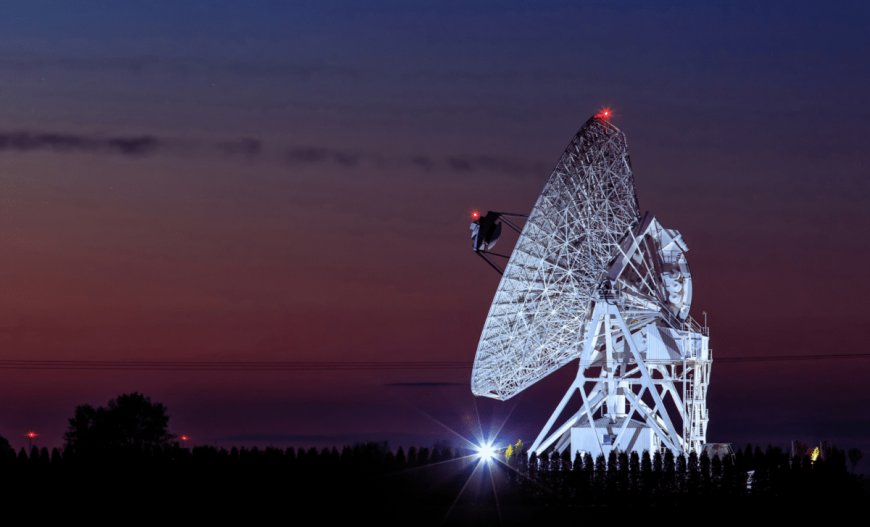
Researchers from the University of Arizona, University of Maryland, and NASA’s Goddard Space Flight Center have proposed a new method for achieving ultra-high-resolution astronomical images using quantum entanglement. This approach promises to overcome the traditional limitations of long-baseline interferometry, offering a way to capture clearer and sharper images of distant cosmological objects without the need to physically combine light from multiple telescopes. Instead, their technique leverages quantum mechanics to link distant telescopes, achieving superior resolution and precision in astronomical imaging.
Quantum Information Meets Optical Imaging
Dr. Saikat Guha, the senior author of the study, published in Physical Review Letters, and Director of the Center for Quantum Networks (CQN), emphasizes that their research sits at the intersection of two advanced fields: quantum information theory and quantum optics. Quantum information theory seeks to quantify the information carried by quantum systems, like light and atoms, while quantum optics explores the quantum nature of light itself. Dr. Guha explains, “Our group’s background lies at the intersection of quantum information theory (the science of quantifying ‘information’ carried by inherently quantum-physical media such as lights and atoms) and quantum optics (the quantum theory of light),” which forms the foundation of their innovative approach.

For over a decade, the team has explored the fundamental limits of resolution in optical imaging, seeking answers to essential astronomical questions. These questions include, “How far apart are those two stars?” and “Has a known object undergone a change?” Through this lens, they have redefined the limits of what can be resolved in the vast expanse of the universe, showing that what was once considered unresolvable could actually be observed using quantum techniques.
Overcoming Traditional Limits of Interferometry
Historically, astronomers have combined the light from multiple telescopes through an interferometer to produce sharper images of distant objects. However, this method relies on physically transporting light signals to a central location, a task that becomes increasingly difficult as the distance between telescopes grows. The breakthrough proposed by Dr. Guha and his colleagues replaces this complex process with quantum entanglement.
Dr. Guha further elaborates,
“We knew that coordinated telescopes situated across long distances, looking at the same scene, could mimic a telescope whose diameter is as big as the distance separating them, and are hence capable of resolving much finer grained details of a scene.”
This understanding formed the basis of their new technique, which leverages the power of entanglement to link distant telescopes, enabling them to share quantum states without the need for physical light transportation.
The Quantum Solution: Entanglement Without Physical Links
Quantum entanglement enables two distant parties to share a correlated quantum state, which can be utilized to perform precise measurements on distant objects. According to Dr. Guha,
“Quantum mechanics allows for two distant parties to share entanglement—a form of correlation that is stronger than any probabilistic correlation allowed by physics.”
This entanglement is stored in quantum memories located at each telescope site, allowing the telescopes to work in tandem as part of a larger quantum network.

Using this method, researchers can perform measurements on the collective light gathered by the telescopes without ever bringing the light together in one place. Dr. Guha describes the achievement: “We came up with a way to perform the pairwise combining of the locally sorted starlight at each telescope in an array of beamsplitters, but without any physical beamsplitter, and without ever physically bringing the light from the two telescopes to one location.” This innovative technique opens the door for far more precise and efficient astronomical observations.
Quantum Imaging: Potential Applications in Astrophysics
The implications of this quantum-enhanced approach are vast. Dr. Guha highlights several potential applications, from localizing clusters of stars to detecting exoplanets and monitoring changes in known objects in space.
“Our approach could have applications in areas spanning from localizing clusters of stars, to detecting a change to a known object for space domain awareness, classifying objects from a library, detecting exoplanets, and more,” he explains.
This quantum-based system also promises significant advancements in space domain awareness, offering precision far beyond the current capabilities of single telescope systems. By eliminating the need for classical communication channels between telescopes, this approach makes way for quantum communication links that can carry far more information with higher security and accuracy. Dr. Guha suggests, “It could also be applied to quantitative imaging problems that underlie in astrophysics and space domain awareness, achieving far greater precision than is currently possible with single telescope systems and even with current-day long-baseline systems where telescopes communicate using classical channels, as opposed to leveraging quantum communications links of the future.”
Enjoyed this article? Subscribe to our free newsletter for engaging stories, exclusive content, and the latest news.
What's Your Reaction?
 Like
0
Like
0
 Dislike
0
Dislike
0
 Love
0
Love
0
 Funny
0
Funny
0
 Angry
0
Angry
0
 Sad
0
Sad
0
 Wow
0
Wow
0