




























Astronomers Reveal Hidden Star Formations in RCW 36 Nebula

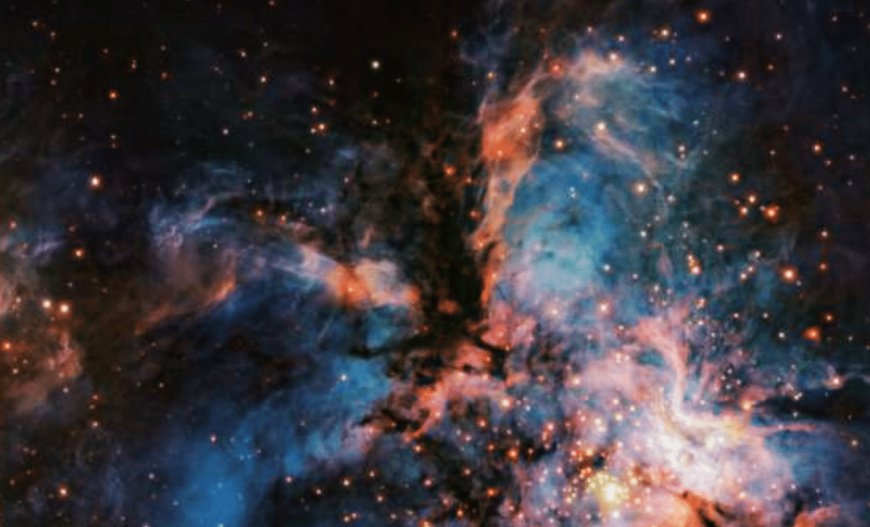
A mesmerizing cosmic scene has recently been captured by the Very Large Telescope (VLT), revealing the RCW 36 nebula, which appears to resemble a cosmic hawk with its outstretched wings. This breathtaking image not only showcases massive, newly-formed stars but also provides insights into the formation of elusive brown dwarfs. The study, which was published in Astronomy & Astrophysics, delves deeper into these mysterious objects, shedding light on their hidden presence within nebulae like RCW 36.
A Cosmic Hawk Guarding Its Stars
The RCW 36 nebula, located approximately 2,300 light-years away in the Vela constellation, has been dubbed “the cosmic hawk” due to its resemblance to a bird of prey in the VLT image. The dark clouds in the image form the bird’s head and body, while the filaments extending from its body resemble the wings of a hawk. Below the nebula, the vibrant blue gas clouds illuminated by young, bright stars stand out, creating a spectacular cosmic portrait. This dramatic view was captured by the HAWK-I instrument, which is capable of observing infrared light, making it ideal for identifying cold objects like brown dwarfs.
The Role of Brown Dwarfs in the RCW 36 Nebula
While massive stars often steal the spotlight in images like this one, scientists are particularly interested in the fainter, more elusive brown dwarfs hidden within the nebula. These objects are often described as “failed stars” because they lack the necessary mass to sustain hydrogen fusion in their cores. As a result, they don’t shine as brightly as regular stars, making them hard to detect. However, brown dwarfs can emit faint infrared radiation, which is why the HAWK-I instrument’s infrared capabilities are crucial for their identification.
In the study published in Astronomy & Astrophysics, the team of astronomers used the high-resolution imaging technology provided by HAWK-I to study the distribution of these brown dwarfs in the RCW 36 nebula. Their findings suggest that these objects play a significant role in the early stages of star formation, and understanding them could provide valuable insights into the processes that occur in nebulae like RCW 36.

Credit: Astronomy & Astrophysics
The Science Behind the HAWK-I Instrument
The HAWK-I instrument is a state-of-the-art tool for observing the cosmos at infrared wavelengths. It has the unique ability to correct for atmospheric turbulence using adaptive optics, which allows for clearer and more detailed images. This capability has proven essential for studying faint objects like brown dwarfs, which would otherwise be difficult to detect in visible light. Thanks to HAWK-I’s precision, astronomers are now able to peer deeper into the nebula than ever before, unveiling new details about the formation of stars and brown dwarfs.
The recent study emphasizes how crucial these advanced instruments are for exploring the early stages of star formation. Without tools like HAWK-I, much of the hidden activity within nebulae like RCW 36 would remain a mystery, and the understanding of brown dwarfs would remain limited.
Massive Stars “Hatching” in RCW 36
One of the most fascinating aspects of the RCW 36 nebula is the way massive stars appear to push away the surrounding gas and dust. In the study, the researchers liken this process to an animal breaking free from its eggshell for the first time. As these young stars form, their intense radiation and stellar winds create shockwaves that drive the surrounding material outward, clearing a path for the stars to grow and evolve.
This dynamic process is a critical part of star formation, as it not only shapes the surrounding nebula but also helps regulate the rate at which stars and other objects, like brown dwarfs, form. The study reveals how these massive stars interact with their environment, influencing the overall structure and evolution of the nebula.
The Vela Constellation and Its Cosmic Secrets
The Vela constellation, home to the RCW 36 nebula, is a region rich in star formation and cosmic phenomena. Located in the southern sky, it is one of the most active areas for studying the birth of stars. The nebula itself is a region where massive stars are being born, making it an ideal location for studying the dynamics of stellar evolution.
The Vela constellation also holds other nebulae and star-forming regions that provide valuable data for astronomers studying the lifecycle of stars. By examining the RCW 36 nebula, scientists gain a deeper understanding of how stellar systems evolve over time and how the environment around them influences their development.
Enjoyed this article? Subscribe to our free newsletter for engaging stories, exclusive content, and the latest news.
What's Your Reaction?
 Like
0
Like
0
 Dislike
0
Dislike
0
 Love
0
Love
0
 Funny
0
Funny
0
 Angry
0
Angry
0
 Sad
0
Sad
0
 Wow
0
Wow
0