




























Astronomers Find Massive Stellar Bubble Around Star That Mimics the Sun’s Youth

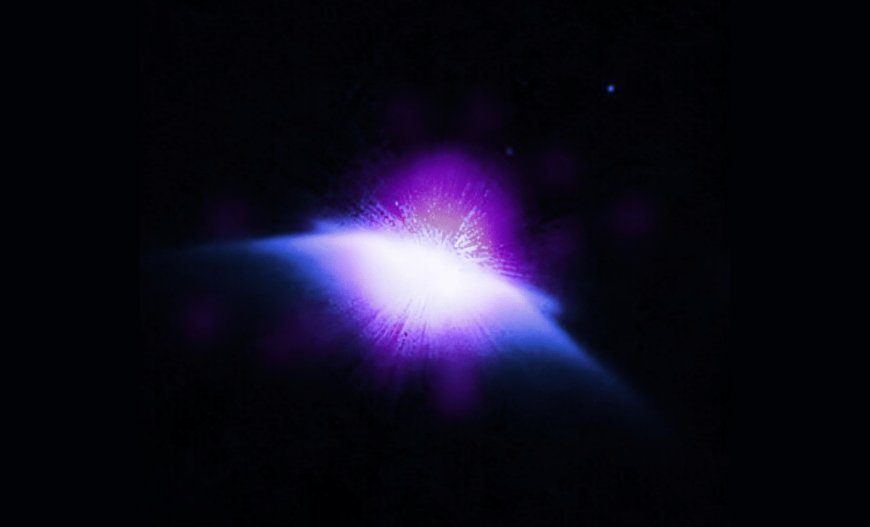
Astronomers using NASA’s Chandra X-ray Observatory have captured an unprecedented image of a stellar bubble surrounding a young star, HD 61005, providing crucial insights into how our Sun’s astrosphere may have looked billions of years ago. Published in a recent study available on the arXiv, this groundbreaking research not only unveils a bubble-like structure around the youthful star but also helps scientists better understand the evolution of the Sun’s protective astrosphere.
The Astrosphere Around HD 61005: A Stellar Discovery
For decades, scientists have attempted to understand the structure of the Sun’s astrosphere, the bubble of particles surrounding the star created by solar winds. However, seeing this phenomenon from the outside has been a significant challenge. “We have been studying our sun’s astrosphere for decades, but we can’t see it from the outside,” said Carey Lisse, a leading researcher at Johns Hopkins University. His team’s new work provides a much-needed breakthrough by capturing an image of a similar stellar bubble around HD 61005, a much younger star about 120 light-years away. This discovery has opened a window into understanding how the Sun’s astrosphere has evolved over billions of years, offering key insights into its current shape and behavior.
The newly captured image of HD 61005’s astrosphere reveals a unique structure that is vastly different from the single point of light typically observed in older stars. The star, which is approximately 100 million years old, is blowing much more powerful stellar winds than the Sun, amplifying the creation of its astrosphere. By studying this star’s bubble, scientists are able to infer how the Sun’s own astrosphere looked during its earlier stages of life.
“This new Chandra result about a similar star’s astrosphere teaches us about the shape of the sun’s, and how it has changed over billions of years as the sun evolves and moves through the galaxy,” added Lisse.

The Powerful Winds of HD 61005 and Their Impact
HD 61005, although similar to the Sun in mass and temperature, exhibits a much more intense solar wind due to its younger age. This star’s stellar wind is not only three times faster than the Sun’s but also about 25 times denser, creating a stronger and more expansive astrosphere. The stellar wind from HD 61005 impacts the surrounding interstellar dust and gas, creating an environment rich in hot gases that produce X-ray emissions, making the discovery possible with Chandra’s advanced technology.
This discovery has profound implications for our understanding of how solar winds affect planetary systems. “We are impacted by the sun every day, not only through the light it gives off, but also by the wind it sends out into space that can affect our satellites and potentially astronauts traveling to the moon or Mars,” said Scott Wolk, a co-author of the study available on arXiv. He emphasized how this discovery could help us understand the effects of the Sun’s early solar wind and how it may have impacted the formation and evolution of our own solar system.
The “Moth” System: A Unique and Mysterious Star
Astronomers have affectionately nicknamed HD 61005 and its surrounding environment the “Moth,” due to the dust surrounding the star resembling the wings of a moth when viewed in infrared light. This dust, leftover from the star’s formation, plays a critical role in the development of its astrosphere. The “wings” of the Moth system are formed from interstellar material similar to the Kuiper Belt in our solar system, which has been crucial for understanding the formation of planetary systems.
The dust surrounding HD 61005 is about 1,000 times denser than the material around our Sun, providing a contrasting environment for comparison. The combination of this dense interstellar material, the high-density stellar wind, and the X-ray emission from the interaction between the wind and surrounding gases allowed Chandra to detect the astrosphere. The discovery of the Moth system offers astronomers an invaluable look into the early stages of stellar evolution, particularly in relation to solar winds and the formation of planetary systems.
What the Astrosphere of HD 61005 Tells Us About the Sun’s Past
The Sun, like HD 61005, likely passed through a similar phase in its youth, surrounded by a much denser environment of dust and gas. This discovery provides an opportunity to imagine what our Sun’s environment may have been like during its early years.
“It is amazing to think that our protective heliosphere would only extend out to the orbit of Saturn if we were in the part of the galaxy where the Moth is located, or, conversely, that the Moth would have an astrosphere 10 times wider than the sun’s if it were located here,” said Lisse.
The Sun’s heliosphere, which is the bubble of space that protects the Earth from harmful interstellar particles, is much smaller in comparison to the astrosphere of HD 61005. This stark difference reveals how the Sun’s environment has changed over time, particularly as it moved through different regions of the galaxy. Studying the Moth’s astrosphere allows scientists to hypothesize how solar winds and protective bubbles around young stars might have played a crucial role in shaping the early conditions of the solar system.
Enjoyed this article? Subscribe to our free newsletter for engaging stories, exclusive content, and the latest news.
What's Your Reaction?
 Like
0
Like
0
 Dislike
0
Dislike
0
 Love
0
Love
0
 Funny
0
Funny
0
 Angry
0
Angry
0
 Sad
0
Sad
0
 Wow
0
Wow
0