




























Astronomers Discover Violent Planetary Collision in Distant Star System

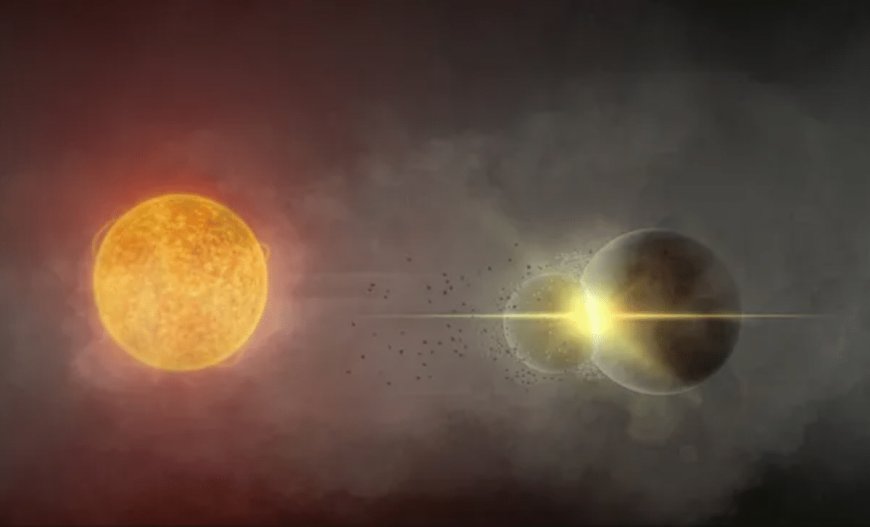
Astronomers have uncovered evidence of a rare and violent collision between two planets orbiting a star known as Gaia20ehk, located over 11,000 light-years from Earth. The unprecedented discovery, published in The Astrophysical Journal Letters, offers an extraordinary glimpse into the violent processes that shaped our own solar system billions of years ago, suggesting that planetary impacts like the one that created Earth’s moon may be more common than we thought.
The Mystery of Gaia20ehk: A Star That Went “Bonkers”
Gaia20ehk, an otherwise stable star located in the distant reaches of the Milky Way, had been behaving in a completely predictable manner for years, until 2016, when astronomers noticed something strange. The star, which is similar to our Sun, began to flicker and exhibit chaotic fluctuations in brightness, a behavior no one had anticipated.
“It went completely bonkers,” said team leader and University of Washington researcher Anastasios Tzanidakis. “I can’t emphasize enough that stars like our sun don’t do that. So when we saw this one, we were like ‘Hello, what’s going on here?'”
This anomaly was particularly baffling because, typically, the flickering and dimming of stars are the result of intrinsic processes within the stars themselves, such as pulsations or magnetic activity. However, this was different, Gaia20ehk’s unusual behavior was not caused by the star itself, but by something much more dramatic: a violent collision between two planets orbiting it.
The Clue in the Dimming: A Planetary Collision Unveiled
After investigating the star with various telescopes, the team discovered that the star’s flickering was actually caused by large amounts of dust and debris passing in front of it as the planets orbited Gaia20ehk. The debris originated from the catastrophic collision of two planets, which had been spiraling ever closer to each other for millions of years.

The discovery, detailed in The Astrophysical Journal Letters, was nothing short of extraordinary, as planetary collisions of this scale are exceedingly rare and have only been observed a handful of times in history.
“It’s incredible that various telescopes caught this impact in real time,” Tzanidakis explained. “There are only a few other planetary collisions of any kind on record, and none that bear so many similarities to the impact that created the Earth and moon. If we can observe more moments like this elsewhere in the galaxy, it will teach us lots about the formation of our world.”
The team believes that this collision is a near-identical match to the one that created Earth’s moon approximately 4.5 billion years ago, a crucial event that ultimately shaped the conditions for life to thrive on our planet.
The Role of Infrared Light: Confirming the Collision’s Heat
To understand the scale of the planetary collision, the researchers turned to infrared observations, which revealed even more about the nature of the impact.
“The infrared light curve was the complete opposite of the visible light,” said Tzanidakis. “As the visible light began to flicker and dim, the infrared light spiked. Which could mean that the material blocking the star is hot—so hot that it’s glowing in the infrared.”
This spike in infrared light was a key piece of evidence pointing to the tremendous heat generated by the planetary collision. The two planets, originally on a slow spiral towards each other, initially produced grazing impacts that didn’t release much infrared energy. However, the catastrophic final collision generated enough heat and debris to cause significant infrared emissions, confirming that the event was as dramatic as it appeared. The discovery of such an intense collision provides insight into the violent processes that likely occurred during the early days of our solar system.
Implications for the Search for Exomoons and Life
The collision of these two planets could have far-reaching implications for our understanding of how planetary systems, and potentially life, form elsewhere in the galaxy. The debris cloud generated by the collision now orbits Gaia20ehk at a distance roughly equivalent to the distance between Earth and the Moon. In the distant future, as the material cools, it could coalesce to form an exomoon, a natural satellite similar to Earth’s Moon.
Such a formation process, if observed on a larger scale, could provide valuable insights into the early stages of moon formation. As team member James Davenport pointed out, the discovery represents a new frontier in astronomical research.
“Andy’s unique work leverages decades of data to find things that are happening slowly — astronomy stories that play out over the course of a decade,” Davenport said. “Not many researchers are looking for phenomena in this way, which means that all kinds of discoveries are potentially up for grabs.”
The creation of moons like Earth’s is believed to have been crucial in enabling the conditions necessary for life, such as stabilizing the planet’s axial tilt and controlling tides. Understanding how often such collisions occur could help determine how frequently life-supporting moons might form around exoplanets. This knowledge may be instrumental in the ongoing search for life beyond our solar system.
Enjoyed this article? Subscribe to our free newsletter for engaging stories, exclusive content, and the latest news.
What's Your Reaction?
 Like
0
Like
0
 Dislike
0
Dislike
0
 Love
0
Love
0
 Funny
0
Funny
0
 Angry
0
Angry
0
 Sad
0
Sad
0
 Wow
0
Wow
0