




























Astronauts on Artemis II Witness Earth Vanishing Beyond the Lunar Horizon in a View Not Seen Since Apollo Era

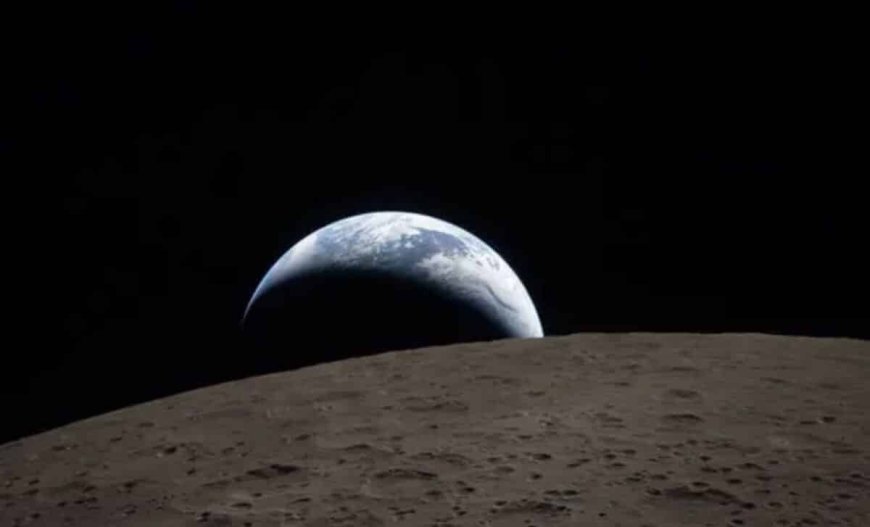
A rare image of Earth slipping behind the Moon has been captured by the crew of NASA’s Artemis II mission. Taken during a flyby of the lunar far side. The image shows a crescent Earth descending below the lunar horizon, combining the vivid colors of the planet with the stark relief of the Moon’s surface. It is already considered one of the most notable visuals returned from the 10-day mission.
The Artemis II mission marks a key phase in NASA’s return to human deep space exploration. During its trajectory, the crew traveled around the far side of the Moon, a region that cannot be seen from Earth.
According to NASA, this segment of the mission lasted about seven hours and provided a unique observational window. The spacecraft operated without direct communication with Earth, allowing astronauts to capture images and data from an unusual vantage point.
A Rare Earthset Mirrors A Historic Moment
The photograph of Earthset recalls the famous Earthrise image taken by Apollo 8 astronauts in 1968. Instead of showing Earth appearing above the lunar horizon, this view captures the planet gradually disappearing behind it. According to NASA’s description:
“The Earth’s sunlit side shows white clouds and blue water over the Oceania region, while the dark areas are experiencing nighttime.”
The image was taken at 6:41 p.m. Eastern Daylight Time on April 6, 2026. At that moment, the Orion spacecraft was passing behind the Moon, placing the crew in a position that few missions have achieved.

A Seven-Hour Flyby Filled With Unique Observations
The Earthset image is part of a broader collection gathered during the far-side flyby. As explained by The U.S Space Agency, astronauts on Artemis II also captured a total solar eclipse and observed light from nearby planetary bodies.
“The light from several planetary neighbors, and the long shadows cast along the terminator line where lunar day meets night,” stated the space agency in the statement.

NASA reported that these shadows revealed fine details in craters and basins. The absence of an atmosphere on the Moon allows for sharp contrasts between light and dark areas, making geological features more visible. The imagery noted that subtle features such as ridges and deep depressions can be seen due to the angle of sunlight.
The Artemis mission concludes on April 10, 2026, with a splashdown off the coast of California. NASA indicates that additional images will continue to be processed after the crew returns, expanding the visual record of this flyby.
Enjoyed this article? Subscribe to our free newsletter for engaging stories, exclusive content, and the latest news.
What's Your Reaction?
 Like
0
Like
0
 Dislike
0
Dislike
0
 Love
0
Love
0
 Funny
0
Funny
0
 Angry
0
Angry
0
 Sad
0
Sad
0
 Wow
0
Wow
0