




























Artemis II Crew Captures Breathtaking Earth Portrait On Journey To The Moon

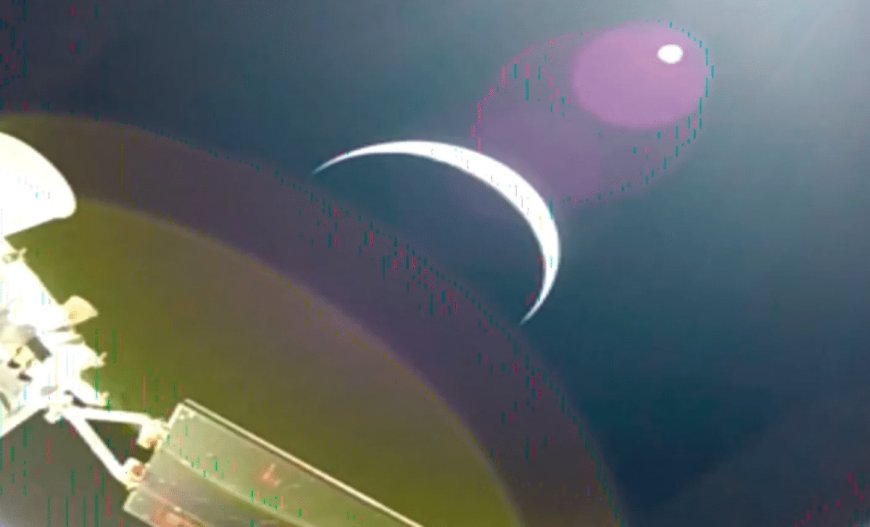
A newly highlighted image tied to NASA’s Artemis II mission is reshaping how scientists and the public envision humanity’s return to deep space, offering a rare perspective that underscores both the fragility and unity of our planet.
A Historic View Framed By Artemis II
The upcoming Artemis II mission, set to carry astronauts around the Moon, is not just a technical milestone, it is a visual and emotional one. At the center of growing attention is a striking representation of what astronauts will witness: Earth suspended in the vast darkness of space, reduced to a luminous sphere against an infinite backdrop. This perspective, often compared to the iconic “Blue Marble” and “Earthrise” images, carries profound implications. It transforms Earth from a place we inhabit into an object we observe, finite, isolated, and interconnected.
Unlike previous missions, Artemis II aims to reintroduce human presence beyond low Earth orbit for the first time in over 50 years. The image associated with this mission is not just symbolic; it is grounded in trajectory modeling, lighting simulations, and observational predictions. It reflects what astronauts will actually see as they travel thousands of miles beyond our planet. This framing turns a scientific mission into a shared human experience, bridging data and emotion.
Good morning, world! 
We have spectacular new high-resolution images of our home planet, all of us looking back through the Orion capsule window at our Artemis II astronauts as they continue their journey to the Moon. pic.twitter.com/QjxGfWiRcS— NASA (@NASA) April 3, 2026
The Science And Vision Behind The Image
According to NASA, the visualization is based on precise orbital mechanics and mission design. Engineers and scientists calculated the spacecraft’s path, orientation, and timing relative to the Sun and Earth to reconstruct this anticipated view. This is not artistic guesswork, it is a scientifically informed projection rooted in decades of spaceflight data and modern computational modeling.
The image highlights how distance alters perception. From the vantage point of Artemis II, Earth appears both smaller and more unified, with no visible borders or divisions. Atmospheric layers glow subtly, emphasizing the thin shield that sustains life. These visual cues are not only aesthetically powerful; they reinforce scientific understanding of Earth as a delicate system.
NASA has emphasized that such imagery plays a role in public engagement and education. Visuals like this help translate complex mission parameters into something immediately graspable, making space exploration accessible beyond technical communities.

Credit: NASA/Reid Wiseman
Why This Perspective Matters More Than Ever
Images of Earth from space have historically influenced culture, policy, and environmental awareness. The Artemis II view arrives at a time when global challenges, climate change, resource management, and geopolitical tension, are intensifying. Seeing Earth from deep space strips away abstraction and highlights shared vulnerability.
This perspective can reshape how people think about planetary stewardship. When Earth is seen as a single, isolated entity, the idea of collective responsibility becomes more tangible. The Artemis II image has the potential to renew that awareness for a new generation, much like Apollo-era photographs did decades ago.
There is also a psychological dimension. Astronauts often describe a cognitive shift known as the “overview effect,”a profound sense of connection and responsibility triggered by viewing Earth from space. Artemis II may extend that experience to millions through imagery that captures the same essence.
A New Chapter In Human Spaceflight
Artemis II represents more than a return to lunar orbit, it signals the beginning of a sustained human presence beyond Earth. The mission will test critical systems, validate spacecraft performance, and pave the way for future lunar landings under the Artemis program.
The image associated with this mission acts as both a preview and a promise. It hints at what is to come: humans once again venturing into deep space, carrying with them not just technology, but perspective. It reinforces the idea that exploration is not only about reaching new destinations, but also about redefining how we understand our place in the universe.
As anticipation builds, this visual stands as a reminder that the most powerful discoveries are not always new worlds, but new ways of seeing our own.
Enjoyed this article? Subscribe to our free newsletter for engaging stories, exclusive content, and the latest news.
What's Your Reaction?
 Like
0
Like
0
 Dislike
0
Dislike
0
 Love
0
Love
0
 Funny
0
Funny
0
 Angry
0
Angry
0
 Sad
0
Sad
0
 Wow
0
Wow
0