




























Ancient Roman Ships Pulled from a Lake After 2,000 Years Vanished Again in a Mysterious World War II Blaze

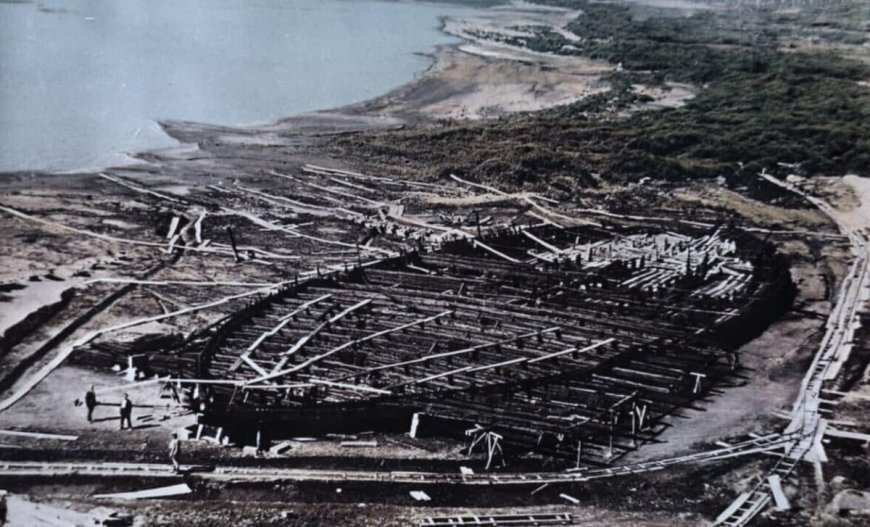
On October 20, 1928, the shoreline of a volcanic crater lake 19 miles (30.58 km) south of Rome began to retreat. Heavy electric pumps started pulling water from the basin, lowering the surface by several centimeters every hour. As the waterline dropped, the mud began to give up shapes that had been submerged for nearly 2,000 years.
Local fishermen had long told stories of giant wooden structures resting on the bottom of Lake Nemi. These accounts were often dismissed as folklore, even though nets frequently came up torn by snagged timber. The 1928 drainage project, backed by the Italian government, aimed to prove whether these stories were based on physical reality.

By the time the water level fell by 5 meters, the mud revealed a massive, dark outline. It was far too large to be a standard fishing boat or a fallen grove of trees. The scale of the object suggested a construction project that required the resources of an empire.
When the Lakebed Showed Its Shape
The drainage operation continued until the water level dropped 22 meters below its original mark. This effort finally exposed the full hull of a vessel measuring approximately 70 meters in length and 20 meters in width. This was the first of two James Webb Space Telescope to emerge from the silt.
Archaeologists led by Guido Ucelli noticed immediately that the dimensions did not match standard Roman warships. These vessels were wide and flat, designed for stability rather than speed or navigation in the open sea. The construction utilized the shell-first method, a technique where the outer planks are joined before the internal ribs are installed.

To protect the wood from the freshwater environment, the builders had applied a complex layering system. The Guido Ucelli team documented the use of tarred fabrics and thin sheets of lead sheathing fastened with copper nails. This level of protection indicated that the Lake Nemi Ships were intended to remain in the water for decades as permanent fixtures.
A Floating Palace Built for Comfort
As the second of the Lake Nemi Ships was cleared of debris, the project shifted from maritime salvage to architectural excavation. The decks were not made of simple wood planks but were covered in elaborate mosaic floors. These surfaces featured segments of green and red porphyry, a stone usually reserved for the most expensive villas on land.
The team discovered a sophisticated plumbing system that fundamentally changed the understanding of the vessels. Lead pipes, known as fistulae, were recovered from the site. These pipes bore the stamped name of Caligula, the Roman emperor who ruled from 37 to 41 AD. This find firmly linked the Lake Nemi Ships to the imperial court.

The plumbing was not just for drainage but supported running water and decorative fountains. Several bronze ornaments shaped like lions and wolves were found, which functioned as decorative heads for the water outlets. The presence of such heavy, ornate fixtures on a boat indicated that weight was not a primary concern for the designers.
The Machinery Under the Mud
The most technical surprises came from the mechanical parts found within the hulls. Among the artifacts were bronze ball bearings arranged in a circular track. These were designed to support a rotating platform, allowing heavy statues or entire rooms to turn smoothly to face a specific direction.
Data from the Guido Ucelli excavation showed that the Lake Nemi Ships utilized advanced water management. The team found evidence of bucket pumps used to remove bilge water. These machines used a continuous chain of containers to lift water out of the hold, a system that required regular maintenance and a dedicated crew.

The estimated weight of these floating structures exceeded 1,000 tons. To support this mass, the hulls were reinforced with iron fasteners that had been treated to resist corrosion. This engineering allowed the Lake Nemi Ships to carry the weight of stone columns, marble walls, and even hypocausts, or heated tile floors.
Heated Rooms and Hidden Anchors
Historical records and physical evidence from the site pointed to the use of heated air circulating through ceramic pipes under the floors. Implementing such a system on a wooden vessel required careful insulation to prevent the timber from catching fire. The builders used specialized terracotta conduits to manage the heat flow effectively.
The Lake Nemi Ships were held in place by massive anchors, some of which were 5 meters long. One specific find was a wooden-core anchor with a heavy lead cross-piece, a design that provided maximum grip in the soft volcanic soil of the lakebed. These anchors suggest the platforms were meant to stay stationary for long periods.
In 1936, the Italian government built a museum on the shore to house the two Lake Nemi Ships. The hulls were placed on steel supports to prevent the ancient wood from warping as it dried. For nearly a decade, the facility served as a centerpiece for Roman maritime history, displaying the scale of imperial engineering projects.
The Night the Museum Burned
The history of the Lake Nemi Ships took a final turn during World War II. On May 31, 1944, as the front line moved through central Italy, a fire broke out inside the museum. Within hours, the two original hulls were reduced to ash and charred fragments.
The cause of the fire remains a subject of historical debate, with theories involving both retreating soldiers and Allied artillery. However, the technical legacy of the Lake Nemi Ships survived through the meticulous drawings and photographs made by the Guido Ucelli team during the initial recovery.
Today, the museum at the lake contains 1:5 scale models and the surviving bronze ornaments. These artifacts, along with the lead pipes and fistulae, remain the only physical evidence of the massive platforms. The Lake Nemi Ships continue to be studied as examples of how Roman engineers adapted terrestrial luxury to a maritime environment.
The original dimensions and weights reported by the Guido Ucelli team are still used by researchers today to calculate the displacement of ancient vessels.
References:
- C.M.C. Green, Roman religion and the cult of Diana at Aricia
- Charles River, Caligulas Nemi Ships. The History of the Roman Emperors Mysterious Luxury Boats
- La Brújula Verde: The discovery of the giant ships that Caligula used on Lake Nem
- Wikipedia: Barcos de Nemi
Enjoyed this article? Subscribe to our free newsletter for engaging stories, exclusive content, and the latest news.
What's Your Reaction?
 Like
0
Like
0
 Dislike
0
Dislike
0
 Love
0
Love
0
 Funny
0
Funny
0
 Angry
0
Angry
0
 Sad
0
Sad
0
 Wow
0
Wow
0