





























A walk along a Canadian shore 13,000 years ago left footprints revealing one of the earliest human traces in North America

For thousands of years, the shoreline looked ordinary. Waves came and went, forests grew thick along the coast, and tides slowly reshaped the land. Nothing on the surface suggested that people had once passed through this place long before cities, roads, or even written history. Yet beneath layers of sand and clay, a silent trace of human movement had been waiting. Only recently did scientists begin to realize that this quiet stretch of coastline might hold one of the oldest clues to how humans first moved across North America.
A discovery hidden beneath the shoreline
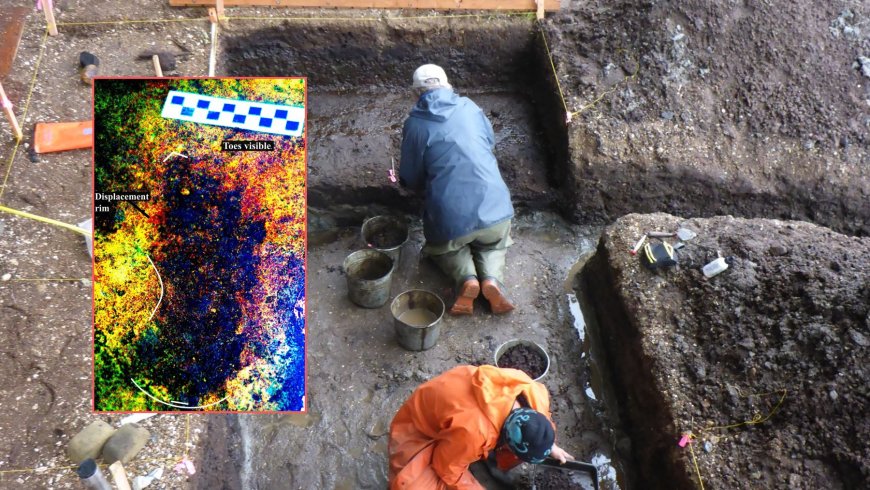
The story began on Calvert Island in British Columbia, a remote place along Canada’s Pacific coast. In 2014, anthropologist Duncan McLaren from the Hakai Institute and the University of Victoria noticed something unusual along the shoreline.
At first glance, the shapes looked like natural impressions in the ground. But as researchers carefully examined the area, they began to see something far more remarkable.
The marks were clearly human footprints.
Over several field trips in 2015 and 2016, the team uncovered more impressions buried in clay beneath layers of sand and sediment. In total, 29 separate human footprints were discovered along the ancient shoreline.
The ground itself had helped preserve them. Layers of clay and coarse sand formed a natural protective seal, keeping the shapes intact for thousands of years.
A trail left by a small group
As researchers studied the outlines, a picture slowly began to emerge. The footprints were not all the same size. Some were larger and deeper, while others were noticeably smaller.
Based on these shapes, scientists believe the prints were left by two adults and a child walking together along the coast.
To determine when the footprints were made, researchers used radiocarbon dating on nearby material. The results revealed something extraordinary.
The prints were created about 13,000 years ago.
That makes them the oldest human footprints ever discovered in North America.
Footprints that reveal an ancient journey
The discovery does more than show that people once stood on that shoreline. It offers a rare glimpse into how humans may have first moved through the continent.
According to the study published in the journal PLOS ONE, the footprints support a long-standing theory that early humans traveled south along the Pacific coast after reaching Alaska.
Many scientists believe prehistoric people originally crossed into North America from Asia using a land bridge that once connected Siberia and Alaska during the last Ice Age. From there, some groups may have followed the coastline southward.
These footprints provide physical evidence of people living along that coastal route at the end of the last major Ice Age.
Finding such evidence is extremely difficult today. After the Ice Age ended, sea levels rose several feet, covering many ancient shorelines. Dense forests now blanket much of the coast, and many areas can only be reached by boat.
That makes preserved traces like these incredibly rare.
One clue in a much bigger human story
While the discovery is exciting, scientists say it is only one piece of a much larger puzzle.
Other research has tried to understand when humans first arrived in the Americas. In 2007, DNA extracted from a tooth found in southern Alaska was dated to about 10,300 years ago. Later studies comparing ancient and modern genetic material suggested humans reached the Americas no earlier than about 15,000 years ago.
The story stretches even further back. Human origins are believed to trace to southeast Africa around 200,000 years ago, though some evidence suggests early humans may have appeared as far back as 300,000 years ago in Morocco.
From those beginnings, humans gradually spread across the planet — traveling into Europe, Asia, and eventually the Americas.
Scientists believe climate shifts may have helped make those journeys possible. For example, a warming period about 130,000 years ago may have created wetter environments and navigable rivers, making migration easier.
Still, the exact path humans took into North America remains a mystery.
That is why discoveries like the footprints on Calvert Island matter so much. They show that long before cities or written records, small groups of people were already exploring distant coastlines, leaving behind brief impressions of their presence.
For a moment, thousands of years ago, someone walked across wet clay near the water’s edge.
Today, those simple steps are helping scientists trace one of humanity’s oldest journeys.
What's Your Reaction?
 Like
0
Like
0
 Dislike
0
Dislike
0
 Love
0
Love
0
 Funny
0
Funny
0
 Angry
0
Angry
0
 Sad
0
Sad
0
 Wow
0
Wow
0