



























A Couple of Dog Walkers Discovered Human Footprints in the Sand, But They Vanished Within 48 Hours Before They Could Be Fully Studied

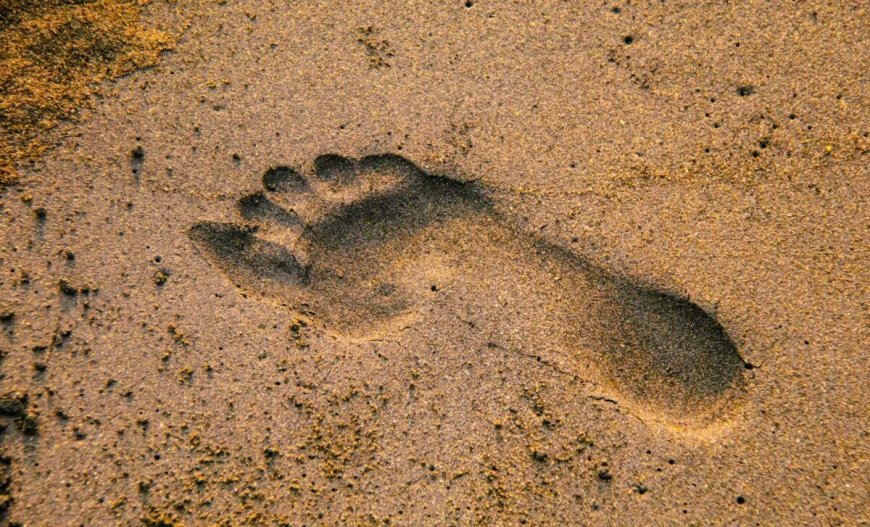
On a windswept afternoon at Lunan Bay Beach, dog walkers Ivor Campbell and Jenny Snedden made a rare archaeological discovery: footprints preserved in the sand. However, it quickly turned into a race against time to preserve them. The remarkable find consisted of footprints preserved in clay, possibly dating back 2,000 years.
The prints were briefly exposed when high winds shifted the sand dunes. But just as quickly as they appeared, the elements threatened to erase them. Archaeologists had only hours to document and preserve the footprints before the storm and the advancing tide destroyed everything.
The Discovery That Almost Didn’t Happen
It was a chance encounter. While walking their dogs along Lunan Bay Beach in Angus, Scotland, Campbell and Snedden noticed something unusual in the sand. What they discovered were human footprints, preserved in the clay beneath a shifting layer of sand. According to Bruce Mann, a regional archaeologist from Aberdeenshire, this was a rare find that demanded immediate attention.
“It was a powerful reminder that some of the most important discoveries start with someone noticing something and choosing to report it,” he said. “What came next was a race against time.”

The discovery was particularly significant because such footprints are rarely preserved, and even rarer are those from this period. The prints were believed to date back to the late Iron Age, approximately 2,000 years ago, coinciding with the Roman invasions of Scotland. The site was also home to prints from animals such as red and roe deer.
Battling the Elements
Once the discovery was reported, time became the most precious resource. As archaeologists scrambled to reach the site, 55 mph winds whipped across the coastline, and the high tide steadily inched closer.
According to a press release from the University of Aberdeen, despite the harsh conditions, a team of researchers rushed to the beach, equipped with plaster of Paris to make casts of the footprints. As Kate Britton, an archaeologist with the team, explained, it was some of the worst fieldwork conditions she had ever encountered.

“We were effectively being sand-blasted and the site was too, all while we were trying to delicately clean, study and document it, so it became a race against the elements. And, within 48 hours the entire site was destroyed.”
Working in near-blinding sandstorms, the team quickly mapped the site, capturing 3D models of the prints. They also took physical casts to ensure a record of the find would survive. But with each passing hour, the prints were being eroded by the elements. As the waves began to lap at the site, it became clear that the prints would soon be gone.
A Vanishing Piece of History
In just 48 hours, the site was completely destroyed. The footprints, once visible and preserved in the clay, had vanished beneath the relentless winds and the rising tide. While the archaeological team managed to capture some key data and make physical casts of the footprints, the moment of discovery and its subsequent destruction raised an important question: How many more archaeological finds are lost to the elements before we even have the chance to study them?
William Mills, a post-doctoral researcher at the University of Aberdeen, noted that the transient nature of the site highlights just how rapidly irreplaceable pieces of history can be lost.
“It is incredibly rare to see such a delicate record saved, taking only minutes to create and hours to be destroyed, a snapshot of what people were doing thousands of years ago.” He added, “the site also tells us how this now sandy beach was once a muddy estuary and that humans were using this environment, perhaps for hunting deer or to collect wild plant foods such as samphire.”
Enjoyed this article? Subscribe to our free newsletter for engaging stories, exclusive content, and the latest news.
What's Your Reaction?
 Like
0
Like
0
 Dislike
0
Dislike
0
 Love
0
Love
0
 Funny
0
Funny
0
 Angry
0
Angry
0
 Sad
0
Sad
0
 Wow
0
Wow
0