


























A Chinese Team Just Found a Way to Turn Desert Sand Into Soil Without Planting A Single Tree

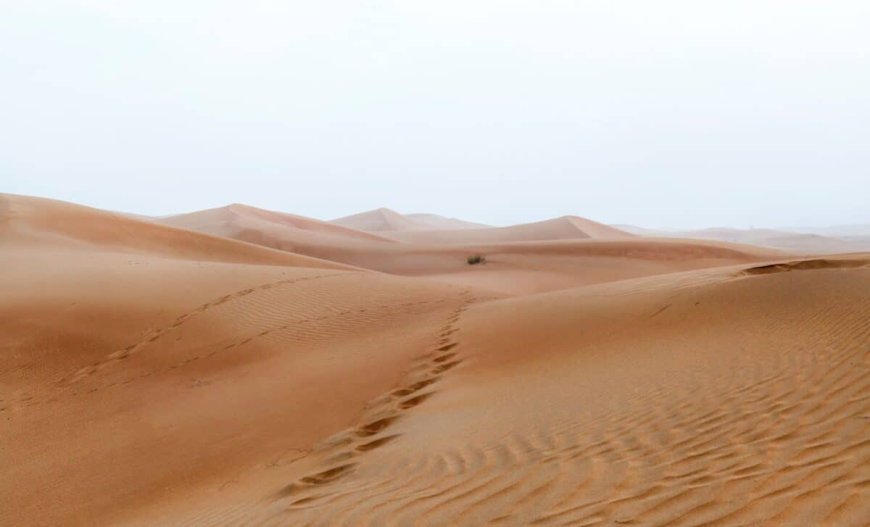
A 59-year field experiment in northern China suggests that seeding desert dunes with cyanobacteria can reduce soil recovery time from 15 years to as little as one or two.
The method, based on induced biological soil crusts, offers a new way to slow desertification without relying only on trees.
For years, the response to advancing deserts has been straightforward: plant more vegetation. China has done exactly that along the edge of the Taklamakan Desert, building green belts to anchor shifting sand. The results are visible, though the approach demands time and resources.
Tiny Engineers Beneath the Surface
The key players are cyanobacteria, microorganisms that use sunlight for energy and tolerate intense heat. When moisture arrives, they release sticky polysaccharides that glue sand grains together, forming a thin layer known as a biological soil crust.

According to findings published in Soil Biology and Biochemistry, naturally occurring crusts, called Natural Biological Soil Crusts (NBSCs), can take about 15 years to stabilize. Once formed, they reduce wind erosion and create conditions that make it easier for native grasses and shrubs to settle in.
Speeding Up A 15-year Process
The long-running study compared natural crusts with Induced Biological Soil Crusts (IBSCs), created by adding cyanobacteria directly to sand. According to the research team, induced crusts reached comparable stability within one to two years.
The difference was measurable. Carbon and nitrogen levels increased significantly as the crusts aged, strengthening the soil’s nutrient base. The correlation between crust development and nutrient accumulation was clearly documented in the data.

At the Shapotou Desert Research and Experiment Station, scientists refined how the microbes are delivered. Early attempts involved spraying liquid cultures, which required heavy equipment and electricity, something rarely available in remote dune fields. Researchers later developed dry “solid seeds” made of cyanobacteria mixed with organic material. These can be carried into isolated areas and scattered by hand or drone. After rainfall, the microbes activate and begin binding sand.
Durable In Heat, Fragile Under Pressure
The induced crusts tend to merge with the local microbial community over time. As explained by the study, they do not remain simple bacterial layers. Rising carbon and nitrogen levels attract other organisms, gradually enriching the ecosystem.
Still, the system has limits. A single vehicle track or grazing herd can undo years of microbial work in seconds. The crust is biologically resilient under intense heat and radiation, yet physically delicate when disturbed.
Desertification affects roughly 40 percent of Earth’s land surface. China plans to rehabilitate nearly 100,000 mu, about 6,600 hectares, using these solid microbial seeds over the next five years. The area is modest, yet the idea behind it is straightforward. Before planting forests, let the microbes prepare the ground.
Enjoyed this article? Subscribe to our free newsletter for engaging stories, exclusive content, and the latest news.
What's Your Reaction?
 Like
0
Like
0
 Dislike
0
Dislike
0
 Love
0
Love
0
 Funny
0
Funny
0
 Angry
0
Angry
0
 Sad
0
Sad
0
 Wow
0
Wow
0