


























Underwater Drone Detects Strange Object at 2,567 Meters; It Turns Out to Be France’s Deepest-Known Shipwreck

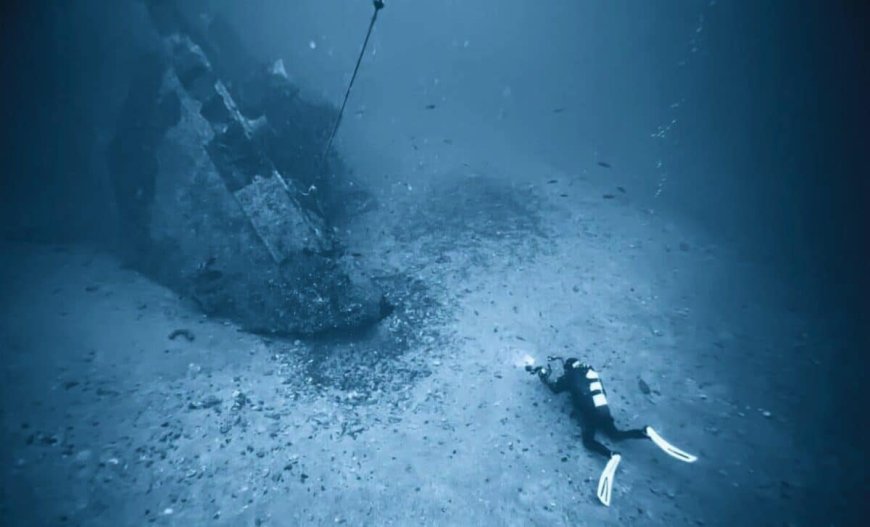
For a while, it looked like just another anomaly on a sonar screen. The French Navy was surveying the seabed off Ramatuelle, near Saint-Tropez, in early March 2025 when an underwater drone picked up something large more than 2,500 meters below the surface. A follow-up look with a camera suggested this was no rock formation. It was a ship.
What emerged from the images was a wreck so deep that no one had catalogued anything like it before in French waters. The vessel, now known as Camarat 4, lies at 2,567 meters in the Mediterranean Sea and appears to be a 16th-century merchant ship, still surrounded by much of its cargo. French officials said it is the deepest shipwreck ever found in waters under French jurisdiction.
The depth explains why the discovery has drawn so much attention. At that distance below the surface, human interference is far less likely. Marine archaeologists were not looking for a Renaissance-era trading vessel when they found it. The drone was part of a government mission focused on the seabed itself, including minerals and undersea cables, when it happened upon the wreck by chance.
Underwater Drone Discovery off the Coast of Ramatuelle
The first detection happened on March 4, 2025, during a French seabed operation off the Var coast. According to Deputy Maritime Prefect Thierry de la Burgade, sonar revealed “something quite big,” prompting the team to return with a camera and then an underwater robot capable of taking sharper images. Those later passes confirmed the site’s scale and structure.
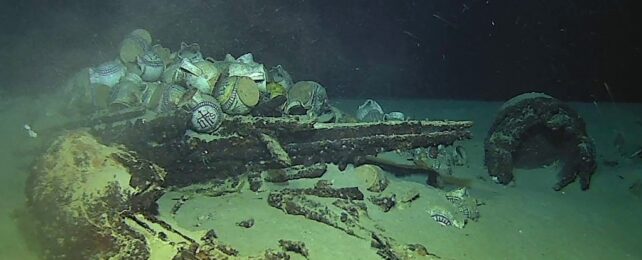
Officials later identified the wreck as a merchant vessel from the 16th century. The provisional name comes from nearby Cap Camarat and its listing order in the area. Arnaud Schaumasse, who heads the culture ministry’s underwater archaeology department, described the find in direct terms: “It’s the deepest shipwreck ever found in French territorial waters.”
That record matters because depth is central to the story. Unlike many shallower wrecks, this one remained out of reach for salvage, tourism, or casual disturbance. That alone makes it a major deep-sea archaeology discovery.
Ancient Cargo Preserved on the Mediterranean Seabed
The ship appears to have been sailing from northern Italy when it sank. Among the most visible objects on the seabed are around 200 ceramic jugs with pinched spouts, many still grouped together, along with roughly 100 yellow plates, two cauldrons, six cannons, an anchor, and metal bars.
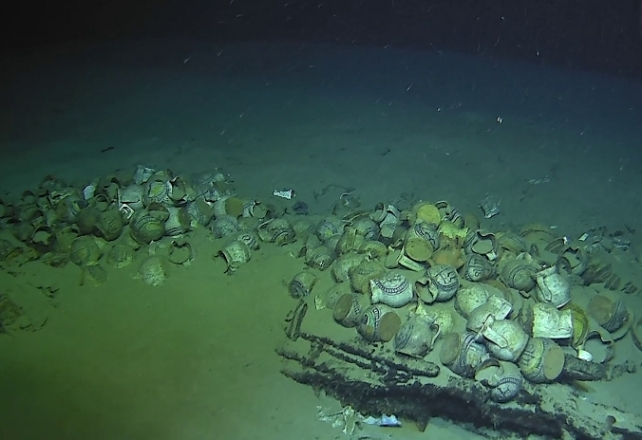
Some of the jugs carry the monogram “IHS,” the first three letters of the Greek name of Jesus, while others bear plant-inspired or geometric designs. Those details point to the Liguria region in what is now northern Italy. The cargo makes the wreck more than a maritime mystery. It is also a snapshot of Renaissance trade moving across the western Mediterranean.
There are also signs that the ship still has more to reveal. Archaeologists have noted that part of the stern appears unusually empty, even though cargo space on merchant ships of that period was used carefully. That raises the possibility that some material remains buried in the sediment around the wreck.
France’s Deepest Shipwreck Frozen in Time
The most striking feature of Camarat 4 may be its state of preservation. Marine Sadania, an archaeologist working on the site, said, “The site—thanks to its depth, which prevented any recovery or looting—has remained intact, as if time froze, which is exceptional.” At 2,567 meters down, the ship was simply out of reach for the kind of disturbance that often strips shallower wrecks of their contents.
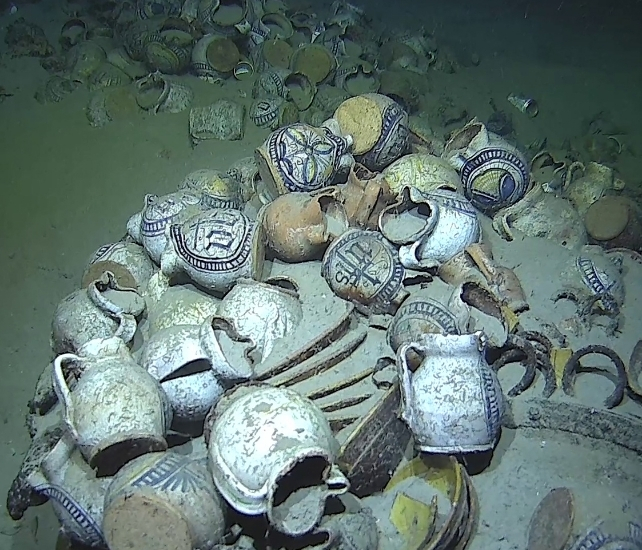
That does not mean the site is untouched by the present. Researchers also spotted modern debris among the 16th-century artifacts, including a soda can and an empty yogurt pot. The contrast is hard to miss: a preserved merchant ship from five centuries ago lying beside evidence of modern marine pollution.
That detail gives the discovery a second layer of relevance. The wreck is not only an archaeological story. It is also a reminder that even the deep seabed now carries traces of contemporary waste.
3D Reconstruction Planned for the Camarat 4 Wreck
For now, the plan is not a full excavation. Over the next two years, the archaeological team intends to build a 3D reconstruction of the wreck and take selected samples for study. The goal is to document the site closely while limiting disruption to a shipwreck that has survived for centuries in exceptional condition.
That caution is partly practical. The depth places the wreck near the limit of current equipment, which means any future intervention has to be carefully planned. For now, the ship remains where it sank, in darkness far below the coast, with its ceramics, cannons, and metal cargo still spread across the seabed.
Enjoyed this article? Subscribe to our free newsletter for engaging stories, exclusive content, and the latest news.
What's Your Reaction?
 Like
0
Like
0
 Dislike
0
Dislike
0
 Love
0
Love
0
 Funny
0
Funny
0
 Angry
0
Angry
0
 Sad
0
Sad
0
 Wow
0
Wow
0