























This ‘Gate to Hell’ Kept Burning for Decades and the Bigger Threat Is Buried Below

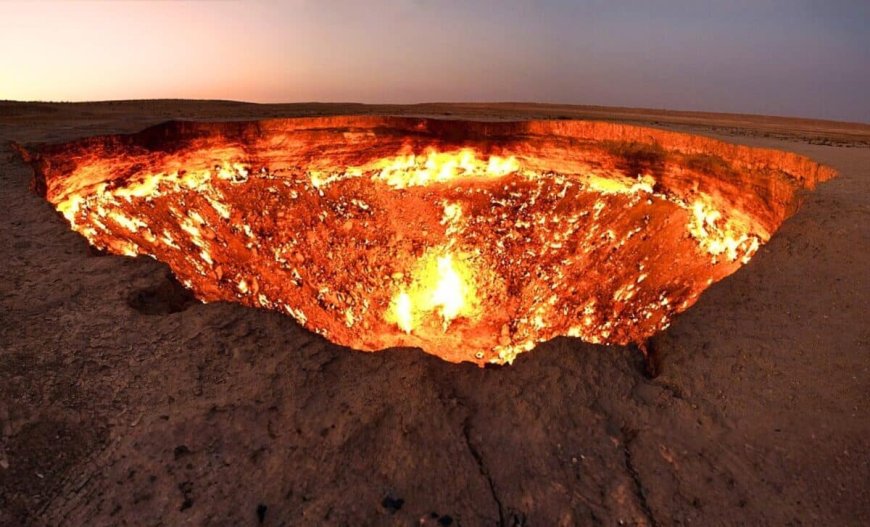
At night, the Darvaza gas crater looks almost theatrical: a ring of fire dropped into the Karakum Desert, its orange glow carrying across the dark, flat landscape of central Turkmenistan. For decades, the burning pit has drawn travelers to one of the most isolated parts of Central Asia, earning the nickname “Gateway to Hell” and becoming one of the country’s most recognizable landmarks.
The crater is widely believed to be the result of a Soviet-era drilling accident, though the exact details remain difficult to pin down. The most repeated version places the collapse in 1971, when a rig broke through into a gas pocket and engineers set the escaping methane alight, expecting the fire to burn out quickly. Other reporting is more cautious, suggesting only that the accident likely happened sometime between the 1960s and 1980s. What is clear is that the flames were never meant to last, and yet they have burned for more than half a century.

That persistence has transformed Darvaza from a curiosity into a national problem. The crater is still a tourist draw, but it also symbolizes energy waste, environmental damage, and the lingering legacy of Soviet extraction. In January 2022, France 24 reported on then-president Gurbanguly Berdimuhamedow’s public call to extinguish the fire, quoting his argument that the site was harming the environment, affecting nearby residents, and consuming natural resources that could otherwise benefit the country. The statement gave new urgency to an issue that had resurfaced before but never led to a lasting fix.
Why the Fire Matters Beyond the Crater
Darvaza’s political importance comes from more than its eerie appearance. Turkmenistan sits on vast natural-gas reserves, and the sight of fuel burning uselessly in the desert carries an obvious economic sting. Yet the crater also exists within a much broader methane problem. The country has drawn international scrutiny for leakage from aging wells, pipelines, and other fossil-fuel infrastructure, much of it dating back to the Soviet era.
That wider context helps explain why foreign governments have taken notice. In 2023, Bloomberg reported that the United States was in talks with Turkmenistan over a possible deal to help curb methane pollution, an effort tied to the global push to reduce one of the most potent greenhouse gases. For Turkmenistan, the appeal is twofold: methane control is both a climate issue and a matter of preserving a valuable export resource.

Still, the crater’s role in that equation is complicated. Because the gas is burning, much of the methane is being converted into carbon dioxide and water vapor before entering the atmosphere. That does not make the fire harmless, but it does mean Darvaza may be less significant as a direct climate threat than its image suggests. Its visibility, however, makes it politically irresistible. A leaking pipeline does not command the same attention as a blazing hole in the desert.
The Hard Part Lies Underground
Extinguishing the visible flames is not the same thing as solving the underlying problem. The fire persists because gas continues to rise from beneath the crater, and that means any meaningful intervention has to address the subsurface source as well as the combustion at the surface. Simply smothering the flames or covering the opening may stop the spectacle temporarily, but if methane keeps moving upward through fractures in the ground, it could escape elsewhere.
That is the core challenge emphasized by fire scientist Guillermo Rein, whose work at Imperial College London has been cited in reporting on the crater. Rein has warned that any attempt to shut Darvaza must begin with a much clearer understanding of the underground rupture feeding it. Without that knowledge, efforts to block the flow could fail or, worse, create a dangerous buildup of gas. The problem is not just heat. It is pressure, geology, and the risk of turning one open fire into a less visible but more hazardous leak.

The same caution appears in the work of energy geoscientist Mark Ireland of Newcastle University, who has pointed to the hydrocarbon-rich geology of the region as a reason the crater should not be treated like an isolated surface fire. The gas has to go somewhere. If one pathway is closed without controlling the source, another may open. That possibility is what makes Darvaza such an unusual engineering puzzle: it is a crater, but also the visible outlet of a much larger underground system.
A Spectacle That Became a Symbol
The crater’s fame has given it a second life beyond geology and energy policy. Over time it has become a symbol of excess, mystery, and state control over narrative. That tension is part of what keeps Darvaza in the headlines. It is at once a failed industrial site, a tourist destination, and a national emblem that Turkmen authorities may no longer find useful in its current form.
Popular coverage has sometimes leaned into the surreal quality of the site, as in Gizmodo, which framed the challenge in terms of just how difficult it would be to shut down a fire that has been burning in open desert for decades. The fascination is understandable. Darvaza looks like a myth, but its real significance lies in how stubbornly material it is: an accident, a fuel source, and an engineering hazard all at once.

That is why calls to close it have so often stalled. The crater invites grand declarations, but the technical demands are far more exacting. Engineers would need to map the underground gas pathways, determine whether they can be safely sealed, and prevent methane from simply reappearing somewhere else on the desert floor.
Enjoyed this article? Subscribe to our free newsletter for engaging stories, exclusive content, and the latest news.
What's Your Reaction?
 Like
0
Like
0
 Dislike
0
Dislike
0
 Love
0
Love
0
 Funny
0
Funny
0
 Angry
0
Angry
0
 Sad
0
Sad
0
 Wow
0
Wow
0