


























These Ancient Dinosaur Eggs Reveal Exactly When Fossils Were Buried Across Massive Rock Formations

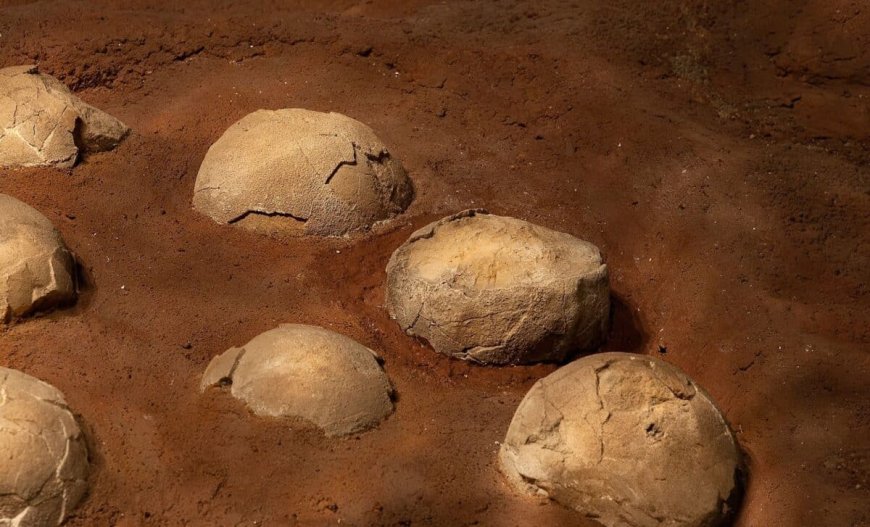
Fossilized dinosaur eggshells may hold the key to determining when surrounding rocks and fossils were buried. A study published in Nature Communications Earth & Environment reports that uranium-lead dating of eggshells can produce ages that closely match independently dated rock layers. For paleontologists, that is no small development.
Dating dinosaur remains has long been a complicated exercise. Sedimentary rock layers represent distinct intervals of geologic time, yet pinning down their exact age, or that of the fossils trapped inside has often proven unreliable.
The new research shifts attention away from bones and toward calcified shells. Led by paleontologist Ryan Tucker of Stellenbosch University, the team investigated whether the microscopic structure of eggshell calcium carbonate could preserve isotopic signatures well enough to function as a geological clock.
A Crystalline Structure That Records Burial History
Vertebrates have laid calcified eggs for hundreds of millions of years, although the earliest dinosaur eggs were soft-shelled. What makes later fossil eggshells particularly useful is their crystalline microstructure. The arrangement of calcium carbonate crystals captures a record of diagenesis; the physical and chemical changes that occur as sediments harden into rock.
Water infiltration, sediment compaction, and the formation of microfractures leave identifiable traces. These features, the researchers explain, allow scientists to evaluate how well an eggshell has been preserved before attempting uranium-lead radioisotopic dating. In other words, the shell itself carries clues about whether it has remained chemically stable over time.
By measuring the ratio between uranium and lead and accounting for their half-lives, scientists can calculate a sample’s age. The method can date materials from about one million years old to roughly 4.5 billion years.

Two Sites, Continents Apart
To test the reliability of eggshell dating, the team examined samples from two Cretaceous locations separated by thousands of miles. One group came from the Deep Eddy site in Utah’s Cedar Mountain Formation, where surrounding volcanic ash beds had already been dated using zircon crystals. The eggs are thought to belong to Macroelongatoolithus carlylei, likely laid by an oviraptor species.
The second set originated from the Teen Ulaan Chaltsai region in Mongolia’s Eastern Gobi Basin. These eggs were possibly laid by small, birdlike theropods known as microtroodontids. Their age had previously been estimated, but uncertainty lingered.
According to findings reported in Nature Communications Earth & Environment, uranium-lead dating determined that the Utah eggshells were approximately 95 million years old. The result aligned with expectations: rock beneath the clutch was older, while rock above was younger. The Mongolian samples also yielded ages extremely close to those of the surrounding bedrock.

A Meteor Signature In The Mix
One detail from the Mongolian site stood out. Trace element analysis suggested that a meteor may have fallen to Earth around 99 million years ago, close to the time the eggs were buried. As explained in the study, if no direct impact occurred at that specific site, meteor dust was likely already present in the sediment covering the eggs.
It is a small but intriguing reminder that local fossil beds can carry traces of broader planetary events. As Ryan Tucker stated in the publication,
“This study demonstrates that eggshell biocalcite from non-avian dinosaurs, birds, and other egg-laying vertebrates has the potential to serve as a reliable geochronometer in Mesozoic and Cenozoic terrestrial sedimentary basins.”
For fossil sites whose ages remain uncertain, the answer may lie not in the bones themselves, but in the fragments of shell once designed to shield developing embryos.
Enjoyed this article? Subscribe to our free newsletter for engaging stories, exclusive content, and the latest news.
What's Your Reaction?
 Like
0
Like
0
 Dislike
0
Dislike
0
 Love
0
Love
0
 Funny
0
Funny
0
 Angry
0
Angry
0
 Sad
0
Sad
0
 Wow
0
Wow
0