



























The rock looked ordinary on camera — then its chemistry didn’t match anything else on Earth

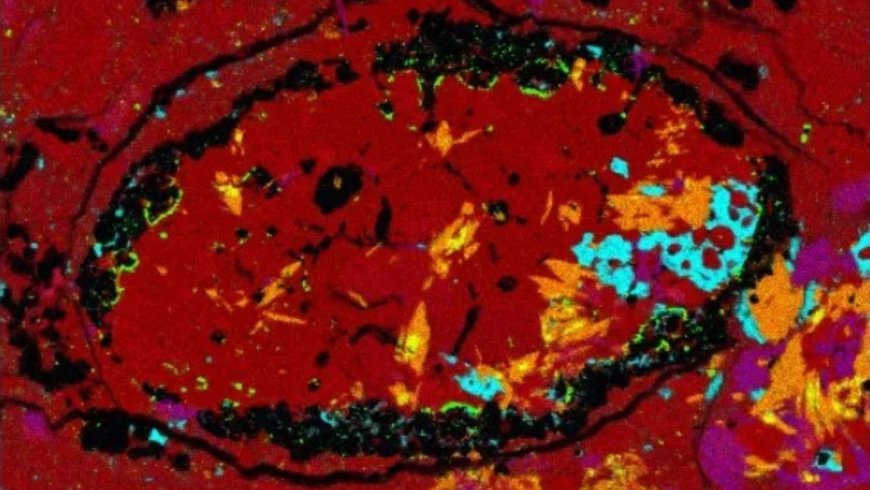
It started with a rock that didn’t look like a big deal. Just a dark lump in the Sahara. The kind of thing you could walk past without slowing down. Then labs ran the numbers. And the rock refused to fit in.
A stone that wouldn’t behave
Plenty of meteorites get found in deserts. Dry air helps them last. People pick them up, sell them, study them. Most end up telling familiar stories about the early Solar System.
This one played the same part at first. A chunk called Erg Chech 002 (EC 002), found in Algeria in 2020, looked like a normal space rock: dark, dense, and quietly dramatic in that “older than everything” way.
Then researchers looked closer and saw the first problem. Its minerals suggested it formed from melted rock, like volcanic stuff. But its exact blend was… off. Too clean in some places, and too weird in others.
The desert find with an uncomfortable timeline
Age matters with meteorites. Not in a museum-label way. In a “were you around before the planets finished building themselves?” way.
When scientists date igneous meteorites (rocks that were once molten), they’re usually looking at bodies that formed, melted, cooled, and got smashed apart in the Solar System’s first chaotic moments.
EC 002 seemed to come from a world that melted early and cooled fast. That’s already a little eerie: a whole planetary crust forming, hardening, and then vanishing long before Earth really got going.
But the real tension wasn’t just its age. It was the feeling that this rock carried a recipe that should have been common… and yet almost never shows up.
The finding: a missing kind of crust from the early Solar System
In the study, researchers showed that EC 002 is an andesitic rock from an ancient, differentiated body—basically, a small planet or protoplanet that had already sorted itself into layers and built a crust.
Andesitic rocks are a big deal on Earth because they’re tied to the kinds of volcanism that build continents. But outside Earth, they’re rare. Most meteorites we find are more like basalt—simpler chemistry, more common in early rocky worlds.
EC 002 points to something scientists call a “missing reservoir”: an early generation of crust that formed in the young Solar System and then largely disappeared. Not because it never existed—because it likely got ground up by impacts or swallowed back inside its parent body, leaving almost no trace.
In other words, this rock may be a surviving chip from a type of early planetary crust that was once widespread, then erased.
Why this matters now
EC 002 tweaks a deep assumption: that early rocky bodies mostly made simple, basalt-like crust, and more complex crust was a later Earth specialty.
If andesitic crust formed early on other bodies too, then the early Solar System may have produced more “Earth-like” chemistry than we thought—just not for long. The evidence may have been destroyed, hidden, or recycled until it was gone.
It also changes the vibe of meteorite hunting. A desert rock isn’t just a souvenir from space. It can be a single surviving page from a book that got burned.
And it’s a reminder that some of the Solar System’s biggest events don’t leave neat monuments. Sometimes they leave one stubborn stone that doesn’t match anything else on Earth.
What's Your Reaction?
 Like
0
Like
0
 Dislike
0
Dislike
0
 Love
0
Love
0
 Funny
0
Funny
0
 Angry
0
Angry
0
 Sad
0
Sad
0
 Wow
0
Wow
0