

























Scientists Thought Dinosaurs Moved Alone, But New Footprints Found in Alberta Say Otherwise

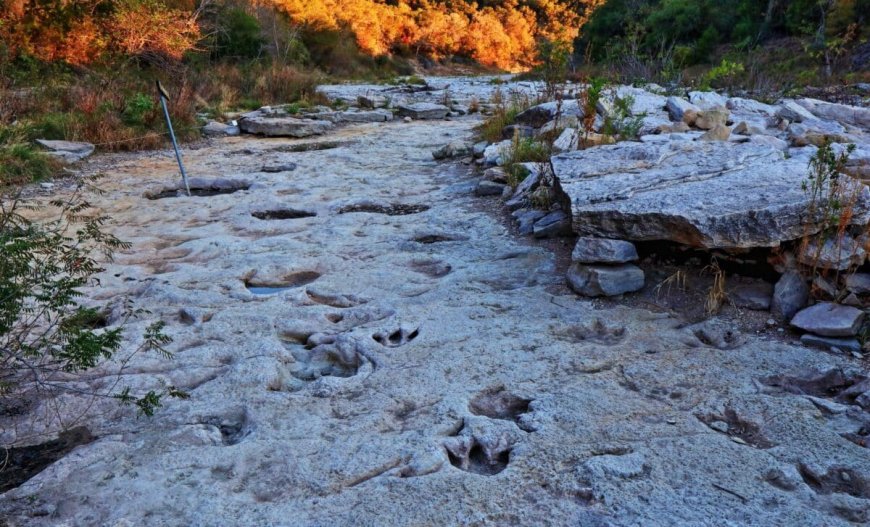
Fossil footprints discovered in Alberta show that several dinosaur species crossed the same area within a limited time span. The site includes tracks from herbivores and large predators, preserved in sediment dating back approximately 76 million years. The arrangement of these prints provides direct evidence of movement rather than inference based on skeletal remains.
Located in Dinosaur Provincial Park, the site has long been studied for fossilized bones. Footprints, by contrast, have received less attention despite their ability to record behavior. In this case, a distinct surface pattern led researchers to re-examine what had previously been overlooked.
The findings, published in PLOS ONE, are based on the number, distribution, and morphology of the tracks. According to the study, multiple animals from different species moved across the same area within a relatively short timeframe, although the exact sequence remains uncertain.
A Footprint Identified During Field Observation
The discovery began when Dr. Phil Bell noticed an unusual rock surface resembling compacted mud. Based on the researchers, this feature was identified as a footprint from a ceratopsian, prompting a broader survey of the area.
“Using the new search images for these footprints, we have been able to discover several more track sites within the varied terrain of the Park, which I am sure will tell us even more about how these fascinating creatures interacted with each other and behaved in their natural environment,” he said.
The team documented around 13 footprints within approximately 29 square meters. These were attributed to at least nine individuals from four species, based on size, shape, and spacing of the impressions.

Overlapping Paths of Herbivores
Five of the footprints were assigned to ceratopsians. Their alignment and direction indicate that these individuals moved in the same direction. As explained in the study, this pattern is consistent with group movement within a single species.
Tracks attributed to ankylosaurids appear along the same path. The research notes that the route followed by these animals overlaps with that of the ceratopsians. It does not confirm that both species moved together, only that they used the same route within a limited time window.

Tracks Left by Large Predators
Three larger footprints were identified as belonging to tyrannosaurs. Their size and shape distinguish them from the herbivore tracks. The latest research showed that it is not possible to determine whether these predators were following the herbivores or simply crossing the area independently.
“The tyrannosaur tracks give the sense that they were really eyeing up the herd, which is a pretty chilling thought, but we don’t know for certain whether they actually crossed paths,” said Dr. Bell.
Sediment conditions indicate that the surface could retain footprints only briefly. This suggests that all identified species passed through the area within a constrained period. The data support temporal proximity but do not establish direct interaction between the animals.
“This discovery shows just how much there is still to uncover in dinosaur paleontology. Dinosaur Park is one of the best-understood dinosaur assemblages globally, with more than a century of intense collection and study, but it is only now that we are getting a sense for its full potential for dinosaur trackways,” concluded Dr. Caleb Brown from the Royal Tyrrell Museum of Palaeontology.

Enjoyed this article? Subscribe to our free newsletter for engaging stories, exclusive content, and the latest news.
What's Your Reaction?
 Like
0
Like
0
 Dislike
0
Dislike
0
 Love
0
Love
0
 Funny
0
Funny
0
 Angry
0
Angry
0
 Sad
0
Sad
0
 Wow
0
Wow
0