



























Rare pink rocks are emerging from the ground in Antarctica, and researchers believe a hidden island may lie beneath the ice

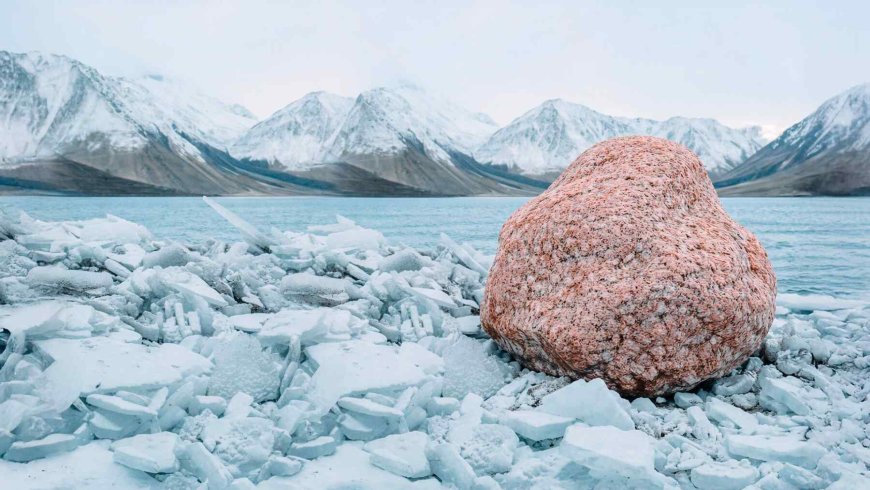
Antarctica is easily one of the most mysterious continents on the planet.
For as long as mankind has been exploring the world, the Antarctica continent has been shrouded in mystery. The latest discovery made has seen rare pink rocks emerging from the ground in the iconic cold part of the world. The question is why?
What could be the origin of these odd and rare pink rocks in Antarctica?
What mysteries have been explained in Antarctica over the last century
The extraordinary discoveries made over the last century in Antarctica have boggled the mind.
Such as the “ghost” mountains discovered in 1958. Researchers found evidence of a massive mountain range the size of the European Alps entirely buried under miles and miles of ice in Antarctica.
Recent data have suggested that these “ghost mountains” were formed by ancient continental collisions millions of years ago and preserved in the ice.
Scientists have also found evidence of the remarkable and unique microbial ecosystem that survives in Antarctica without sunlight or even oxygen. This provides a model for how microscopic life could exist on icy moons in the universe.
Science has shown that life on Earth is complex and adaptable
Humans have a deep-rooted need to understand the world around us.
Many millions of people have dedicated their entire lives and careers to understanding how life ticks on our one and only home in the cosmos. And as our technology and scientific prowess enhance, we are making new discoveries about the world and life on it at a rapid pace.
Such as how krill trawlers around the South Orkneys are wreaking havoc on whales in the region.
But animal life is not the only part of our world that science has been studying for decades. Life has been boiling away on Earth for millions of years, and recent discoveries may have proven that our planet was once far different than what it is now.
Researchers have found that early life was breathing oxygen long before it filled our atmosphere roughly 500 million years ago.
As we know, Antarctica is an inhospitable part of the world, meaning that studying it requires either decades-long commitments or new technology that allows researchers to study the region without having to actually set foot there.
So what have the teams of researchers found in the infamously cold part of the world?
A recent study, “These strange pink rocks just revealed a hidden giant beneath Antarctica,” published by the British Antarctic Survey via ScienceDaily, has detailed the latest discovery on the Antarctica continent.
Researchers have found odd pink rocks emerging from the ground in Antarctica
Geological research has unearthed some astonishing facts about the planet we live on.
Such as the recent discovery of a massive freshwater reservoir directly underneath the Great Salt Lake in Utah. But when researchers turned their attention to Antarctica, they never would have expected to find oddly colored rocks emerging out of the Hudson Mountains.
Science has taught us that rocks can come in a variety of shapes, sizes, and colors.
New geological research conducted in Antarctica has found a massive hidden granite formation beneath Antarctica’s Pine Island Glacier. Researchers found pink granite boulders atop a mountain in the region.
By analyzing them, the team found that the formation of these pink rocks came during the Jurassic period.
The team used gravity mapping to analyze the formation and concluded these oddly colored rocks are millions of years old and have been patiently waiting for us to discover them.
Scientific research has made studying our planet that much easier in recent years.
Such as the discovery of 500-million-year-old rocks that give off a strange magnetic signal. But this discovery in Antarctica proves that we have many secrets to unearth about our planet in the years and decades to come.
What's Your Reaction?
 Like
0
Like
0
 Dislike
0
Dislike
0
 Love
0
Love
0
 Funny
0
Funny
0
 Angry
0
Angry
0
 Sad
0
Sad
0
 Wow
0
Wow
0