
























No Way Back: Meet Chrysalis, the 36-Mile Interstellar Ship Engineered to Carry 1,000 People Far Beyond Earth… Forever

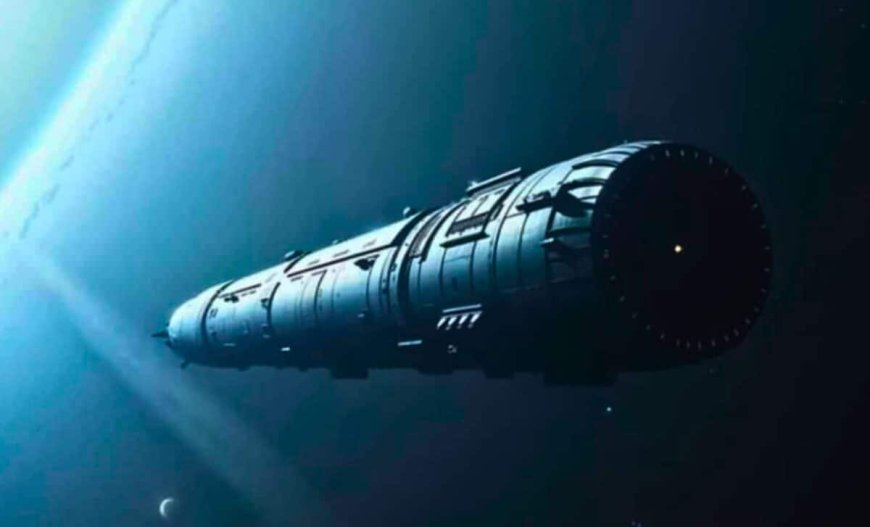
A spacecraft that spins to create its own gravity. A closed ecosystem where 1,000 people grow their own food and recycle their own air. A journey lasting two and a half centuries with no option to turn back.
This is Chrysalis, a generation ship concept designed to carry humans across the void between stars. The proposal, developed for the Project Hyperion Design Competition, outlines a 36-mile-wide rotating habitat capable of sustaining a population of 1,000 on a roughly 250-year voyage to a neighboring star system. Unlike conventional spacecraft that serve as temporary transports for small crews, Chrysalis reimagines interstellar travel as a permanent way of life.
The design team, which includes Andreas M. Hein of the University of Luxembourg and designer Frederic Spiedel, approached the problem from an unusual angle. Instead of engineering a spacecraft for a defined mission with a clear endpoint, they imagined a settlement that happens to travel through interstellar space.
According to the team’s official statement published by Project Hyperion, “Chrysalis is thought as a dual space: as a physical environment for the body survival and as a cyberspace and metaverse to free the inhabitant minds from the confinement inside a spaceship in the void of space.”
Why This Ship Must Spin
Extended weightlessness wrecks the human body. Bone density plummets as calcium leaches from the skeleton. Muscles atrophy without constant resistance. The cardiovascular system weakens, and fluids shift upward, causing pressure on the eyes and brain. Astronauts on the International Space Station combat these effects with hours of daily exercise, but for a multi-generational voyage, exercise alone cannot suffice.

Chrysalis addresses this through artificial gravity generated by rotation. Centrifugal force pushes inhabitants outward against the ring’s interior wall, mimicking the sensation of standing on Earth. A detailed explanation from ABC Science on spinning spacecraft notes that smaller rotating habitats must spin faster to generate the same force, which can cause motion sickness and uncomfortable gravity differences between head and feet. If your head experiences significantly less force than your feet, blood pools in the lower body and disorientation follows.
Chrysalis solves this by increasing the diameter of the rotating section dramatically. A larger ring rotates more slowly while maintaining a stable Earth-like environment across the entire body. The 36-mile scale is not architectural excess. It is a physiological requirement for comfortable long-term habitation under artificial gravity. The slow rotation rate reduces the Coriolis effects that would otherwise make walking or simply turning one’s head a nauseating experience.
A Forest Inside a Starship
The interior of Chrysalis is not a sterile metal tube. Agricultural zones and communal spaces are arranged to resemble natural landscapes wherever possible. Vertical farming arrays grow crops under controlled lighting spectrums optimized for photosynthesis. Those crops feed the population while simultaneously producing oxygen. Carbon dioxide exhaled by residents feeds the plants in return. Organic waste breaks down into nutrients that replenish the soil.
The Project Hyperion documents describe this as a fully integrated environmental loop. Nothing is wasted. Nothing arrives from outside. The system must remain stable for centuries without intervention from Earth. A crop failure, a pathogen outbreak, or a disruption in the nitrogen cycle could cascade into catastrophe. Ecological balance becomes as critical to mission success as propulsion engineering.

Designers also considered the psychological needs of people who would spend their entire lives inside the vessel. Green spaces, varied terrain, and sightlines that suggest openness all contribute to a sense of place rather than imprisonment. The team’s statement acknowledges that “the phenomenological aspect of living and dwelling in the deep space, what is experienced, the psychological meaning of being a creature of the Cosmos is central in the design.”
Water shielding serves double duty. Massive reservoirs positioned around the habitat’s outer layers protect inhabitants from deep space radiation, absorbing high-energy particles that would otherwise penetrate the hull and damage living tissue. The same water that sustains life also shields it.
Assembling a City Where Gravity Balances
Chrysalis cannot launch from Earth. The energy required to lift a 36-mile structure through the atmosphere exceeds any propulsion system ever built. Instead, the concept assumes assembly in space at the Earth-Moon L1 Lagrange point.
According to NASA’s explanation of these orbital positions, Lagrange points are locations where gravitational forces of two large bodies balance with orbital motion. A spacecraft parked at such a point can maintain position with minimal fuel consumption, making these regions ideal for long-term construction projects. The L1 point between Earth and the Moon offers a stable construction zone where components launched separately could rendezvous and gradually assemble into the full vessel over many years.
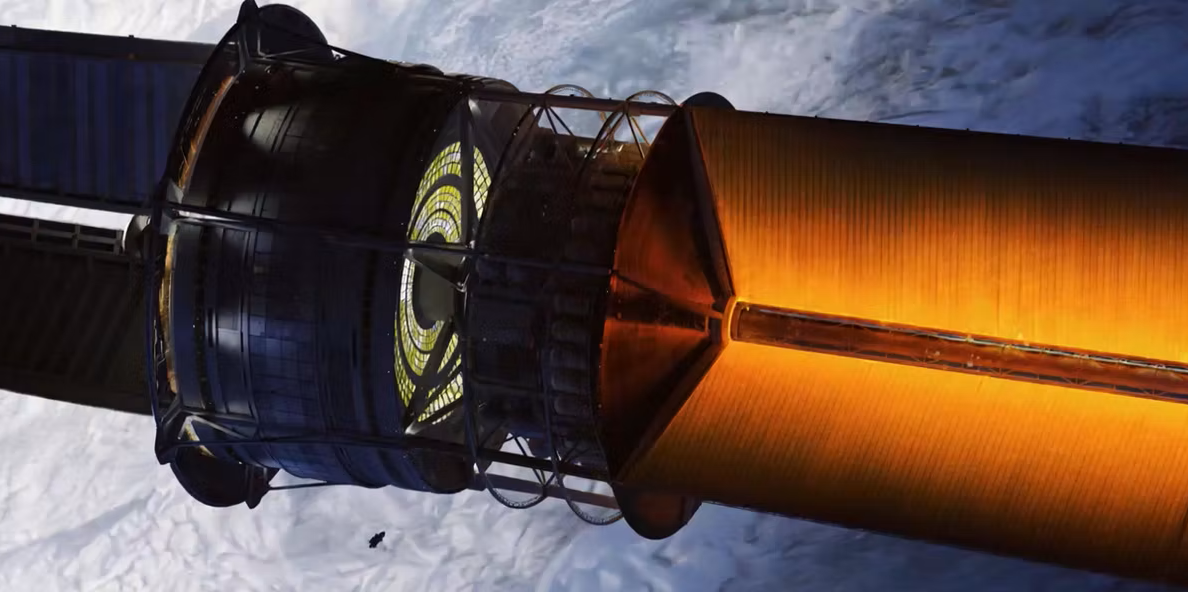
Materials procurement presents another layer of complexity. The Project Hyperion documents explore sourcing resources from lunar regolith or near-Earth asteroids to reduce the mass that must be lifted from Earth’s gravity well. After construction completes, Chrysalis would depart the solar system using nuclear thermal propulsion, which provides greater efficiency than conventional chemical rockets.
Generations Born in the Void
The ship’s inhabitants will never see Earth. Children born aboard will inherit responsibility for maintaining systems their grandparents designed. Skills must transfer across generations without gaps. Knowledge must persist without the institutional backup of a planetary civilization.
The competition required teams to address governance, education, and knowledge preservation across multiple generations. How does a society of 1,000 people govern itself without emigration or external intervention? These questions receive as much attention in the design documents as the engineering specifications.
Educational facilities, research areas, and community spaces are built into the habitat layout. Robotic maintenance systems inspect the hull and repair mechanical faults without exposing humans to the vacuum of space. The Project Hyperion team describes “a living spaceship where humans, robots and artificial intelligent agents share information, experiences and decision-making processes.”
Enjoyed this article? Subscribe to our free newsletter for engaging stories, exclusive content, and the latest news.
What's Your Reaction?
 Like
0
Like
0
 Dislike
0
Dislike
0
 Love
0
Love
0
 Funny
0
Funny
0
 Angry
0
Angry
0
 Sad
0
Sad
0
 Wow
0
Wow
0