



























NASA Wants to Build a $2.6 Billion Giant Telescope on the Moon’s Far Side to Escape Earth’s Growing Signal Noise

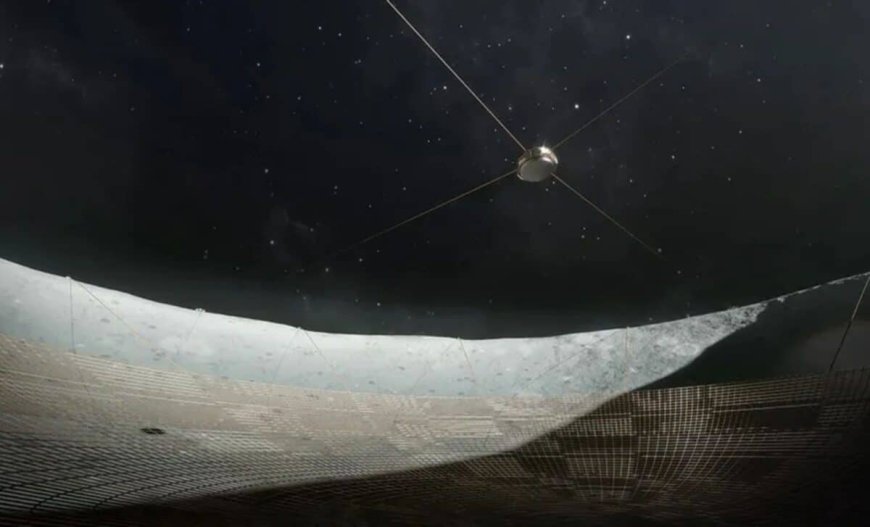
NASA is seriously looking at building a huge radio telescope on the far side of the Moon. The goal is to get away from all the interference around Earth and listen to the universe more clearly.
The project is called the Lunar Crater Radio Telescope (LCRT). It has been in the works for a few years and is now getting closer to a key decision. If it gets the green light, it could be built in the 2030s using robots, with a price tag of more than $2 billion.
Building A Massive Dish In A Lunar Crater
The plan is to use a natural crater on the Moon’s far side and turn it into a giant radio dish. As explained by the NASA, cables would hold up a wire mesh, creating a structure about 350 meters wide. That would make it bigger than the old Arecibo Observatory, though still smaller than China’s FAST telescope. The U.S Space Agency also added that:
“This Lunar Crater Radio Telescope (LCRT), with 1km diameter, will be the largest filled-aperture radio telescope in the Solar System! LCRT could enable tremendous scientific discoveries in the field of cosmology by observing the early universe in the 10-50m wavelength band.”
Everything would be built by robots, since sending humans for construction would be far more complex. According to Live Science, teams at NASA’s Jet Propulsion Laboratory (JPL) are already working on a 200:1 scale prototype that will be tested in California.
So far, the project has gone through early funding stages with NASA’s Institute for Advanced Concepts. It received $125,000 in phase I and $500,000 in phase II. The next step is phase III, which could turn the concept into a full mission.

Escaping The Noise From Earth And Its Satellites
The far side of the Moon is one of the quietest places for radio signals anywhere near Earth. It blocks signals coming from our planet, including interference from satellites and even some solar noise. That is becoming a bigger deal every year. Satellite constellations like SpaceX’s Starlink are expanding fast. According to astronomers cited by the same source, these satellites can leak radiation that interferes with radio telescopes.
“It would mean that we are artificially closing ‘windows’ to observe our universe,” said Federico Di Vruno, from the Square Kilometer Array Observatory.
Even then, one telescope would not replace everything we have on Earth. It would mainly protect access to certain signals that might otherwise disappear.

Picking Up Signals We Cannot Detect On Earth
One of the main reasons scientists are excited about LCRT is that it could detect ultra-long wavelength signals, meaning anything longer than 10 meters. These signals are mostly blocked by Earth’s atmosphere, so they are very hard to study from the ground. On the Moon, that limitation disappears. These wavelengths are important for studying the cosmic dark ages, the time before the first stars formed. Researcher Gaurangi Gupta explained that:
“During this phase, the universe primarily consisted of neutral hydrogen, photons and dark matter, thus it serves as an excellent laboratory for testing our understanding of cosmology.” Gupta added, “Observations of the dark ages have the potential to revolutionize physics and cosmology by improving our understanding of fundamental particle physics, dark matter, dark energy and cosmic inflation.”
There have already been some early tests. In 2024, NASA sent the ROLSES-1 instrument to the Moon on the Odysseus lander. It did collect data, but since it was facing Earth, most of what it picked up came from our own planet. According to the same source, that result showed why the far side is so important. More missions are on the way, including Firefly Aerospace’s Blue Ghost II, which will carry another radio experiment.
Enjoyed this article? Subscribe to our free newsletter for engaging stories, exclusive content, and the latest news.
What's Your Reaction?
 Like
0
Like
0
 Dislike
0
Dislike
0
 Love
0
Love
0
 Funny
0
Funny
0
 Angry
0
Angry
0
 Sad
0
Sad
0
 Wow
0
Wow
0