





























Marine scientists began detecting a strange “acoustic fog” near New York until they saw whales fleeing the area in large numbers

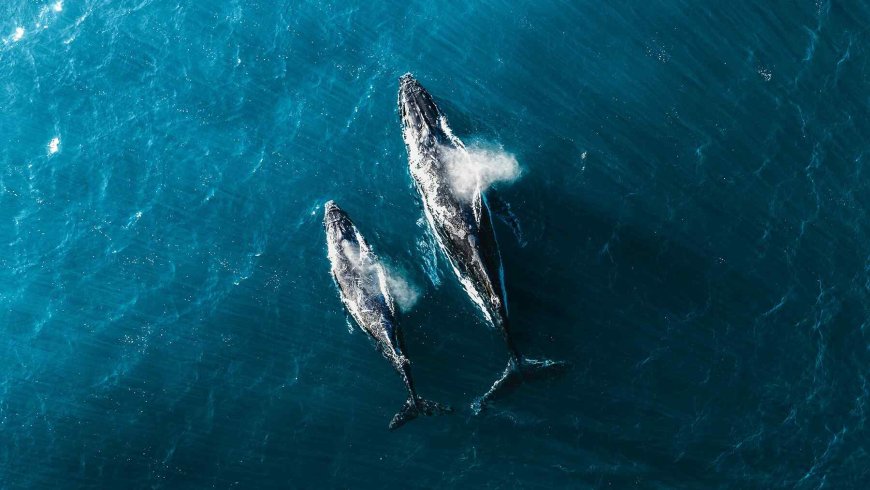
The world of animal life on Earth has been a major focus for researchers for decades.
Mankind has been studying the world of life around us for as long as we have existed as an intelligent species. So, what pretell is this strange acoustic fog that has been detected by marine scientists near New York, and why are large numbers of whales fleeing the area?
How can significant numbers of whales simply flee such a rich and diverse area for marine life?
How studying whales has revealed some interesting behaviors
Through decades of study, marine scientists have found that whales exhibit a wide range of sophisticated social, cognitive, and survival behaviors that mimic humans.
Such as the fact that sperm whales often rely on other “babysitters” to protect their young.
We have also come to understand that the very “language” that whales use to communicate can change, much like our own languages do too. Humpback whales have been found to evolve their “songs” depending on what region of the world they are originally from.
This led to the discovery of “cultural revolutions” that see entire whale populations abandoning old songs for new ones.
The study of marine life has led to some astonishing truths being revealed
Our ability to study the molecular forms of life around us has led to some amazing and unexpected discoveries about our planet.
Such as the recent rediscovery of parasites in a can of salmon, which proves that as life repopulated the ocean after decades of devastation by humans, our collective archives of information regarding marine life needed to be updated.
New frontiers for ecological research are being found and developed nearly every day in modern-day society.
We have come to understand over the last few decades of study that life is adaptable. Constantly changing to reflect its surroundings is a factor of life on Earth. And the ocean is the unequivocal boiling pot for life on our planet.
A recent review of thousands of hours of underwater footage has revealed that some species exhibit remarkably similar behavior to us humans.
One specific study, “Seasonal and diel acoustic activity of sei whales (Balaenoptera borealis) in the New York Bight,” published in Nature, has attempted to detail how a strange “acoustic fog” has been detected in one of the most active regions in the world for marine life.
Study reveals that whale activity is directly linked to ocean temperatures
The New York Bight is a triangular indentation of the Atlantic Ocean along the East Coast of the United States.
It extends from Cape May, New Jersey, to Montauk Point in Long Island. It holds a diverse world of marine life, ranging from microscopic plankton to some of the largest marine mammals in the world.
Our industrial progression as a society has come at a significant cost for animal life and our environment overall.
However, thanks to substantial conservation efforts, many species have been brought back from the brink of extinction in recent years. Like a crocodile that has repopulated Laos, thanks in no small part to local conservationists.
Researchers have found that the critically endangered sei whales in the New York Bight have been expressing themselves in “acoustic activity” in the region.
The study found that this acoustic activity is more prevalent during spring and leads to higher vocalization rates during daylight hours. As our planet heats up due to our impact via climate change, these Sei Whales are leaving the New York Bight rapidly as sea surface temperatures increase.
The study provides critical data for conservation efforts in one of the most diverse marine and high-traffic maritime regions of the world.
What's Your Reaction?
 Like
0
Like
0
 Dislike
0
Dislike
0
 Love
0
Love
0
 Funny
0
Funny
0
 Angry
0
Angry
0
 Sad
0
Sad
0
 Wow
0
Wow
0