




























It’s the crown jewel of solar energy — Experts put gold on solar panel… and something strange happens

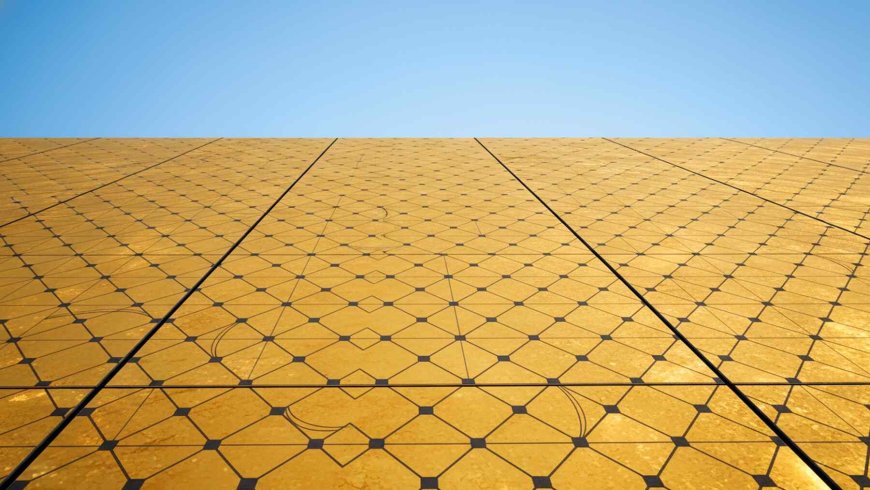
Even solar panels are becoming obsolete: we need something more.
Today’s solar panels—mostly made from silicon—are good, but they’re bumping up against limits scientists have been chasing for years.
Researchers everywhere are trying to find materials that absorb sunlight better, convert it into electricity more efficiently, and can be made practically and affordably. That’s the core challenge pushing solar research forward: higher performance without prohibitive cost or complexity.
A big part of that search has focused on a class of materials called perovskites. These crystalline compounds are cheap to produce and excellent at capturing light and turning it into electrical energy—so much so that labs around the world are racing to overcome the main flaw holding them back: long-term stability.
For decades, metals like gold have largely stayed on the sidelines of solar tech. Gold is chemically stable and conductive, but it’s expensive and has been thought of as impractical for large-scale energy production. Traditionally, gold shows up in solar systems only in small roles—like conductive contacts—because of that perceived mismatch.
So the big question has been: how do you combine the low cost and efficiency promise of perovskites with materials that offer new functionality without breaking the economics or adding instability?
Gold in solar panels: Who would have imagined it?
Enter a surprising twist.
A team of researchers at Stanford University found a way to stabilize a form of gold that doesn’t normally exist.
But this team figured out how to trap it within a perovskite lattice using simple room-temperature chemistry—you don’t need extreme heat or exotic machinery.
Why does that matter?
Because embedding this unusual form of gold into a perovskite doesn’t just change the chemistry—it could change how the material absorbs, moves, and responds to energy. That’s the tantalizing part. And here’s the tension: this isn’t just tweaking an old recipe. It’s creating a material showing electronic and magnetic behavior not normally seen in conventional solar materials.
Up until now, most perovskite solar research has targeted efficiency and stability separately—but this approach throws both challenges into a new light.
It’s a giant leap forward, just like this other technology that makes light “explode.”
This solar panel wins the “gold medal”
Here’s the breakthrough in plain terms: Stanford chemists have created a gold-infused halide perovskite material containing a stable Au²⁺ oxidation state—something chemists thought was too unstable to isolate in a solid material.
This material isn’t just a lab curiosity. It absorbs light efficiently, conducts electrons more effectively, and forms at room temperature from readily available chemicals without the intense energy inputs used for traditional silicon or even most perovskite cells.
In other words, scientists aren’t just pushing the edge of material science—they’re redefining what kinds of chemistry could power the next generation of solar panels.
Who would have thought that even solar panels would like gold? This opens access to electronic and magnetic behaviors researchers couldn’t reliably harness before — creating real opportunities for new light-emitting devices, sensors, and advanced components.
You won’t see gold-based solar panels on rooftops overnight. But this breakthrough forces a rethink of what gold can actually do inside energy systems.
For decades, gold’s value was symbolic — beauty, rarity, permanence. Now its value may become technical. Functional. Strategic.
If this momentum continues, gold won’t just sit at the top of the periodic table as a luxury metal. It could help anchor the next phase of clean energy innovation.
And that’s a shift few people saw coming. Just like this dark side of solar power, which reaches 250 million tons.
What's Your Reaction?
 Like
0
Like
0
 Dislike
0
Dislike
0
 Love
0
Love
0
 Funny
0
Funny
0
 Angry
0
Angry
0
 Sad
0
Sad
0
 Wow
0
Wow
0