





























Hidden for 1,600 Years, a Diver Accidentally Found 50,000 Roman Coins Beneath the Seafloor

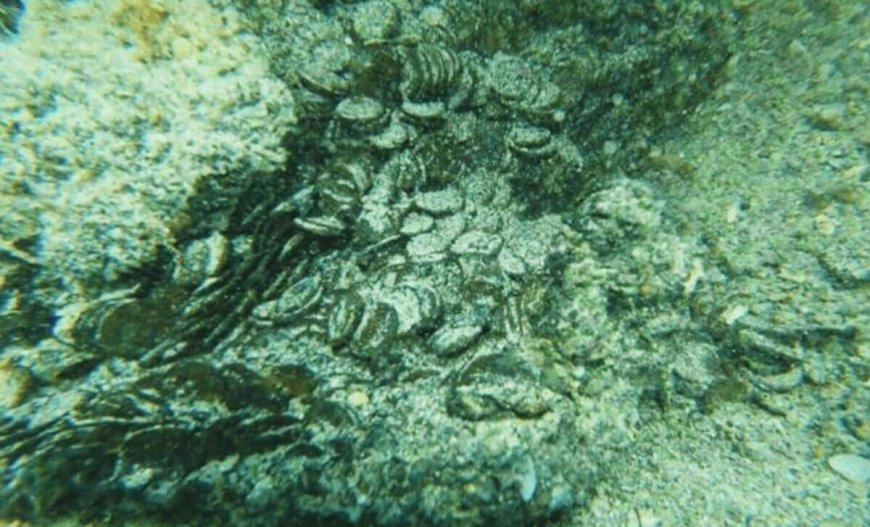
The seabed off Sardinia’s northeast coast held its secret for 1,686 years. Then an amateur diver, searching waters known more for scattered wreck debris than structured deposits, encountered a concentration of bronze objects the Italian government now confirms exceeds 50,000 specimens.
What the diver found in late 2024, and what recovery teams spent the final quarter of 2025 extracting, was not a shipwreck. No hull structure has been located. Instead, investigators from the Ministero della Cultura documented ceramic transport amphorae fragments, iron nails, packing residues, and a dense mass of fourth century Roman nummi arrayed across the seafloor in patterns that suggest rapid, permanent sealing rather than gradual dispersal.

Italy’s national heritage agency has classified the deposit as the largest maritime Roman coin hoard ever recovered in the Mediterranean and one of the best preserved in Europe. The designation carries an implicit puzzle. The coins are uncorroded. The ship is missing. And the cargo, based on mint marks and iconography, was assembled between 324 and 340 AD, a period when the bronze currency Diocletian had designed to stabilize the empire was instead losing confidence faster than vessels could transport it.
What 50,000 Bronze Discs Reveal
The assemblage consists almost entirely of bronze nummi, the denomination introduced under Diocletian’s monetary reorganization of 294 AD and struck in vast quantities throughout the Constantinian dynasty. Officials from the Ministero della Cultura reported that the coins bear imagery consistent with standard fourth century emission series: Sol Invictus, the Chi-Rho Christogram, imperial fortresses, and victory motifs. Mint marks indicate production facilities in Gaul and the eastern Mediterranean, suggesting the cargo aggregated fiscal transfers from multiple provincial treasuries.
Fragments of the transport vessels recovered with the hoard are consistent with Roman amphorae typologies documented in the Classical Art Research Centre’s reference archive at Oxford University. The containers would have been stacked in a vessel’s hold, their pointed bases secured in dunnage or fitted into receptacles. Iron nails and residual packing materials were present in sufficient quantity to confirm maritime conveyance but insufficient to identify vessel type, tonnage, or ownership.

The Italian Ministry of Culture has classified the entire hoard as state property under national cultural patrimony statutes, with details available through the Ministero della Cultura official portal. No private claims have been registered. Conservation and attribution work continue at national laboratories, with select specimens expected to transfer to regional museums after 2026.
The Seagrass Vault
The hoard’s condition cannot be explained by coin metal composition alone. Fourth century nummi carried only unstable silver surface treatments, which metallurgical analysis published in Heritage Science in 2019 confirmed typically degrade within decades under normal burial conditions. The Sardinian specimens retain these surfaces.
Researchers from Italy’s heritage authority determined the deposit site lies within an extant meadow of Posidonia oceanica, a seagrass species whose sedimentary dynamics have become the subject of intensified archaeological attention.

A 2018 paper in Ambio, accessible through the National Institutes of Medicine archive, documented that Posidonia meadows function as what the authors termed “security vaults” for submerged cultural heritage. The seagrass root mat traps sediment, elevates the seafloor, and maintains anoxic conditions that inhibit electrolytic corrosion of nonferrous metals.
The report notes that sediment accumulation rates in such meadows range from 0.6 to 5 millimeters annually. Based on these parameters, the Sardinian deposit would have been completely sealed within two to three decades of deposition. The coins were not merely preserved. They were entombed.
Britain’s Buried Payroll, Sardinia’s Lost Freight
Terrestrial hoards of comparable period and composition provide contrast. The Seaton Down Hoard, discovered in Devon, England in 2013 and subsequently analyzed by the Royal Albert Memorial Museum, contained 22,888 nummi buried in a single leather sack near a Roman waystation. A detailed examination of the Seaton Down Hoard published in 2017 confirmed the last coins were dated to 348 AD.
Thomas Cadbury, assistant curator at the museum, stated in the same report that “the lowest paid agricultural labourer was probably only paid about one nummus a day.” Two nummi purchased a flagon of the poorest quality Roman wine. Better quality wine cost eight.

The Seaton Down coins were produced in mints as distant as Syria, Egypt, and Turkey, though the majority originated in Gaul. Their find location, three hundred meters from a substantial Roman site, suggested to investigators that the hoard represented accumulated payroll or estate reserves.
Cadbury noted that the burial coincided with the period when Emperor Constantius II dispatched the notary Paulus Catena to Britain to hunt supporters of the usurper Magnentius. “Perhaps this hoard belonged to one such supporter,” a commenter on the museum’s analysis later wrote, “and it remained buried simply because the owner didn’t survive Catena’s bloody, maniacal purge.”

The Sardinia hoard differs in every contextual particular. It is maritime. It is twice the size. It shows no evidence of owner intent to recover. And it lacks the political specificity that attaches to the British deposit.
When the Coinage Lost Faith
The nummus was conceived as solution. Diocletian, who ruled from 284 to 305 AD, inherited an empire whose silver coinage had been debased to the point of market rejection. A comprehensive overview of Diocletian’s reforms by historian Ralph W. Mathisen records that the emperor “attempted to address rampant inflation and economic decline with measures like the Maximum Price Edict, though these efforts yielded mixed results.” The edict failed. The gold and silver issues Diocletian attempted to reintroduce could not be sustained at scale.
What survived was the bronze nummus, its face value maintained by imperial decree rather than metallic content. The Sardinia hoard, minted a full generation after Diocletian’s abdication, represents the mature phase of this experiment. By 340 AD, based on economic historians’ reconstructions, currency confidence had eroded sufficiently that soldiers and civil servants received increasing portions of their compensation in kind: grain, oil, textiles, and other commodities delivered through the annona system.
The Sardinia deposit may represent an attempt to convert one form of state obligation into another. Officials leading the investigation have not ruled out that the vessel was transporting tax revenues toward distribution points, or that it was carrying coin already rejected by recipient populations in favor of commodity payments.
Enjoyed this article? Subscribe to our free newsletter for engaging stories, exclusive content, and the latest news.
What's Your Reaction?
 Like
0
Like
0
 Dislike
0
Dislike
0
 Love
0
Love
0
 Funny
0
Funny
0
 Angry
0
Angry
0
 Sad
0
Sad
0
 Wow
0
Wow
0