



























From Concord to Kansas City: Henry David Thoreau’s Influence Ripples Throughout the Region

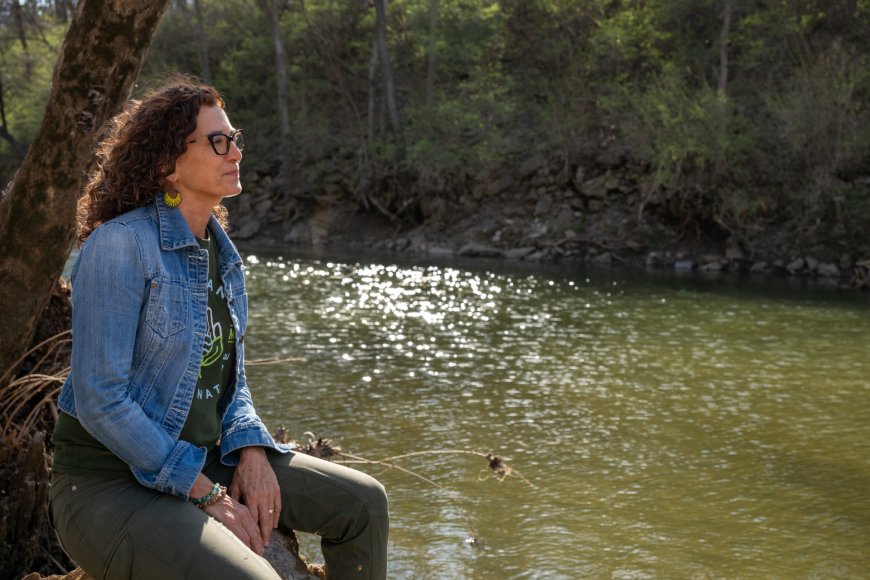

As a teenager, she sometimes would just walk.
Often, it was to escape the chaos and loneliness of being one of 11 children in her family.
“We had moved to the suburbs of Chicago, and we didn’t fit in,” Evelyn Vogel-Leutung said on a recent morning, standing on a perch overlooking the Blue River in South Kansas City.
“I was bullied and lonely. And so I just walked anyplace I could. There was a lot of undeveloped land there, and I remember finding a willow tree by a pond.
“And I would just sit there, reflecting as a 14-year-old.”
Years later, as a college student, she discovered an unlikely kindred spirit. That was the son of a Concord, Massachusetts, pencil factory operator who, some 130 years before, had found his own pond and built a cabin near it.
Ken Burns’ Three-Part Documentary on Henry David Thoreau Premiers Monday and Tuesday
Go here for more information about the documentary
The book about that experience, “Walden,” published in 1854 by Henry David Thoreau, reminded readers of the calm that could come by shedding the fatigue of their workaday existence for the benefits of being among trees, birds, and water.
“And I remember being really struck by ‘Oh, someone else knows the importance of finding that solitude.’”
So began a path that led Vogel-Leutung to a career with the U.S. Environmental Protection Agency. She spent much of her time promoting community-based environmental initiatives.
She helped institute what’s now called the Blue River Urban Waters Federal Partnership, “bettering urban rivers and working directly with communities to bring people back to those rivers on their own terms.”
Following her 2017 retirement, Vogel-Leutung has maintained her connection with the Blue River.
She has joined organized cleanups along the river corridor; the 36th Project Blue River Rescue is scheduled for April 4.
More often, she returns by herself to one of several favorite places along the river. If the conditions are just so, she walks down to the river’s exposed gravel bars.
“Sometimes I’ll take naps on the rocks,” she said. “It’s quiet and rejuvenating.”
Out East, Thoreau’s celebrated Walden Pond still exists.
The Concord, Massachusetts, preserve attracts visitors who inspect a replica of Thoreau’s cabin before hiking in the woods or swimming in the pond.
But no one has to drive to Walden Pond to discover what Thoreau found there, said Bill Graham, a retired Missouri Department of Conservation media specialist.
“Thoreau took time to look, admire, and think about what he saw, heard, smelled, and touched,” Graham said. “The beauty made him look more deeply, and he was moved in soul as well as mind.
“Anyone can do this, anywhere in nature. Nature is always in motion through the season’s changes, and there is so much diversity in shape, texture, and color — plus creatures — in any wild place.”
Kansas City history can claim several in sympathy with Thoreau’s sentiments.
Among them: George Kessler, designer of Kansas City’s park and boulevard system.
Escaping the ‘unnatural life’
Dona Boley, co-founder of the Kessler Society of Kansas City, can remember no specific Kessler reference to Thoreau.
But Kessler’s connection to Frederick Law Olmsted, Sr. — considered the patriarch of American landscape architecture — is documented, as is Olmsted’s connection to Thoreau.
Related Flatland Content
In 1858, Olmsted was named chief architect of New York’s Central Park.
This was soon after Olmsted had served as an editor of “Putnam’s Monthly Magazine,” where he solicited work from prominent writers, Thoreau included.
Fast forward 25 years.
In 1882, Kessler wrote Olmsted seeking work. In a reply, Olmsted mentioned the president of the Kansas City, Fort Scott and Gulf Railroad Co., who was looking for someone to design a Merriam, Kansas, amusement park.
Kessler took that position.
In the same letter, Olmsted directed Kessler to “educate yourself about nature,” adding how “a day’s walk along the rolling of any stream or any of the foothills of any mountain range would be much more to you than a year in the park.”
Ten years later, the Kansas City Board of Park and Boulevard Commissioners hired Kessler to design a park and boulevard plan; Kessler submitted it in 1893.
“Life in cities is an unnatural life,” the plan read.
The document articulated the challenge faced by “…the man and woman who by daily and unremitting toil only can supply the most necessary wants of the family,” and added it was the “city’s duty” to offer an “opportunity to temper the daily recurring struggle for existence” by providing acreage set aside for relief.
Following the 1896 donation of more than 1,300 acres by real estate investor Thomas Swope, Kessler built — not a pond — but two lakes in what became Swope Park.
The nine-acre Lake of the Woods and the 25-acre Lagoon were in place by 1909.
Gathering weeds, writing poetry
Working at the same time as Kessler, but with a lower profile, was Benjamin Franklin Bush.
In 1892, he collected specimens for display in the Missouri forestry exhibit at the World Columbian Exposition in Chicago.
Bush built his reputation as a botanist while running a general store and post office in Courtney, a farming district near the Missouri River in eastern Jackson County. There, he documented the vast number of flowers and plants surrounding it.
“Most of the people of Courtney thought his gathering weeds was a strange thing to do,” said Gloria Smith of Independence, Bush’s great-granddaughter.
“I love his story,” she added. “A simple old country storekeeper and postmaster who corresponded with scientists all over the world.”

Bush died in 1937.
Smith today serves as archivist of his papers, the bulk of which consist of highly technical letters.
But there are also examples of verse.
One 1879 poem appeared in the Jackson Sentinel.
“Old Father Time with horologe in hand/
Has ushered in October days/
A soft and golden sun shines o’er the land/
In the place of melting blaze.”
Smith said it’s possible Bush’s walks into the woods were not always in pursuit of the technical but — to reference Thoreau — the transcendent.
“My guess is his journeys were more for scientific discovery than self-reflection,” said Smith.
“But who knows?”
Kansas City’s Bird Man
In 1920, not everyone was pleased with George Kessler’s work.
Albert Shirling, a Kansas City educator and member of the American Ornithologists Union, that year noted how Kessler’s Lagoon had affected the park’s winged residents.
The conditions there, he wrote, “are now quite artificial,” with few places for birds to nest.
The remark comes from Shirling’s book, “Birds of Swope Park.”
It includes the story of how he built a fire and began monitoring the birds heard there, beginning at 3 a.m.
“The morning’s chorus was opened at 3:34 by a scolding Blue Jay, which made a rather discordant beginning,” Shirling wrote. He soon heard the Yellow-Breasted Chat. The bird’s “sudden broken outbursts could scarcely be called musical,” nor could, Shirling added, “the caw of the Crow” noted moments later.

Shirling’s career began in 1905 at what would become Manual High School. But over a 40-year career, the classroom could not contain him.
A 1914 Kansas City Post article described a public lecture during which Shirling projected slides of various birds while imitating their signature calls.
In 1919, he helped establish Kansas City’s Burroughs Nature Club. That year, in a Kansas City Star story, he reminded readers to be alert to the birds of spring.
“Be on the watch for the first meadow lark and the first towhee,” he wrote. “You should be able to hear them now any morning. Look and listen and learn to recognize them instantly.
“They will add to your joy of living.”
Shirling died in 1947.
Today, what is now the Burroughs Audubon Society of Greater Kansas City maintains a nature center and bird sanctuary at Lake Jacomo in Blue Springs, Missouri.
“Even if he never directly mentioned Thoreau, Shirling did have much in common with him,” said longtime society member Elizabeth Stoakes.
There’s a passage in “Birds of Swope Park” in which Shirling laments “the discomforts and fatigue” of getting up at 4 a.m. and heading out to Swope Park, only to learn again how he would be “repaid” upon arrival.
“To see the morning mist hang lazily over the green treetops along the Blue River,” Shirling wrote, “to see the sun rise in indescribable glory over the rolling jumble of tree-clad hills, and to feel that I was part of the great plan of nature — all this was worth twice the discomforts and efforts.”
That seems, Stoakes said, “a very Thoreau-like statement to me.”
Shortswords and shoe leather
And, then, there’s Thoreau’s connection to radical abolitionist John Brown.
In Osawatomie, Kansas, an hour south of Kansas City, there’s a replica of a shortsword used in the Pottawatomie Massacre of 1856.
Brown organized the nighttime raid, during which he and a small band killed five pro-slavery men of Kansas Territory.
Some were hacked to death by just such a blade, constructed of sharp-edged steel, measuring perhaps a foot long — and heavy.
As demonstrated by Grady Atwater, John Brown Memorial Park and Museum State Historic Site superintendent, the blade’s weight — when swung from above — contributed to the devastation caused when it met flesh and bone.

Less than a year later, Brown was in Concord sharing a meal at the Thoreau family home.
Thoreau would be among those, such as fellow transcendentalist philosopher Ralph Waldo Emerson, who — after hearing Brown denounce slavery in Concord’s town hall — contributed money to Brown’s abolitionist activities.
That included Brown’s unsuccessful 1859 raid on the federal armory in Harpers Ferry, in what’s now West Virginia.
Ten years earlier, Thoreau had published “Civil Disobedience,” his essay asserting how individuals should follow a higher authority when confronted with governmental wrongdoing, and demonstrate nonviolent resistance in the face of it.
At the same time, Thoreau had grown ever more agitated over slavery, Atwater said.
“He had grown frustrated, feeling that somebody had to do something,” he said.
“And one reason people like Thoreau backed John Brown was that he was somebody who was actually doing something.
“John Brown, Thoreau believed, was actually putting shoe leather to use.”
Seeking the ‘Thoreauvian’ experience
Thoreau’s earnest testimony on behalf of nature, perhaps time-worn to those content with communicating by text and email, may be more timely than ever today, said Kathryn Dolan, professor and chair of the department of English and technical communication at Missouri University of Science and Technology in Rolla, Missouri, and a co-editor of “Henry David Thoreau and the Nick of Time: Temporality and Agency in Thoreau’s Era and Ours,” published last year.
Thoreau’s resolution “to front only the essential facts of life” represented not only an explanation to his readers but also an invitation to peers back in Concord to ponder whether they, too, could leave the tedium of their everyday tasks and slow down their inner clocks.

For anyone joining Thoreau in the woods, Dolan said, “the time scales found in nature would just be so different.”
Consider how different, Dolan said, “the time scale of a tree would be compared to the time scales of whatever their factory or farming jobs might have been — the ‘lives of quiet desperation,’ in the famous quote.
“So much of what we do in modernity today is sped up that having this other idea of time might be more relevant now.”
And if the meditative time spent in the woods was not rewarding enough, Dolan said, there was the contentment of returning to one’s daily tasks a little less desperate than before.
“The beauty is when you return to your regular life, you’ve had this moment of transcendence,” Dolan said. “It helps you deal with all the mundanity in a much more healthy way.”
A former board member of the national Thoreau Society, Dolan has made the pilgrimage to Walden Pond.
In addition to the replica of Thoreau’s cabin, there’s a cairn where the original cabin once stood. There are hiking trails, a gift shop, and the pond itself.
“It’s mostly people in swimsuits hanging out at the beach,” Dolan said.
Dolan isn’t suggesting the curious not seek out Walden Pond. But Concord is rich in places green and accessible, where visitors might find reasonable facsimiles of Walden Pond’s repose.
“The fun part of it is how, when you leave, you think, ‘Well, this looked very ordinary. It’s just people hanging out and having barbecue. Is this very Thoreauvian?’
“If you want the true quiet Thoreau experience, maybe you would just go to a different pond.”
The post From Concord to Kansas City: Henry David Thoreau’s Influence Ripples Throughout the Region first appeared on Flatland.
What's Your Reaction?
 Like
0
Like
0
 Dislike
0
Dislike
0
 Love
0
Love
0
 Funny
0
Funny
0
 Angry
0
Angry
0
 Sad
0
Sad
0
 Wow
0
Wow
0