

























Deep Below Argentina’s Coast, Researchers Filmed Coral Cities, Rare Sea Ghost, and Something Out of Place

In late 2025, a comprehensive scientific expedition off the coast of Argentina brought back high-resolution footage, environmental samples, and a series of unusual findings from depths few vessels have reached. The mission covered the length of the country’s continental margin, from Buenos Aires in the north to the sub-Antarctic waters off Tierra del Fuego.
Much of what was recorded had never been documented in this region. Some discoveries were biological, others geological. A few were unexpected for their scale, and others for their silence. One, captured on the seafloor nearly four kilometers down, has no modern equivalent in Argentine marine records.
The work was carried out aboard the R/V Falkor (too), operated by the United States-based Schmidt Ocean Institute and led by researchers from the University of Buenos Aires and Argentina’s National Scientific and Technical Research Council (CONICET). It was part of a broader initiative to map and characterize deep-sea ecosystems across South America’s southern Atlantic seaboard.
While data are still under analysis, preliminary disclosures point to multiple ecosystems previously unaccounted for in national biodiversity assessments, including dense coral structures, chemosynthetic communities, and rare pelagic fauna.
Large Cold-Water Reef Mapped Hundreds of Kilometers Beyond Known Range
The expedition confirmed the presence of a cold-water coral reef composed primarily of Bathelia candida, a species recognized as an indicator of Vulnerable Marine Ecosystems (VMEs) under United Nations criteria. The reef spans at least 0.4 square kilometers and lies over 600 kilometers south of the species’ previously known distribution, according to Schmidt Ocean Institute’s mission data published in December 2025.

The Bathelia reef was recorded in high-resolution video by the remotely operated vehicle (ROV SuBastian). The coral forms complex, three-dimensional structures that support other species, including basket stars, crustaceans, and demersal fish. These types of reefs are considered critical habitats due to their slow growth, structural fragility, and limited recovery potential following disturbance.
In prior regional assessments, cold-water coral coverage in the southwest Atlantic had been assumed to be sparse and discontinuous. The new survey challenges that assumption by documenting coherent reef systems at multiple points along the Argentine shelf and slope.
First Whale Fall Recorded in Argentine Deep Sea at 3,890 Meters
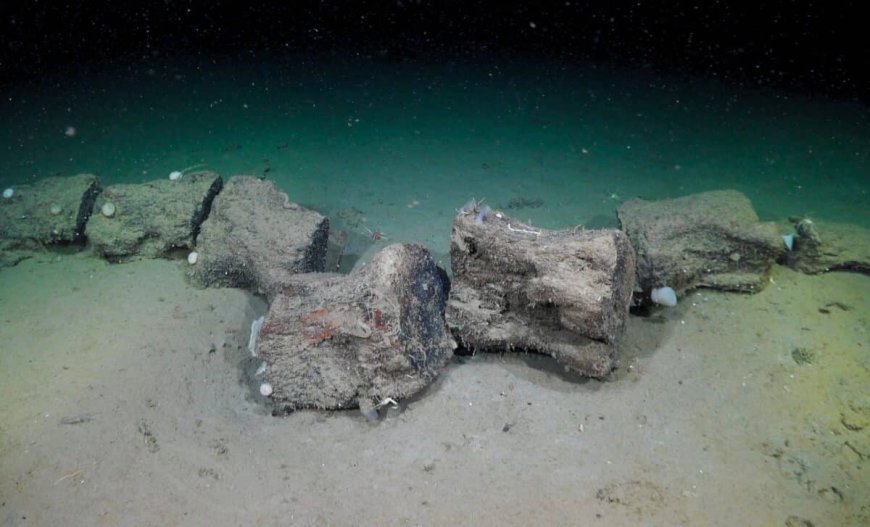
Among the most significant benthic discoveries was a whale fall observed on the seafloor at 3,890 meters in the Salado-Colorado Kilometer scarp. Video collected during the dive showed a partially decomposed whale carcass surrounded by scavengers, including microbial mats and bone-dwelling Osedax worms. These ecosystems form when a whale’s body sinks to the seafloor and decomposes in stages, providing a concentrated source of organic material to deep-sea organisms adapted to nutrient-scarce environments.
According to the expedition report from Schmidt Ocean Institute, “whale falls offer up thousands of years of nourishment to a place accustomed to scarcity.” Once the soft tissue is consumed, the bones serve as hard substrate during what researchers term the “reef phase,” where various invertebrates colonize the remains.

The discovery marks the first time a whale fall has been confirmed and documented in Argentina’s deep sea. Similar observations have been made in the North Pacific and North Atlantic, but data from the South Atlantic remain limited. The team described the find as “presumably decades old,” though precise dating requires further analysis.
Rare Phantom Jellyfish Filmed at Midwater Depth
At a depth of 250 meters, ROV SuBastian recorded a free-floating specimen of Stygiomedusa gigantea, a rarely encountered jellyfish species with no stinging tentacles. The animal uses four elongated oral arms to trap small fish and plankton, and its bell can exceed one meter in diameter.

The sighting was visually confirmed and matched to prior records based on morphological features. While S. gigantea has been observed in other deep-sea basins, this is the first verified encounter in Argentine waters. Video shows juvenile fish swimming close to or within the jellyfish’s bell, behavior previously documented in Pacific populations but not in the South Atlantic.
According to Schmidt Ocean Institute’s public expedition summary, the species “can reach the length of a school bus” and remains extremely rare despite its large size.
Chemosynthetic Clam Fields and Plastic Waste Found Side by Side
The expedition team’s primary scientific objective was to locate and characterize cold seep environments, where methane and hydrogen sulfide emerge from the seabed and support microbial life. At one site, researchers documented an active seep measuring one square kilometer, with fields of chemosynthetic clams and methane-derived carbonate formations.
The clam beds included genera such as Archivesica and Calyptogena, which host symbiotic bacteria capable of oxidizing methane or hydrogen sulfide. These communities exist independently of sunlight and are typically found along tectonic margins or sedimented basins. Their presence in Argentine waters had been suspected, but not verified at this scale.
In the same regions, researchers also found multiple instances of anthropogenic debris, including fishing gear, plastic bags, and a VHS cassette in near-pristine condition. According to the expedition account, the tape label was printed in Korean. Its exact origin, age, and arrival route remain unknown, though its state of preservation was cited as evidence of plastic’s longevity in deep marine environments.
Enjoyed this article? Subscribe to our free newsletter for engaging stories, exclusive content, and the latest news.
What's Your Reaction?
 Like
0
Like
0
 Dislike
0
Dislike
0
 Love
0
Love
0
 Funny
0
Funny
0
 Angry
0
Angry
0
 Sad
0
Sad
0
 Wow
0
Wow
0