

























China Deploys Thousands of Fishing Boats Near Japan’s Coast, and It’s Clearly Not About Fishing

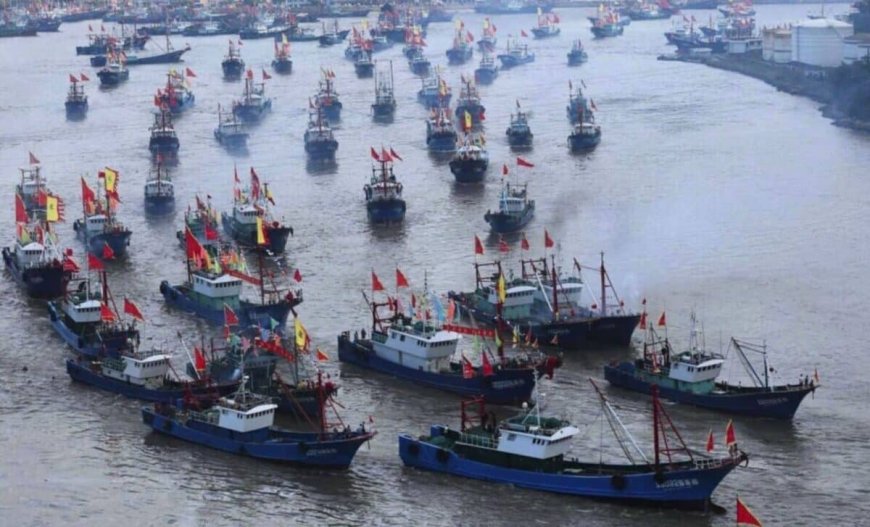
On a clear morning in January 2026, a commercial satellite passed over the East China Sea and captured something difficult to explain. Below, spread across a wide stretch of water near Japanese-administered islands, were thousands of vessels arranged in tight, orderly rows. They were not moving the way fishing boats move.
The images circulated among maritime analysts and regional security researchers within days. What they showed was not a seasonal fleet chasing fish. The vessels held their positions across multiple satellite passes spanning several days, their formations unchanged by tides or weather. No trawling arcs. No dispersal patterns consistent with working a fishing ground.

Japan Coast Guard aircraft flew over the area and visually confirmed what the satellites recorded: clusters of vessels consistent with the photographs published in international media. The coast guard described the activity as large-scale and moved patrol vessels into position, issuing radio warnings to any ship approaching Japanese territorial waters.
What the Satellite Data Revealed About the Formations
The formations appeared in the East China Sea in late January and early February 2026. Commercial satellite providers, now capable of revisiting locations within hours rather than days, captured sequential images that allowed analysts to compare vessel positions across short intervals. The boats were not drifting. They were holding.
Many vessels broadcast Automatic Identification System signals, the civilian tracking transponders required on commercial fishing boats. Maritime analysts noted that AIS compliance shows a vessel’s position but says nothing about intent or coordinated direction. Fishing fleets in the East China Sea typically scatter according to fish stock locations, water depth, and local weather. These boats did not.

The formations were concentrated near the Senkaku Islands, a group of uninhabited outcroppings administered by Tokyo and claimed by Beijing. The islands and surrounding waters have been a recurring point of friction between the two countries, with Chinese coast guard vessels making regular incursions into what Japan considers its territorial sea. As Nikkei Asia reported, Japanese officials said the pattern and scale of the current formations differed from those seen in previous years, a conclusion supported by comparing 2026 satellite passes against archived imagery from earlier fishing seasons.
Japan Detains a Captain Under Fisheries Law
Within 24 hours of the satellite images becoming public, the situation moved from observation to enforcement. On February 12, 2026, Japan’s Fisheries Agency patrol vessel Hakuo Maru intercepted the Chinese fishing boat Qiong Dong Yu inside Japan’s exclusive economic zone, 89.4 nautical miles south-southwest of Meshima island off Nagasaki Prefecture. The captain, a 47-year-old Chinese national named Zheng Nianli, refused to comply and attempted to flee.
“The vessel’s captain was ordered to stop for an inspection by a fisheries inspector, but the vessel failed to comply and fled,” Japan’s Fisheries Agency said in a statement. The Guardian reported the arrest as the first seizure of a Chinese fishing vessel since 2022, noting that in the five-year period through 2025, Japanese agency officials boarded foreign ships 30 times and seized only five vessels. Chief Cabinet Secretary Minoru Kihara told a news conference that Japan would “continue to take resolute action in enforcement activities to prevent and deter illegal fishing operations by foreign vessels.”

China reacted within hours. Foreign ministry spokesman Lin Jian said at a news conference that “it is hoped Japan strictly respects the China-Japan fisheries agreement, fairly enforces the law and safeguards the safety and legitimate rights and interests of Chinese crew members.” Beijing did not address the satellite imagery showing the large-scale formations in the East China Sea and announced no reciprocal measures.
Gray-Zone Maritime Tactics in Disputed Waters
The episode unfolded against a deteriorating diplomatic backdrop. In November 2025, Prime Minister Sanae Takaichi suggested Japan would intervene militarily if Beijing sought to take Taiwan by force. China summoned Tokyo’s ambassador, warned Chinese citizens against visiting Japan, and tightened export controls on items with potential military uses, including rare-earth minerals. The fishing boat seizure landed into that already tense environment.
The use of large civilian fishing fleets to assert maritime presence in disputed waters is a documented pattern elsewhere in the region. Philippine authorities and analysts have described similar tactics in the South China Sea, where Chinese fishing vessels operating in dense formations near contested reefs created sustained friction without involving naval assets directly. The vessels are, on paper, commercial boats, which complicates enforcement responses that would be clearer-cut against military ships.
Maritime militia operations of this kind occupy a legal and military gray zone. Coast guard responses, diplomatic protests, and fisheries law enforcement are the primary tools available. As of late February 2026, diplomatic channels between Tokyo and Beijing remained open, and the vessel formations continued to hold position across the East China Sea.
Enjoyed this article? Subscribe to our free newsletter for engaging stories, exclusive content, and the latest news.
What's Your Reaction?
 Like
0
Like
0
 Dislike
0
Dislike
0
 Love
0
Love
0
 Funny
0
Funny
0
 Angry
0
Angry
0
 Sad
0
Sad
0
 Wow
0
Wow
0