




























Astronomers Uncover Hidden Giant Rings Behind Massive Star Fading

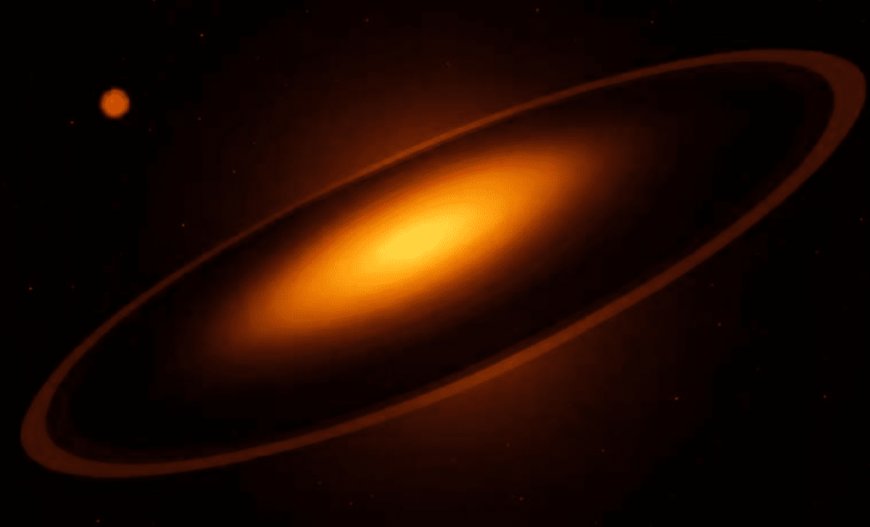
A recently published study in Monthly Notices of the Royal Astronomical Society has uncovered an intriguing explanation for one of the longest and most unusual stellar dimming events ever observed. Researchers have linked the prolonged dimming of the star ASASSN-24fw to an unseen brown dwarf or a super-Jupiter with a vast, saucer-like ring system. This discovery, which has captured the attention of astronomers worldwide, could reshape our understanding of planetary systems and their complex structures beyond our own solar system.
The Unusual Event That Sparked Astronomical Curiosity
ASASSN-24fw, a star located 3,200 light-years away in the Monoceros constellation, has been a subject of astronomical study for years due to its relative stability. However, in late 2024, something unusual happened. For the first time, astronomers observed the star begin to fade dramatically, with its brightness decreasing by nearly 97%. This unprecedented dimming lasted for an astonishing period of over nine months, a duration far beyond what is typical for stellar dimming events, which usually last only a few days or weeks.
The dimming began gradually, leading researchers to initially speculate a range of potential causes, including dust clouds or eclipsing objects. However, the scale and length of the event pointed to a more unusual explanation. The breakthrough came when a team of international researchers, including Dr. Sarang Shah from the Inter-University Centre for Astronomy and Astrophysics (IUCAA), proposed that the cause was likely a brown dwarf or super-Jupiter, massive objects with complex ring systems that are not easily observed. Their study, published in Monthly Notices of the Royal Astronomical Society, provided a plausible explanation for the dimming based on the data collected.

The Role of Brown Dwarfs and Super-Jupiters
Brown dwarfs are fascinating objects that blur the lines between stars and planets. They are larger than planets but lack the mass needed to initiate nuclear fusion, making them incapable of becoming full-fledged stars. In this case, researchers theorized that the brown dwarf was surrounded by a massive, dense ring system. This ring, stretching about 0.17 astronomical units, half the distance from the Sun to Mercury, would have been large enough to cause significant dimming as it passed in front of ASASSN-24fw.
Dr. Shah elaborated on this theory, saying,
“Various models made by our group show that the most likely explanation for the dimming is a brown dwarf—an object heavier than a planet but lighter than a star—surrounded by a vast and dense ring system. It is orbiting the star at a farther distance with the ring.”
The team believes that the outer parts of the ring system were thin, causing the dimming to start gradually and only become fully apparent when the denser regions of the ring passed directly in front of the star.
The Rare Nature of Long-Lasting Dimming Events
The rarity of long-lasting dimming events, such as the one observed with ASASSN-24fw, is a key reason why this phenomenon has generated so much excitement. As Dr. Shah explained, “Long-lasting dimming events like this are exceptionally uncommon as they require very perfect line-ups.” Such events are extremely difficult to predict and even more difficult to observe in real-time. The duration of this particular dimming allowed researchers to gather a wealth of data and study it in great detail, leading to a more thorough understanding of the complex interactions between stars and their companions.
The study revealed that the dimming event was not only caused by the ring system but also offered a glimpse into the formation and evolution of ring structures around other stars. The brown dwarf, with its colossal ring system, is believed to have interacted with ASASSN-24fw in a way that created the perfect conditions for the dimming event. This kind of detailed analysis is crucial for astronomers trying to understand the broader dynamics of planetary systems.

(Monthly Notices of the Royal Astronomical Society)
Serendipitous Discoveries: A New Red Dwarf Companion
While studying ASASSN-24fw, the research team made another surprising discovery. Dr. Jonathan Marshall, an independent post-doctoral researcher affiliated with Academia Sinica in Taiwan, noted that the study also led to the unexpected identification of a red dwarf star in the star’s immediate vicinity. He remarked,
“This rare event allows us to study such a complex system in remarkable detail. In fact, while studying this dimming, we also serendipitously discovered that ASASSN-24fw also has a red dwarf star in its vicinity.”
This discovery of a red dwarf star is important because red dwarfs are among the most common types of stars in the universe, yet they are often difficult to study due to their faintness. The presence of such a star near ASASSN-24fw adds another layer of complexity to the system, potentially influencing the star’s behavior and the dynamics of the surrounding objects.
Enjoyed this article? Subscribe to our free newsletter for engaging stories, exclusive content, and the latest news.
What's Your Reaction?
 Like
0
Like
0
 Dislike
0
Dislike
0
 Love
0
Love
0
 Funny
0
Funny
0
 Angry
0
Angry
0
 Sad
0
Sad
0
 Wow
0
Wow
0