




























Artemis II Returns To Earth As NASA Completes Historic Lunar Expedition

The Artemis II mission has reached a defining moment as NASA confirmed the successful re-entry phase on Flight Day 10, marking a critical milestone in humanity’s return to deep space exploration beyond low Earth orbit.
A High-Stakes Re-Entry That Validates Future Lunar Missions
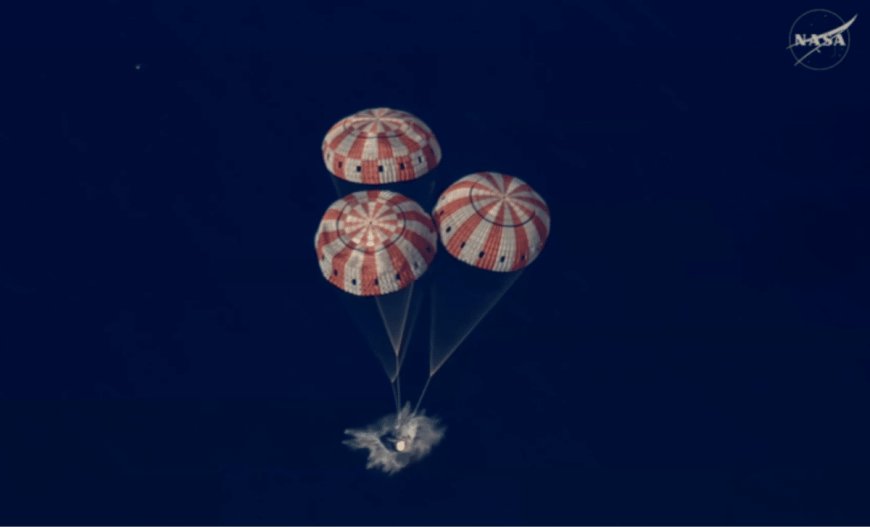
After days traveling through deep space, the Orion spacecraft carrying the Artemis II crew began its long-anticipated return to Earth, executing a precisely timed re-entry sequence designed to test the limits of both engineering and human endurance. This phase is one of the most dangerous parts of any space mission, as the spacecraft must withstand extreme heat levels while maintaining structural integrity and trajectory accuracy. NASA engineers monitored every parameter in real time, ensuring that Orion’s heat shield, guidance systems, and parachute deployment mechanisms performed as expected.
The data collected during this descent will directly inform the safety protocols for upcoming missions, including Artemis III, which aims to land humans on the Moon. What makes this moment stand out is not just the safe return itself, but the validation of technologies that had never before been tested with a crew in deep space conditions. The mission effectively bridges decades of technological evolution since the Apollo era, bringing modern systems into real operational context.

NASA/Bill Ingalls
Inside The Artemis II Mission And Its Strategic Importance
The Artemis II mission represents NASA’s first crewed journey beyond low Earth orbit in over 50 years, a bold step that sets the foundation for sustained lunar exploration. Unlike previous missions confined to Earth’s orbit, this flight pushed Orion into a distant retrograde orbit around the Moon, exposing both crew and spacecraft to deep space radiation, extended communication delays, and autonomous navigation challenges. According to NASA, the mission was designed not only as a demonstration of capability but as a stress test for every critical system that future lunar crews will depend on.
Life support, propulsion, navigation, and onboard computing were all evaluated under real mission conditions. The astronauts themselves played a central role, conducting manual operations and providing feedback on spacecraft usability, which will influence design adjustments moving forward. This mission also serves geopolitical and scientific goals, reinforcing U.S. leadership in space exploration while laying groundwork for international collaboration under the broader Artemis program.

Critical Systems Put To The Ultimate Test
Throughout the mission, Orion functioned as both a spacecraft and a floating laboratory, gathering vast amounts of performance data across multiple systems. The heat shield, one of the most advanced ever built, faced temperatures exceeding 2,700 degrees Celsius during re-entry, a threshold that simulates future high-speed returns from lunar and even Martian trajectories. Navigation systems relied on a combination of onboard autonomy and Earth-based tracking, demonstrating resilience in scenarios where communication delays could become significant.
The parachute system, often overlooked by the public, underwent a complex deployment sequence that had to function flawlessly to ensure a safe splashdown. NASA teams emphasized that every second of this phase was critical, with no margin for error. The mission also tested communication blackouts during re-entry, a period where plasma buildup temporarily disrupts signals, forcing reliance on pre-programmed sequences. These results will be analyzed in detail to refine mission architectures for upcoming Artemis flights.
Welcome home Reid, Victor, Christina, and Jeremy! 
The Artemis II astronauts have splashed down at 8:07pm ET (0007 UTC April 11), bringing their historic 10-day mission around the Moon to an end. pic.twitter.com/1yjAgHEOYl— NASA (@NASA) April 11, 2026
What This Means For The Future Of Human Space Exploration
The successful completion of Artemis II’s re-entry phase signals a turning point in the roadmap toward a permanent human presence beyond Earth. By proving that astronauts can safely travel to and from deep space, NASA has cleared one of the most significant hurdles in its long-term exploration strategy. The mission’s success strengthens confidence in the Artemis program’s timeline, bringing humanity closer to establishing a sustainable presence on the Moon and eventually preparing for missions to Mars. It also demonstrates the effectiveness of modern spacecraft design in handling extreme conditions that were once considered high-risk even for short-duration missions.
As NASA continues to analyze the massive dataset generated during the flight, each insight will contribute to safer, more efficient missions in the near future. The return of Artemis II is not just the end of a journey, but the beginning of a new era where deep space travel becomes a repeatable and reliable endeavor.
Enjoyed this article? Subscribe to our free newsletter for engaging stories, exclusive content, and the latest news.
What's Your Reaction?
 Like
0
Like
0
 Dislike
0
Dislike
0
 Love
0
Love
0
 Funny
0
Funny
0
 Angry
0
Angry
0
 Sad
0
Sad
0
 Wow
0
Wow
0