




























Antarctica’s Most Vulnerable Regions Have Reached an Unstoppable Melting Phase Long Feared by Scientists

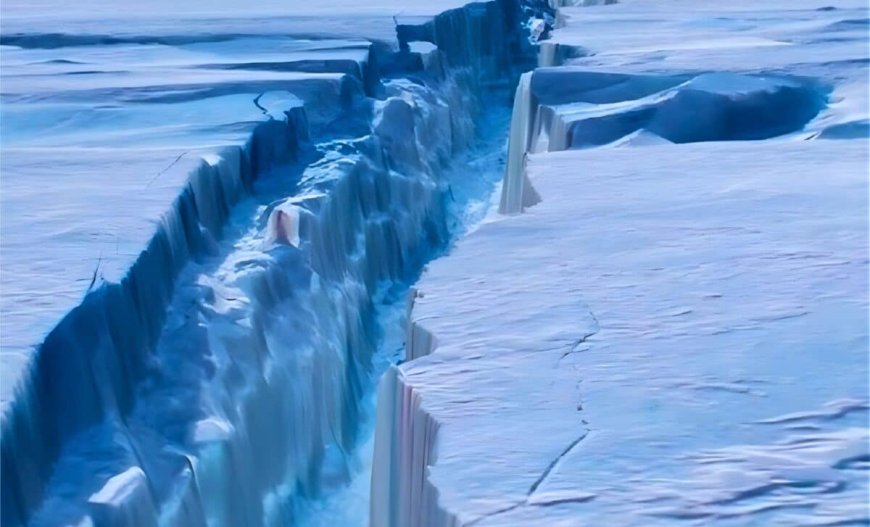
Researchers reporting in Nature Climate Change conclude that several Antarctic ice drainage basins may already be committed to long term ice loss under current levels of global warming. The paper maps temperature thresholds at which individual basins shift from gradual retreat to self sustaining decline. The authors state that some sectors of West Antarctica are likely within or beyond those thresholds at approximately 1.2 to 1.3 degrees Celsius above preindustrial levels.
The findings do not describe imminent collapse. They quantify when retreat becomes dynamically locked in, even if surface temperatures later stabilize. That distinction matters for sea level projections, which depend not only on how much warming occurs, but on whether critical thresholds are crossed.

The research was led by scientists affiliated with the Potsdam Institute for Climate Impact Research and other European institutions. It assesses basin level responses rather than treating the Antarctic Ice Sheet as a single unit. The study builds on two decades of work on marine ice sheet instability, but applies a systematic temperature mapping framework across major Antarctic drainage systems.
The analysis appears amid sustained mass loss from West Antarctica documented through satellite gravimetry and altimetry since the early 2000s. According to NASA and the European Space Agency records, West Antarctica has contributed measurably to global mean sea level rise over the past two decades. The new study addresses whether part of that loss has entered a state that cannot be reversed on human timescales.
Mapping Tipping Thresholds Across Antarctica’s Ice Basins
In the paper published in Nature Climate Change, researchers reported that individual Antarctic basins exhibit distinct temperature thresholds for irreversible retreat. The study uses ice sheet models calibrated against paleoclimate data and present day observations to simulate long term responses under varying temperature scenarios.
The results indicate that sectors draining into the Amundsen Sea, including the Thwaites Glacier and Pine Island Glacier catchments, have comparatively low destabilization thresholds. Under sustained warming near present levels, model runs show retreat continuing even if temperatures are later reduced. The mechanism is linked to bedrock geometry, where inland sloping basins amplify grounding line retreat once initiated.

The authors describe this behavior as hysteresis, meaning that the warming required to initiate retreat is lower than the cooling required to restore the previous ice configuration. Once grounding lines migrate past certain topographic points, restoring them would require temperatures below preindustrial levels in many model realizations. The study does not claim that all West Antarctic basins have crossed such thresholds, but it finds elevated risk in several key sectors.
Eastern Antarctica presents a more varied picture. The study identifies sub basins in East Antarctica that also display threshold behavior, though typically at higher temperature levels than those modeled for West Antarctica. Given that East Antarctica contains a larger total ice volume, the long term sea level implications would be greater if those thresholds were exceeded. The authors state that current warming does not yet place most East Antarctic basins in the high risk category.
The modeling framework integrates physical processes such as grounding line migration, ice shelf buttressing, and ocean driven basal melt. It does not rely solely on surface mass balance changes. The authors emphasize that ocean heat content beneath ice shelves plays a determining role in destabilization, consistent with prior observational studies in the Amundsen Sea region.
Model Assumptions, Scientific Uncertainty, and Points of Disagreement
The study uses a reduced complexity ice sheet model ensemble rather than full three dimensional high resolution simulations. This allows broad basin comparison but introduces limitations in representing localized feedbacks. The authors acknowledge uncertainties in basal friction parameters and future ocean warming pathways, which materially affect threshold estimates.
Independent ice sheet researchers have previously debated the stability of Thwaites Glacier and adjacent basins. Some field studies suggest that portions of Thwaites have already entered a phase of sustained retreat. Others argue that ice shelf interactions and short term variability complicate interpretation. The new analysis does not resolve those disagreements, but provides a temperature indexed framework for evaluating them.
Sea level implications are measured in terms of long term commitment rather than near term acceleration. The study does not project multi meter rise within decades. It estimates that once certain basins pass their tipping thresholds, contributions to sea level accumulate over centuries. That timescale aligns with earlier Intergovernmental Panel on Climate Change assessments, which identify Antarctic dynamics as a major source of long range uncertainty.
The paper distinguishes between basins that may already be committed to retreat and others whose thresholds remain above current warming. According to the modeling results, limiting warming to near 1.5 degrees Celsius reduces the number of basins at risk of irreversible loss compared with 2 degrees or higher scenarios.
Enjoyed this article? Subscribe to our free newsletter for engaging stories, exclusive content, and the latest news.
What's Your Reaction?
 Like
0
Like
0
 Dislike
0
Dislike
0
 Love
0
Love
0
 Funny
0
Funny
0
 Angry
0
Angry
0
 Sad
0
Sad
0
 Wow
0
Wow
0