

























A Mom and Her Daughter Accidentally Found the World’s Largest Hidden Coral Colony off Australian Coast

The water was glassy that morning, unusually calm for the outer Great Barrier Reef. Jan Pope leaned over the edge of the boat and saw something she did not immediately understand. A strange pattern rippled below the surface. Not the typical bommies or outcrops she had seen across 35 years of diving. Something else. She geared up and slipped into the water.
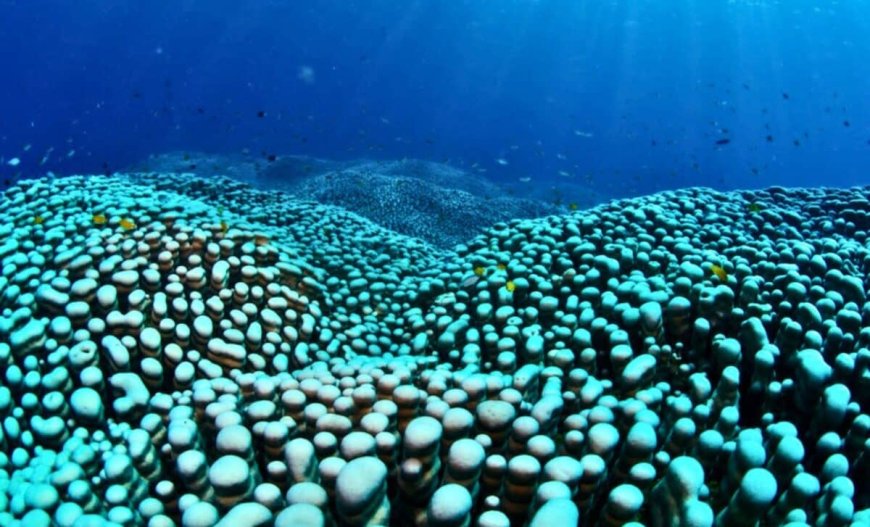
What she found underneath looked less like a coral reef and more like an underwater meadow rolling toward the horizon. The structure extended in ways that did not match normal reef growth. It had shape and form but no clear boundaries. As she later recounted in an interview with the ABC, “I’d never seen coral growing like this before. It just went on and on.”
She had no way of knowing it yet, but Pope and her daughter had just stumbled onto a structure that may rewrite the record books for the Great Barrier Reef. The massive coral discovery would eventually draw the attention of marine scientists across Australia and raise new questions about what else might be hiding in hard to reach parts of the ocean.
A Family Discovery in Open Water
Jan Pope and her daughter Sophie Kalkowski Pope were diving for the Great Reef Census, a citizen science project run by the conservation group Citizens of the Reef. The program recruits volunteer divers, boat owners, and photographers to help monitor reef health across vast areas that professional scientists cannot cover alone. Since 2020, the project has surveyed roughly a quarter of the reef system using crowd sourced images.
They were working in waters a few hours offshore from Cairns in Far North Queensland when they made the find late last year. Kalkowski Pope, who serves as marine operations coordinator for Citizens of the Reef, said the location had likely remained hidden because of difficult diving conditions. The area is tidally dominated with strong currents that can make exploration challenging. Those same conditions may have protected whatever was growing down there.
When Kalkowski Pope returned in January with a full survey team, they brought drones, measuring tapes, and underwater cameras. They built a three dimensional model of the structure using a technique called photogrammetry, stitching hundreds of images together into a measurable digital replica. The numbers that came back surprised even experienced marine scientists.
A Single Structure the Size of a Field
The coral colony measured approximately 111 metres at its longest point. That is roughly the length of a Premier League football pitch or an American football field. Its total footprint covered an estimated 3,973 square metres, about half the area of a regulation soccer pitch. For comparison, as reported in detailed coverage by The Guardian, a massive Pavona clavus coral found in the Solomon Islands in 2024 measured 34 metres across. Another large colony in Nusa Penida came in at 71 metres. If confirmed, this new find would dwarf both.

The species is Pavona clavus, a stony coral that builds hard limestone skeletons and can form massive columnar structures over centuries. Dr. Tom Bridge, curator of corals at the Queensland Museum, said the species is uncommon and often difficult to find. “But where it is found, it can form really, really ridiculously huge colonies,” Bridge said. He added that the coral is currently undergoing a taxonomic revision and may eventually be reclassified under a different name. But its size, whatever scientists ultimately call it, remains extraordinary.
Dr. Mike Emslie, a research scientist at the Australian Institute of Marine Science, estimated the colony is at least a couple of hundred years old based on its size and growth rates for this species. That age carries weight. A coral that has sat in the same spot for centuries has survived cyclones, crown of thorns starfish outbreaks, and multiple mass bleaching events. Its survival suggests something about the location. “It indicates that these large, long lived corals are still standing up in the face of repeated acute disturbances,” Emslie told the ABC.
Age, Resilience, and One Big Question
The site sits in deeper water than many reef flats and experiences strong tidal flows. Those factors may have kept water temperatures lower during marine heatwaves that killed corals in shallower, more sheltered areas. But one major question remains unanswered. Scientists do not yet know whether the structure is a single enormous colony or multiple colonies that grew together over time and fused into one mass.
Bridge explained that genetic testing would be required to answer that question. If the entire structure originated from one larval polyp that settled centuries ago and spread outward, it would represent a single genetic individual. If multiple polyps settled close together and their skeletons merged as they grew, it would be a composite. Kalkowski Pope estimated that definitive testing would require more than 300 individual samples collected across the full expanse of the colony. That work has not yet been done.
Serena Mou, a research engineer at the QUT Centre for Robotics, helped create the three dimensional model that will allow future comparisons. As she explained to BBC Newsround, “It means we can return in future months and years and make direct, one to one comparisons to understand how the coral changes over time.” The mapping also revealed that the colony extends beyond what the divers initially estimated from underwater visual surveys. Mou described the process as interactive, with the digital model gradually revealing a larger structure than anyone had realized.
What Happens Next Underwater
The exact coordinates of the site are not being released. Citizens of the Reef has passed all location data and survey materials to the Great Barrier Reef Marine Park Authority, the federal agency responsible for managing the reef system. The authority will now determine how to monitor the site and whether any additional protections are needed. Keeping the location quiet prevents accidental damage from boat anchors or curious divers who might not understand how fragile a centuries old structure can be.
Marine scientist Allison Paley from James Cook University said the find was a classic example of why citizen science programs matter. “This is just a classic example of the good that can come from these types of developed plans, these citizen science plans or programmes,” Paley said in The Guardian’s coverage.
She also noted that equally large corals likely remain undiscovered in other parts of the world. The oceans are vast, and systematic surveys of coral size are rare. Most giant colonies are found by accident, often by divers who recognize that what they are seeing does not match normal reef structure.
Enjoyed this article? Subscribe to our free newsletter for engaging stories, exclusive content, and the latest news.
What's Your Reaction?
 Like
0
Like
0
 Dislike
0
Dislike
0
 Love
0
Love
0
 Funny
0
Funny
0
 Angry
0
Angry
0
 Sad
0
Sad
0
 Wow
0
Wow
0