





























A 6-Ton Stone at the Heart of Stonehenge May Have Traveled from Scotland 4,500 Years Ago

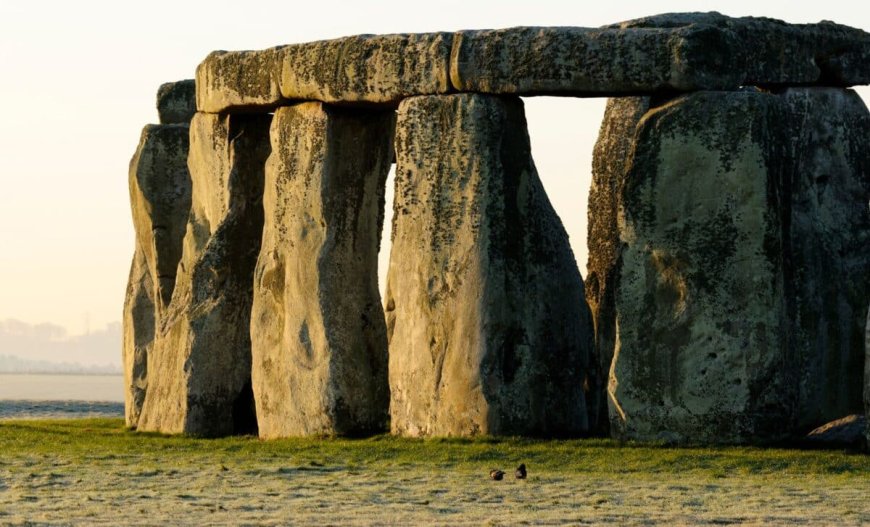
Stonehenge’s largest non-sarsen stone may have come from much farther away than researchers once thought. A new study identifies northeast Scotland, not Wales, as the origin of the monument’s Altar Stone, a six-ton slab of greenish Old Red Sandstone, challenging decades of geological consensus.
Now, research led by Curtin University and published in Nature disputes that conclusion. By closely examining the age and chemical composition of mineral grains embedded within fragments of the block, scientists were able to establish a detailed geochemical profile, ultimately allowing them to reassess the stone’s geographic origin.
A Mineral Record Written Over Billions of Years
The Altar Stone measures about 16 feet by 3 feet and lies partially buried beneath two fallen stones at the center of Stonehenge. To determine its origin, researchers analyzed the age and chemistry of mineral grains embedded in the sandstone.
According to lead author Anthony Clarke, a Ph.D. student in the Timescales of Mineral Systems Group at Curtin’s School of Earth and Planetary Sciences:
“Our analysis found specific mineral grains in the Altar Stone are mostly between 1,000 to 2,000 million years old, while other minerals are around 450 million years old.”
This specific combination forms what Clarke described as a distinct chemical fingerprint. The findings reported in Nature state that the fingerprint matches rocks from the Orcadian Basin and clearly differs from known Welsh bedrock formations.

The Welsh Theory Cracks
Previous geological studies had traced the ceremonial slab to the Brecon Beacons region, reinforcing the view that much of Stonehenge’s imported material came from Wales. The new analysis challenges that framework directly.
Co-author Richard Bevins, a professor at Aberystwyth University, stated that the giant boulder’s chemistry does not align with Welsh sources. According to Bevins, the Scottish match shifts the focus toward identifying the precise quarry site within northeast Scotland.
The revision alters more than a point on a geological map. It forces a reconsideration of how researchers interpret the monument’s construction history around 2,600 BC.

How A Six-ton Monolith Crossed 750 Kilometers
If it originated in Scotland, its journey to southern England would have spanned at least 750 kilometers. Moving a six-ton monolith across that distance during the Neolithic period presents significant logistical questions.
As explained by the co-author Chris Kirkland, a professor at Curtin University, transporting such a massive rock overland would have been extremely challenging. He suggested that:
“This implies long-distance trade networks and a higher level of societal organization than is widely understood to have existed during the Neolithic period in Britain.”
The six-on monolith, once thought to fit neatly into an established narrative, now stands as evidence that the monument’s builders may have operated across a much broader geographic network than previously believed.
Enjoyed this article? Subscribe to our free newsletter for engaging stories, exclusive content, and the latest news.
What's Your Reaction?
 Like
0
Like
0
 Dislike
0
Dislike
0
 Love
0
Love
0
 Funny
0
Funny
0
 Angry
0
Angry
0
 Sad
0
Sad
0
 Wow
0
Wow
0