



























30°C in Greenland in Winter? Yes, It Happened… And It Wasn’t Caused by Global Warming

On 4 February 2026, Reuters reported that Greenland had shattered winter temperature records, citing readings that reached 30°C in localized areas and raising questions about economic impacts on fisheries and mineral extraction. The report followed data compiled by the Greenland Meteorological Institute (DMI) from automatic weather stations operating along the island’s southern coast.
The 30°C figure refers to a historical observation recorded in June 1973 at Maniitsoq, west Greenland, not a winter 2026 measurement. According to DMI archives, that earlier reading remains one of the highest reliably documented temperatures on the island. It was recorded during a short-lived foehn wind event, a downslope warming phenomenon capable of producing sharp, local temperature spikes.

The distinction matters because the 2026 winter anomaly cited by Reuters concerned unusually high seasonal averages rather than a verified new 30°C reading. DMI’s February bulletin documented winter temperatures exceeding the 1991–2020 mean by more than 10°C in some southern stations during specific warm-air incursions. It did not certify a new all-time summer-equivalent record.
Greenland Meteorological Institute Confirms 30°C Event
According to the Reuters report, Greenland experienced sustained above-average winter temperatures in January, with coastal stations reporting anomalies of +8°C to +12°C relative to climatological baselines. The report cited scientists warning that warmer winters are altering sea ice formation and affecting fishing seasons.
The article also noted that diminishing ice coverage is redrawing economic calculations in sectors such as rare-earth mineral exploration and shipping access. However, it did not present evidence that a new 30°C absolute record had been measured in winter conditions.

Long-term climate evidence compiled by NASA shows that Arctic amplification is occurring at roughly four times the global average rate, as documented in satellite observations and surface temperature records. According to NASA’s climate data portal, 2023 and 2024 rank among the warmest years in the instrumental record.
Instrumental datasets from NASA, the U.S. National Oceanic and Atmospheric Administration, and the Copernicus Climate Change Service consistently show rising mean surface temperatures across Greenland since the late 20th century. These datasets measure multi-decade trends rather than isolated weather extremes.
A Rare Weather Event, Not a New Climate Record
Meteorological records indicate that Greenland’s historic 30°C reading occurred during a foehn wind episode, in which descending dry air warms rapidly as it moves downslope. Such events can produce sharp temperature increases of 15°C or more within hours, particularly in mountainous regions along the west coast.
Meteorologists distinguish between these short-duration weather phenomena and persistent climate signals. Climate attribution relies on statistical analysis across decades of observations, not single-day extremes.
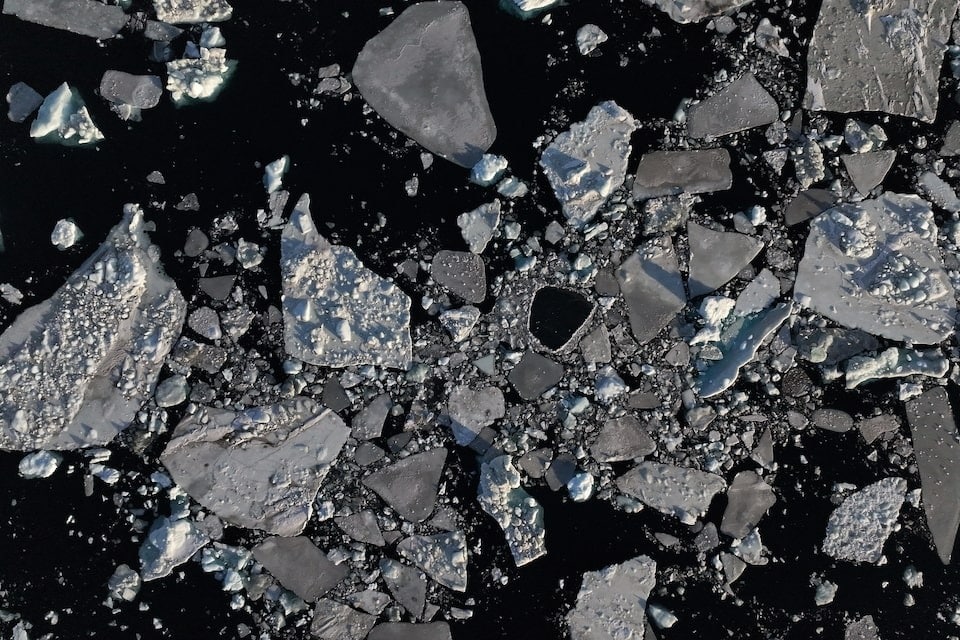
NASA’s published climate evidence documents retreating glaciers, declining Arctic sea ice extent, rising ocean heat content, and increasing global mean surface temperatures. Greenland’s ice sheet has contributed to global sea-level rise since the 1990s through surface melt and accelerated glacier discharge.
Satellite gravimetry missions have documented sustained ice mass loss over successive measurement cycles. These data are independent of surface station records and track cumulative long-term change.
What Warmer Winters Are Changing on the Ground
Reuters’ 4 February report emphasized that warmer winters are shortening sea ice seasons in key fishing regions. The change affects access to cod and shrimp stocks and lengthens maritime navigation windows. It also increases the feasibility of mineral prospecting in southern Greenland, where rare earth deposits are under active evaluation.
However, the island’s interior remains ice-covered, and winter averages across much of Greenland remain well below freezing. The 30°C figure remains confined to specific historical summer conditions and has not been recorded under winter conditions.
The Greenland Meteorological Institute’s long-term dataset shows an increase in winter warm-air advection events compared with late 20th-century baselines. Attribution studies link Arctic amplification to rising greenhouse gas concentrations using ensemble modeling and observational analysis rather than isolated readings.
The Next Official Climate Update
Greenland’s government confirmed in January 2026 that it will revise its national climate adaptation plan by mid-2026 to integrate updated ice-loss projections and fisheries management data. The revision will reference findings from the Intergovernmental Panel on Climate Change Sixth Assessment Report and regional cryosphere modeling.
The Danish Meteorological Institute is scheduled to publish its 2025 Arctic Climate Assessment in April 2026, including updated Greenland surface temperature anomalies and ice mass balance data through the end of 2025.
Enjoyed this article? Subscribe to our free newsletter for engaging stories, exclusive content, and the latest news.
What's Your Reaction?
 Like
0
Like
0
 Dislike
0
Dislike
0
 Love
0
Love
0
 Funny
0
Funny
0
 Angry
0
Angry
0
 Sad
0
Sad
0
 Wow
0
Wow
0