



























Scientists Detect the First Pair of Supermassive Black Holes Orbiting Each Other in a Distant Galaxy

Astronomers have discovered what could be the first-ever pair of supermassive black holes on the verge of merging. This rare and momentous find, published in the Monthly Notices of the Royal Astronomical Society, offers an unprecedented opportunity to witness one of the most powerful events in the universe, the merger of two black holes. This discovery not only deepens our understanding of black holes but could also provide crucial insights into the dynamics of galaxy evolution, with the potential to observe gravitational waves as the black holes spiral ever closer to collision.
The Discovery of a Black Hole Binary System
For years, astronomers have speculated about the existence of supermassive black holes in close proximity to each other at the heart of galaxies. Yet, direct evidence of such a system has remained elusive, until now. A team of scientists led by Silke Britzen from the Max Planck Institute for Radio Astronomy (MPIfR) in Bonn has finally captured the unmistakable signs of two supermassive black holes orbiting each other in the galaxy Markarian 501.
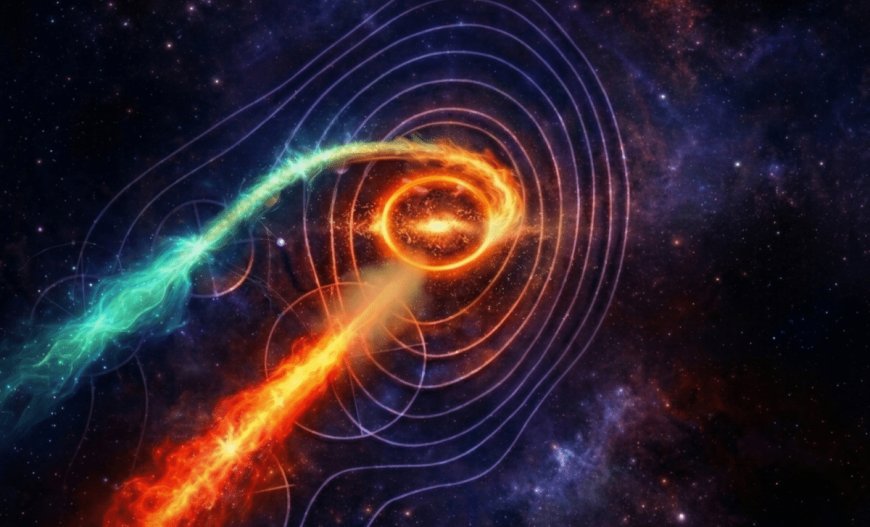
The groundbreaking study, published in the Monthly Notices of the Royal Astronomical Society, uses decades of high-resolution radio data to uncover two powerful particle jets emanating from the galaxy’s center. These jets, previously thought to be the result of a single black hole, have now been identified as the work of two black holes locked in a gravitational dance. This pair of black holes, with masses ranging between 100 million and a billion times that of the Sun, are situated about 250 to 540 times farther apart than the distance between Earth and the Sun.
The Jets That Revealed the Hidden Black Hole
The discovery of the second supermassive black hole came as a complete surprise. For years, astronomers had observed a single jet of particles shooting toward Earth from the center of Markarian 501. The jet was bright and powerful, a known feature of the galaxy. But it wasn’t until the research team analyzed more than 20 years’ worth of data, covering a wide range of radio frequencies, that a second jet was detected, moving in an entirely different direction.
“We searched for it for so long, and then it came as a complete surprise that we could not only see a second jet, but even track its movement,” says Britzen.
This jet, originating from the second supermassive black hole, was not immediately visible due to its angle. But as astronomers observed the system over time, they realized that the jets were not stationary. The second jet began to move in a counterclockwise motion around the larger black hole, completing a full orbit every 121 days.

© S. Britzen, Max Planck Institute for Radio Astronomy
The Dynamic Dance of the Black Holes
The two black holes orbiting each other create a cosmic system in constant motion. The jets they emit appear to sway as the orbital plane shifts, revealing the intricate dynamics of the pair. Britzen likens the experience of analyzing the data to being “on a ship,” as the entire jet system seemed to move with a life of its own. The motion of the jets suggested that both black holes were in close proximity, and that their gravitational influence was warping the light emitted by the system.
Britzen further explains: “Evaluating the data felt like being on a ship. The entire jet system is in motion. A system of two black holes can explain this: The orbital plane sways.” This unique observation offers a rare glimpse into the behavior of supermassive black holes on the brink of merging, allowing scientists to explore their intricate dynamics like never before.
What’s Next? Gravitational Waves and the Future of Black Hole Studies
As the two black holes continue their orbit, they will gradually move closer together, eventually merging into one. The shrinking orbit of the black holes is expected to produce gravitational waves, ripples in space-time, that could be detected by advanced instruments, such as pulsar timing arrays (PTAs).
“If gravitational waves are detected, we may even see their frequency steadily rise as the two giants spiral toward collision, offering a rare chance to watch a supermassive black hole merger unfold,” says co-author Héctor Olivares. This upcoming event could provide scientists with a direct observation of one of the most violent and energetic processes in the universe, offering new insights into the behavior of black holes and the formation of galaxies.
Enjoyed this article? Subscribe to our free newsletter for engaging stories, exclusive content, and the latest news.
What's Your Reaction?
 Like
0
Like
0
 Dislike
0
Dislike
0
 Love
0
Love
0
 Funny
0
Funny
0
 Angry
0
Angry
0
 Sad
0
Sad
0
 Wow
0
Wow
0