
























More and more drivers are wrapping their car keys in aluminum foil, and the reason has a lot to do with silent thefts that can occur in a matter of seconds without breaking in

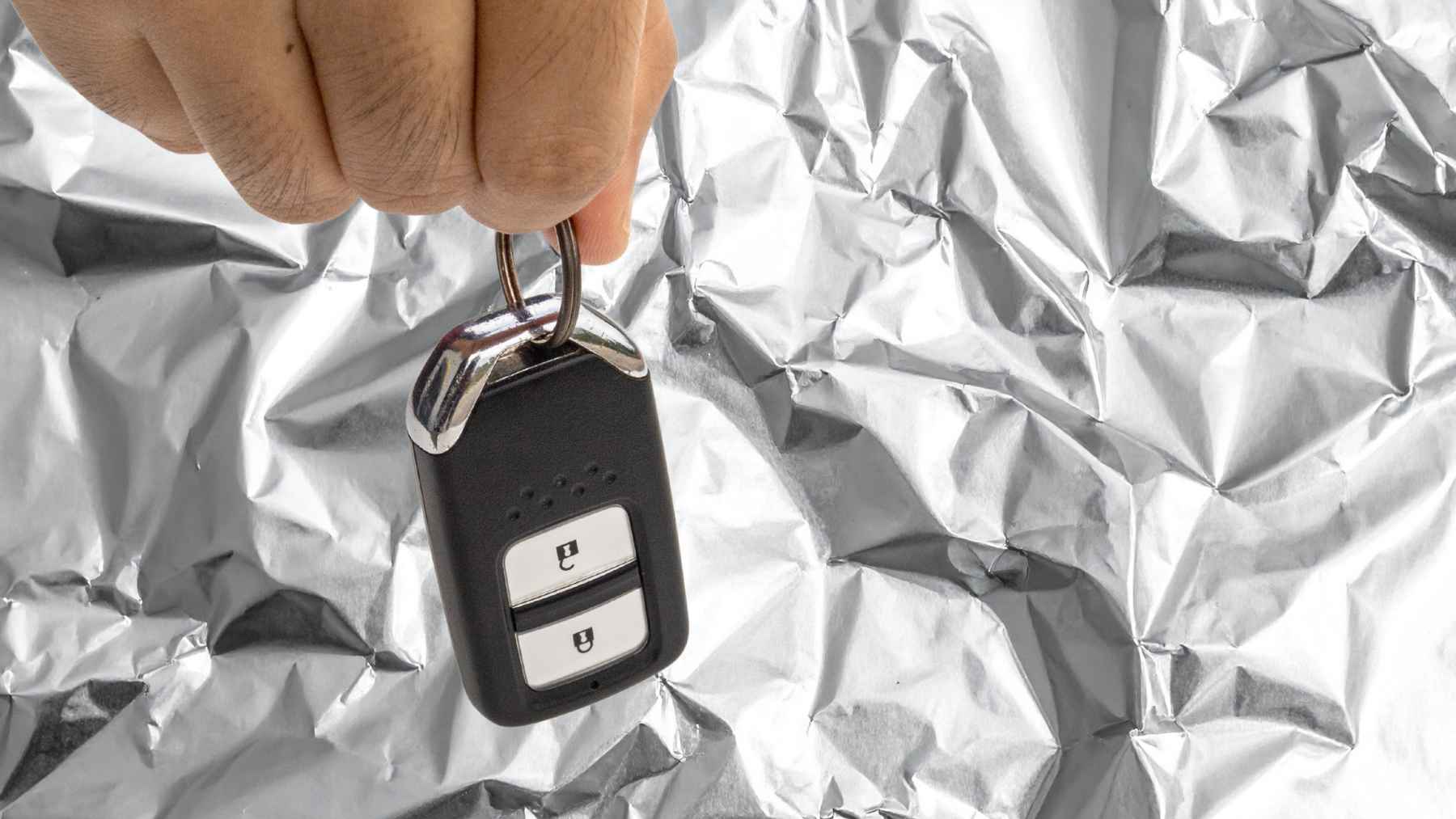
If you have ever dropped your car keys on the little table by the front door and called it a day, you are not alone. But as keyless cars become the norm, that everyday habit has started to look like a security risk.
In 2023, more than 1 million vehicles were reported stolen in the United States, and investigators say modern thieves now mix electronics with old-school crime.
That is why some drivers are wrapping key fobs in aluminum foil, a low-tech shield that can block the radio signal used in a relay attack. “Criminals are employing increasingly sophisticated methods to steal vehicles,” said David J. Glawe, president and CEO of the National Insurance Crime Bureau.
Keyless entry and the new weak spot
Keyless entry is built on invisible radio signals that let your car detect a nearby key fob and unlock without a metal key.
Engineers at Analog Devices say more than 70% of vehicles are sold with remote keyless entry either standard or as an option, and many systems use radio bands around 315 megahertz in the United States and around 433.92 megahertz in much of Europe. For drivers, it feels like magic. For thieves, it can look like an open door.
How a relay attack works in real life
The best-known tactic is the relay attack, which is essentially signal forwarding. Two people can work together, with one close to the car and another closer to the key fob inside a home or apartment.
An industry explainer says the relay signal can reach about 33 to 49 feet into a house, enough to wake up a key that is sitting just inside. The car then unlocks because it thinks the key is right there, even if it is still on your kitchen counter.
This problem has been on researchers’ radar for years. In 2011, Aurélien Francillon, Boris Danev, and Srdjan Capkun at ETH Zurich demonstrated practical relay attacks on 10 cars, including tests where the key and the car were about 164 feet apart with no clear line of sight.
Why aluminum foil can block a key fob signal
So why would wrapping a key fob in aluminum foil help? It can act like a simple Faraday cage, named after scientist Michael Faraday, that blocks electromagnetic waves from getting in or out.
The National High Magnetic Field Laboratory describes Faraday cages as structures that protect what is inside from surrounding electromagnetic radiation, the umbrella term for radio waves and other signals. In plain terms, a conductive shell pushes the energy to the outside surface and leaves the inside quieter.
Aluminum foil is not a perfect lab-grade shield, and gaps matter. But if the foil fully surrounds the fob, it can sharply reduce the radio signal that a relay device is trying to grab.
Making the foil trick actually work
For the foil method, coverage matters more than style. Most advice comes down to fully covering the fob, using a few layers, and folding edges so there are no obvious openings.
Then comes the reality check. Warwickshire Police recommends testing signal blockers by putting the key inside and walking up to the car to see if it still unlocks, and you can use the same test with foil.
Where you store keys matters too. Keeping them away from doors, windows, and exterior walls reduces the chance that someone outside can pick up a signal, especially if the shielding is imperfect.
Why security experts say to add more than one barrier
Aluminum foil can reduce the risk of a relay attack, but it does not stop every kind of vehicle crime. A thief can still break a window, tow a car, or steal a key fob the old-fashioned way, and a 2019 study from KU Leuven warned that some systems have vulnerabilities beyond relays.
Germany’s ADAC has tested hundreds of keyless vehicles and has repeatedly found that many can be opened and started using relay equipment. A May 2025 update to its running list said nearly 90% of the tested models were vulnerable, and it noted that Ultra Wide Band systems have been harder to defeat with its tools.
That is why layered security keeps coming up in official advice. Thatcham Research suggests storing keys in a signal-blocking pouch, checking whether your fob can be switched off overnight, and asking your dealer about security updates or motion-sensor keys that go to sleep when idle.
What comes next for keyless car security
Some fixes are already showing up, but for the most part they depend on the automaker and the model year. Wider use of Ultra Wide Band, along with keys that stop transmitting when they are not moving, could shrink the window that relay thieves rely on.
Still, there is no single silver bullet. In practical terms, that means treating your key fob like a device that broadcasts, not just something you toss in a drawer with loose change.
It may look odd, and it is not very glamorous. But a simple foil wrap can be a quick reminder that small habits add up, especially when you are trying to keep your car exactly where you parked it.
The original study was published in the Network and Distributed System Security Symposium.
What's Your Reaction?
 Like
0
Like
0
 Dislike
0
Dislike
0
 Love
0
Love
0
 Funny
0
Funny
0
 Angry
0
Angry
0
 Sad
0
Sad
0
 Wow
0
Wow
0