


























China Tried to Block the Gobi Desert with Millions of Trees, Only to Turn a “Biological Void” Into Carbon-Sink Territory

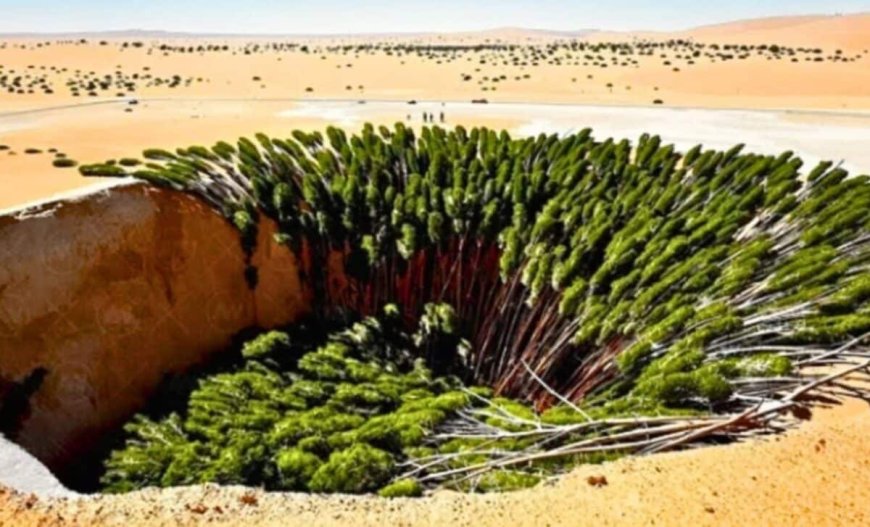
On November 28, 2024, crews on the southern rim of the Taklamakan Desert planted the last 100 meters of trees. Chinese state reporting said the final stretch completed a 3,046-kilometer green belt encircling the desert in Xinjiang, turning decades of incremental planting into a continuous perimeter.
The barrier was never pitched as a climate experiment. It was built to slow dune movement near roads, farms, and settlements, and to blunt dust that can travel far beyond the basin. The urgency behind that logic has been visible for generations in communities where sand can overwhelm pasture and swallow newly exposed ground.
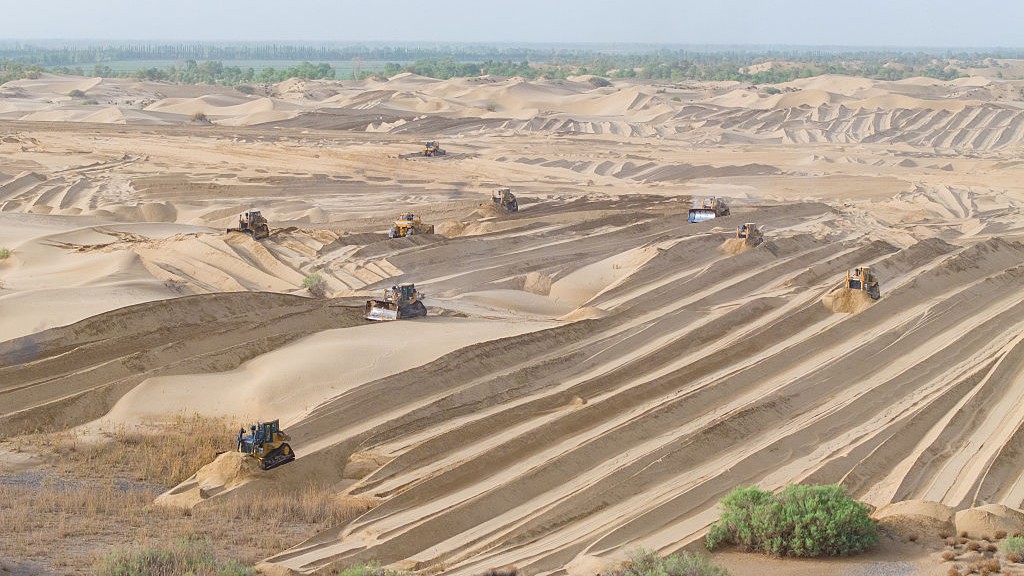
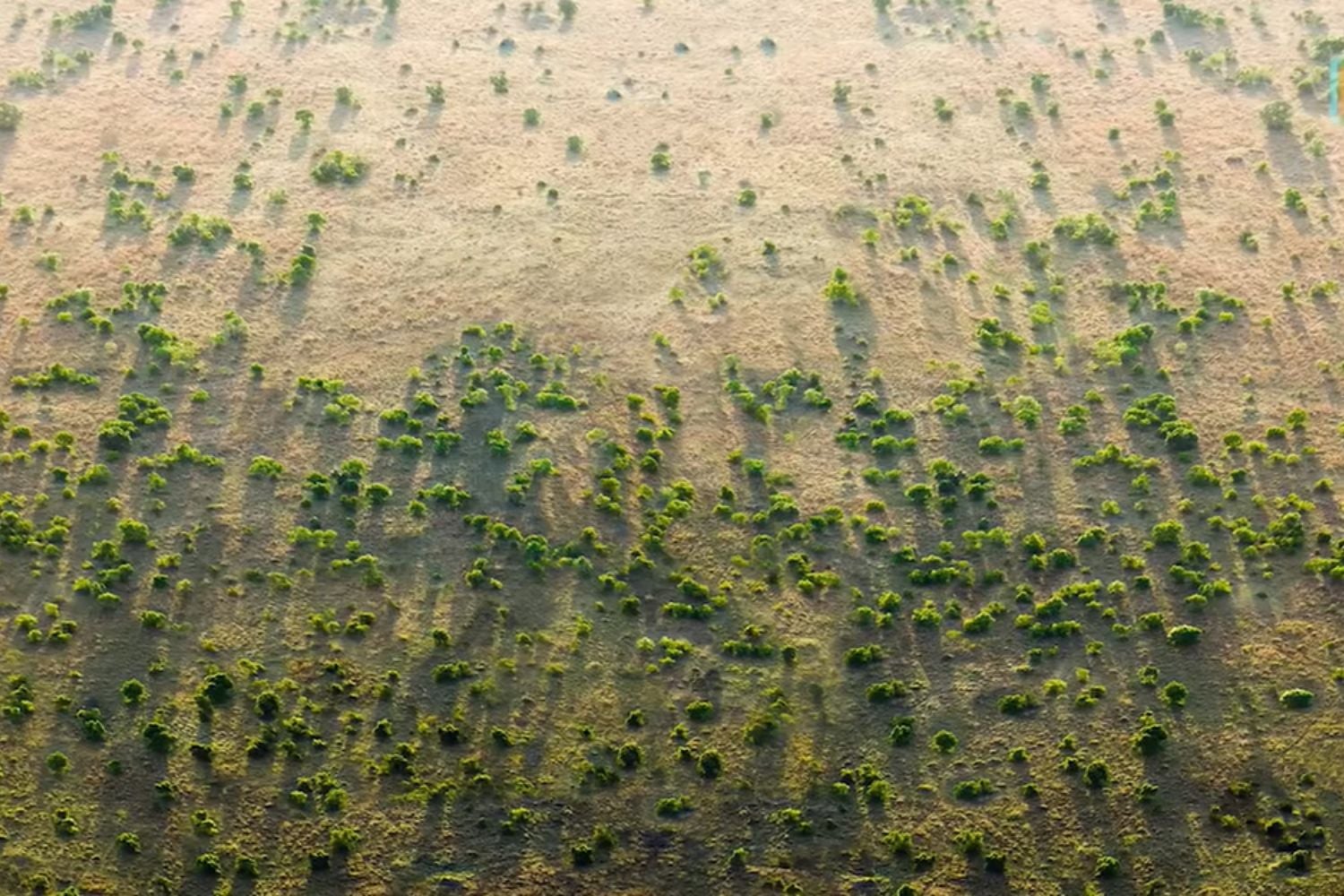
The effort is a major chapter inside China’s Three-North Shelterbelt Program, launched in 1978 and widely known as the Great Green Wall. The Taklamakan ring became one of the program’s most visible pieces, partly because it draws a sharp line around an extreme landscape that rarely offers neat boundaries.
The Ring That Kept Reopening in the Wind
Completion did not mean the desert stopped moving. Keeping a planted perimeter intact in shifting-sand conditions has required repeated repair work as gaps open and saplings fail, especially where dunes migrate fastest and water is hardest to secure.
A state account in People’s Daily described how the belt was already 2,761 km long by the end of 2023, leaving 285 km unfinished in what it called “the most challenging section.” That context matters because the last connection was not symbolic filler. It was the most failure-prone segment, and it took years of incremental pushes to close.
Another view of the milestone came from Dialogue Earth, which emphasized the belt’s continuity and its role as an “ecological shield” around China’s largest desert. The outlet also noted that the Taklamakan encirclement is one part of a wider, long-running strategy to stabilize sands across northern China, not a stand-alone project.
What the Satellites Tracked Along the Desert’s Rim
Once the ring closed, the more revealing question was what long-term monitoring had been showing at the margins. Researchers had access to decades of satellite observations that can detect subtle changes in vegetation cover and plant activity, even when the landscape still looks overwhelmingly barren at ground level.
The clearest scientific framing arrived in a paper published in PNAS. The study analyzed about 25 years of remote sensing and carbon-related datasets, focusing on where planted vegetation actually persists: the desert’s rim, not its interior.
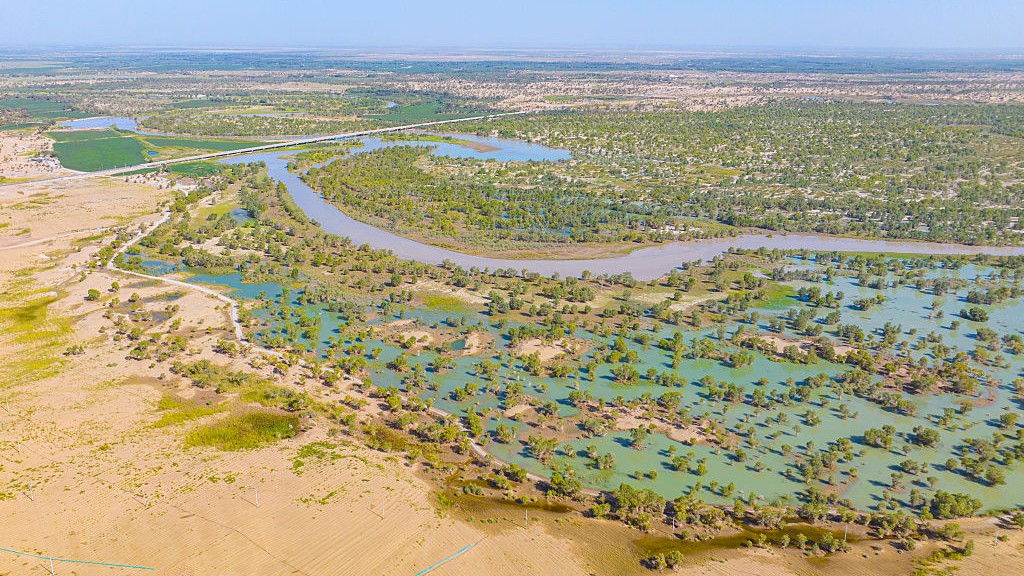
The research leaned on seasonality rather than a single before-and-after comparison. The Taklamakan is biologically quiet for much of the year, but it has a narrow window when moisture rises enough for plants to respond. In the study’s account, that window is the July to September wet season, when precipitation averages about 16 millimeters per month, roughly 2.5 times the dry-season level.
Those months are short, but the signal is consistent. When water arrives, shrubs and trees along the perimeter photosynthesize more actively, and vegetation indices rise most clearly in the same zones where planting and maintenance have been concentrated for decades.
The Carbon Result Hiding in Plain Seasonal Math
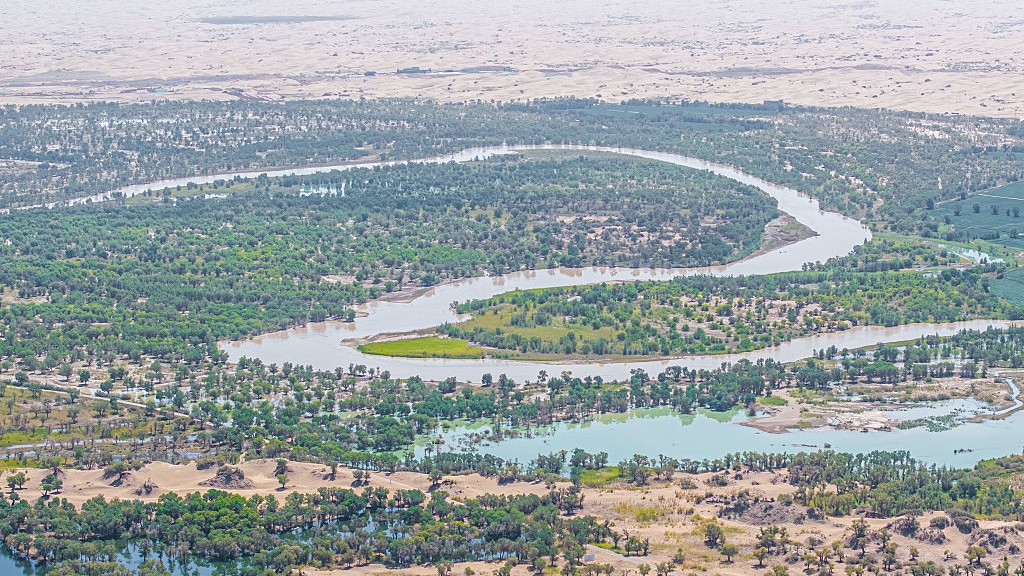
The main finding was not that the Taklamakan “turned green.” It was that the planted rim now behaves, in carbon accounting terms, like a managed carbon sink during the active season.
The authors reported a strengthening net uptake of atmospheric CO2 over time, expressed through net ecosystem exchange, a metric that tracks whether ecosystems are absorbing more carbon than they release. The implication is bounded but measurable: the afforested margins are now changing the regional carbon balance in the months when plants can function.
In coverage of the study by Live Science, co-author Yuk L. Yung described the conclusion in direct terms: “We found, for the first time, that human-led intervention can effectively enhance carbon sequestration in even the most extreme arid landscapes, demonstrating the potential to transform a desert into a carbon sink and halt desertification.”
The same report described an atmospheric pattern that matches the seasonal mechanism. It said carbon dioxide levels over the desert fell from 416 parts per million in the dry season to 413 ppm in the wet season, aligning with the period when rim vegetation becomes most active.
Yung also narrowed the claim to where the plants actually exist, rather than implying the dunes themselves have become biologically productive. “Based on the results of this study, the Taklamakan Desert, although only around its rim, represents the first successful model demonstrating the possibility of transforming a desert into a carbon sink,” he said.
The Water Constraint China Keeps Engineering Around
The carbon story immediately raises a second ledger: water. Afforestation at the desert’s edge depends on careful species choice, sustained maintenance, and in many sites, active water management rather than rainfall alone.
Reuters reported that China plans to keep planting and restoring forests around the Taklamakan’s perimeter, including the use of flood water diversion to restore poplar forests on the northern edge and to protect farmland and orchards along other margins. That detail is easy to skim past, but it is the operational backbone of survival in a hyper-arid region.
The same tension shows up in how scientists talk about what the finding does and does not imply. In a separate summary carried by ScienceAlert, atmospheric scientist King-Fai Li cautioned against treating desert planting as a single-button climate fix: “We’re not going to solve the climate crisis by planting trees in deserts alone.”
The Taklamakan case now sits at an unusual intersection of climate metrics and landscape engineering. The belt was built to slow sand movement and protect human infrastructure, but the newest analysis quantifies an additional effect: seasonal carbon uptake along the vegetated rim that is large enough to show up in long-term datasets. The project’s future, and any attempt to repeat it elsewhere, will hinge on whether that biological gain can be sustained where water remains the limiting resource.
Enjoyed this article? Subscribe to our free newsletter for engaging stories, exclusive content, and the latest news.
What's Your Reaction?
 Like
0
Like
0
 Dislike
0
Dislike
0
 Love
0
Love
0
 Funny
0
Funny
0
 Angry
0
Angry
0
 Sad
0
Sad
0
 Wow
0
Wow
0