




























Archaeologists Found Ancient Artifacts Crafted From Metal That Came Straight From Space

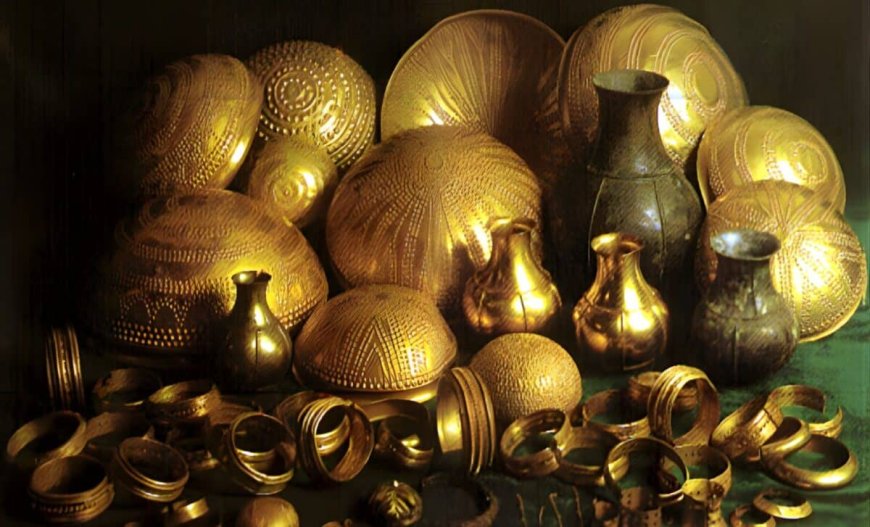
A discovery in Spain shows that ancient people in the Iberian Peninsula were making objects out of iron from meteorites. Two unusual pieces found in the Treasure of Villena were made from this otherworldly metal, challenging what we know about Bronze Age metallurgy. A rusted bracelet and a small hollow sphere have left researchers scratching their heads.
This find could change the way we think about ancient metalworking. It reveals that as far back as 1400 BCE, people in the Iberian Peninsula were already working with meteoritic iron, long before regular iron was commonly used.
The Enigmatic Find
The Treasure of Villena, found in 1963 near Alicante, Spain, is one of the most impressive Bronze Age discoveries in Europe. It includes 66 objects, mostly made of gold, showcasing the incredible skill of ancient artisans. But two pieces in the treasure stood out because they looked like they were made of iron, something that didn’t really appear in Europe until the Iron Age.
“In this case, [the items] were … probably hidden treasure that could have belonged to a whole community and not to a single person. There were no kingdoms in the Iberian Peninsula at this historical period,” explained Ignacio Montero-Ruiz, one of the study’s authors.
The mystery deepened because the rest of the treasure was dated between 1500 and 1200 BCE, while the Iron Age didn’t start in Europe until about 850 BCE. This left researchers wondering if the two iron-like objects were made from a different kind of metal, possibly from space.

Metal From the Stars
To figure out what these objects were made of, researchers tested their chemical composition, focusing on their nickel content. As explained in the study, published in Trabajos de Prehistoria, iron from meteorites has much more nickel than iron from Earth. In 2024, after running tests on the artifacts, they confirmed that the pieces were made from meteoritic iron.
This discovery solved the puzzle: the objects were made around the same time as the rest of the treasure, likely between 1400 and 1200 BCE. This is the first known use of meteoritic iron in the Iberian Peninsula.
“For this reason, they were considered worthy of becoming part of this spectacular ensemble with numerous delicate gold objects. Who manufactured them and where this material was obtained are still questions that remain to be answered,” he added.

Why Finding Meteoritic Iron is Like Finding a Cosmic Needle?
Meteoritic iron has always fascinated scientists. Salvador Rovira-Llorens, the lead researcher in the study, believes this discovery shows that people in the Iberian Peninsula had much more advanced metallurgical knowledge than we thought. It also hints at possible cultural exchanges or trade routes, where ancient civilizations may have shared knowledge of working with meteoritic iron.
While corrosion has made it tough to get a full picture, the findings suggest these objects come from the Late Bronze Age. What’s clear is that the use of meteoritic iron before the Iron Age shows a high level of technological skill.
Enjoyed this article? Subscribe to our free newsletter for engaging stories, exclusive content, and the latest news.
What's Your Reaction?
 Like
0
Like
0
 Dislike
0
Dislike
0
 Love
0
Love
0
 Funny
0
Funny
0
 Angry
0
Angry
0
 Sad
0
Sad
0
 Wow
0
Wow
0