





























67,800-Year-Old Handprints in Indonesia Are the World’s Oldest Cave Art Ever Found

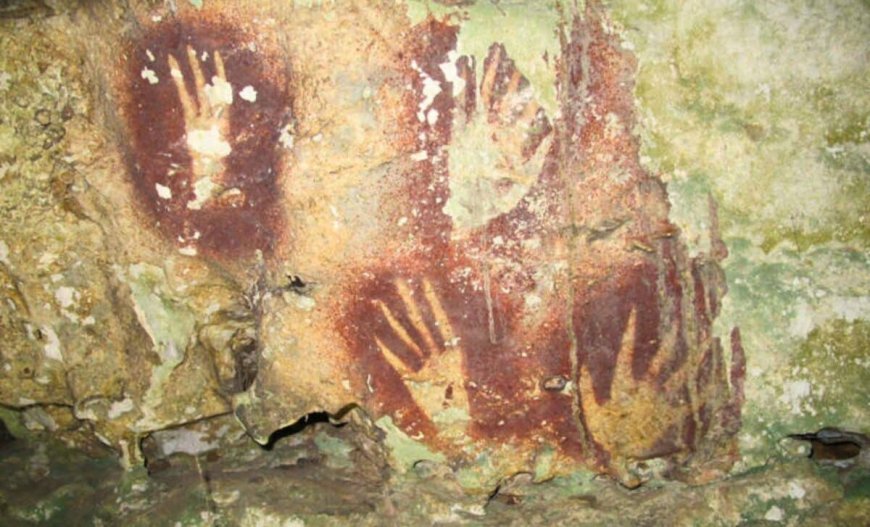
The limestone caves of Sulawesi have held their secrets for tens of thousands of years. Inside a cave on Muna Island, a faded patch of reddish pigment on the wall escaped notice for most of modern history. Only recently did researchers recognize what remained: part of a human hand, pressed against stone and sprayed with color sometime in the deep past.

That patch measures just 14 by 10 centimeters. It shows portions of fingers and part of a palm. One fingertip appears narrower than it should be, deliberately altered either by moving the hand during painting or by adding more pigment afterward. The modification gives the hand a claw like appearance, a rare variation of a universal human gesture found nowhere else in the world’s ancient cave art.
For years, archaeologists believed the oldest rock art belonged to Europe. That view has shifted decisively toward Southeast Asia.
Uranium Series Dating Reveals a 67,800 Year Old Minimum Age
An international team co led by researchers from Griffith University, Indonesia’s BRIN agency, and Southern Cross University examined the mineral layers that formed over the pigment after it was applied. As detailed in the peer reviewed study published in Nature, they used uranium series dating to measure radioactive decay in tiny calcite deposits that had accumulated on top of the artwork.

The analysis showed that the calcite formed 71,600 years ago, give or take 3,800 years. That means the hand stencil underneath must be at least 67,800 years old. The finding exceeds the previous record holder from Sulawesi by more than 16,000 years. It also surpasses a contested hand stencil from Spain attributed to Neanderthals, which carried a minimum age of 66,700 years.
Professor Maxime Aubert from the Griffith Centre for Social and Cultural Research said the discovery reveals an artistic tradition far older than previously recognized. “It is now evident from our new phase of research that Sulawesi was home to one of the world’s richest and most longstanding artistic cultures,” Aubert said. “One with origins in the earliest history of human occupation of the island at least 67,800 years ago.”
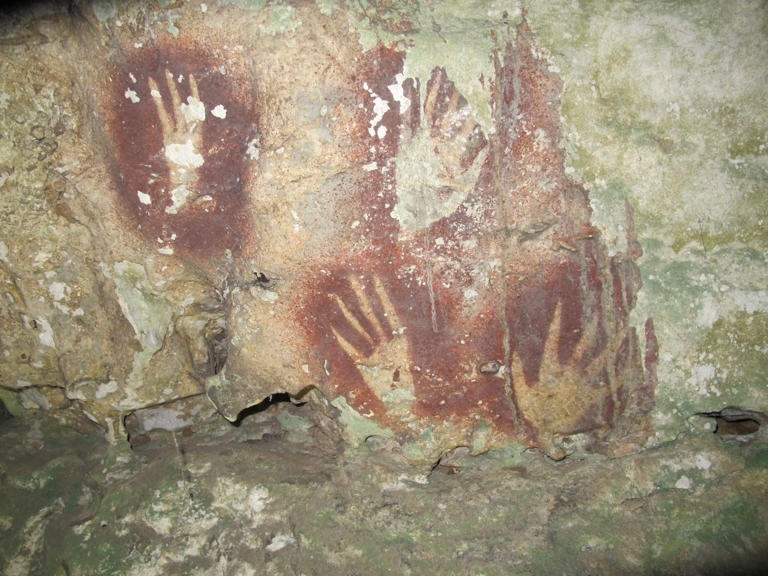
The same rock art panel contains evidence of repeated visits. Another hand stencil located 11 centimeters away yielded a minimum date of 60,900 years. Above it, a separate pigment layer dated to around 21,500 years. The two painting episodes are separated by at least 35,000 years, suggesting that generations of people returned to the same spot to create art over a span of time longer than recorded human history.
What the Cave Paintings Reveal About Ancient Beliefs
The intentionally narrowed fingers set this stencil apart from thousands of others found worldwide. Professor Adam Brumm from Griffith’s Australian Research Centre for Human Evolution said the meaning remains uncertain, though the design may reflect ideas about the relationship between humans and animals.
“This art could symbolize the idea that humans and animals were closely connected,” Brumm said. “Something we already seem to see in the very early painted art of Sulawesi, with at least one instance of a scene portraying figures that we interpret as representations of part human, part animal beings.”

The research team documented 44 sites across Southeast Sulawesi, including 14 previously unknown locations. They dated 11 individual motifs across eight caves, with most hand stencils falling within the Late Pleistocene. One cave, Gua Mbokita, produced hand stencils dated to at least 44,700 and 25,900 years. Another, Gua Anawai, yielded stencils created between 20,100 and 20,400 years ago, placing them near the height of the last ice age.
How This Discovery Reshapes the Story of Migration to Australia
The location of the cave also carries significance for understanding human migration to Australia. During the Pleistocene, lower sea levels exposed a supercontinent called Sahul, which connected Australia, Tasmania, and New Guinea. Reaching it required multiple ocean crossings through the islands of Wallacea, the region between mainland Asia and Sahul.

Researchers have debated two possible migration routes. The northern route passes through Sulawesi and the Maluku Islands toward western New Guinea. The southern route runs east through Timor and the Lesser Sunda Islands toward northwestern Australia. Archaeological evidence along both paths has remained sparse until now.
Dr. Adhi Agus Oktaviana, a rock art specialist at BRIN and Griffith University, said the Sulawesi art provides the oldest direct evidence for modern humans along the northern corridor. In coverage from SciTechDaily, Oktaviana emphasized the connection to Australia’s deep human history.
“It is very likely that the people who made these paintings in Sulawesi were part of the broader population that would later spread through the region and ultimately reach Australia,” Oktaviana said. “This discovery strongly supports the idea that the ancestors of the First Australians were in Sahul by 65,000 years ago.”
The dating also aligns with excavations at Madjedbebe in northern Australia, where artifacts suggest human presence between 68,700 and 59,300 years ago. Professor Renaud Joannes Boyau of Southern Cross University, who led the dating work, said the findings fill a critical gap in understanding how people first reached the continent. “With the dating of this extremely ancient rock art in Sulawesi, we now have the oldest direct evidence for the presence of modern humans along this northern migration route into Sahul,” Joannes Boyau said.
Reference: “Rock art from at least 67,800 years ago in Sulawesi” by Adhi Agus Oktaviana, Renaud Joannes-Boyau, Budianto Hakim, Basran Burhan, Ratno Sardi, Shinatria Adhityatama, Andrea Jalandoni, Hamrullah, Iwan Sumantri, M. Tang, Rustan Lebe, Iswadi, Imran Ilyas, Abdullah Abbas, Andi Jusdi, Dewangga Eka Mahardian, Fadhlan S. Intan, Sofwan Noerwidi, Marlon N. R. Ririmasse, Irfan Mahmud, Akin Duli, Laode M. Aksa, M. Nur, Nasrullah Aziz, Sri Wigati, Iksam, Faiz, M. Sabri, Fardi Ali Syahdar, Eriani, N. A. Hidayatullah, Suryatman, Laode Darma, Nurmin, Laode Zulman, S. H. Sindara, Andi Muhammad Saiful, Pindi Setiawan, Adam Brumm and Maxime Aubert, 21 January 2026, Nature. DOI: 10.1038/s41586-025-09968-y
Enjoyed this article? Subscribe to our free newsletter for engaging stories, exclusive content, and the latest news.
What's Your Reaction?
 Like
0
Like
0
 Dislike
0
Dislike
0
 Love
0
Love
0
 Funny
0
Funny
0
 Angry
0
Angry
0
 Sad
0
Sad
0
 Wow
0
Wow
0